
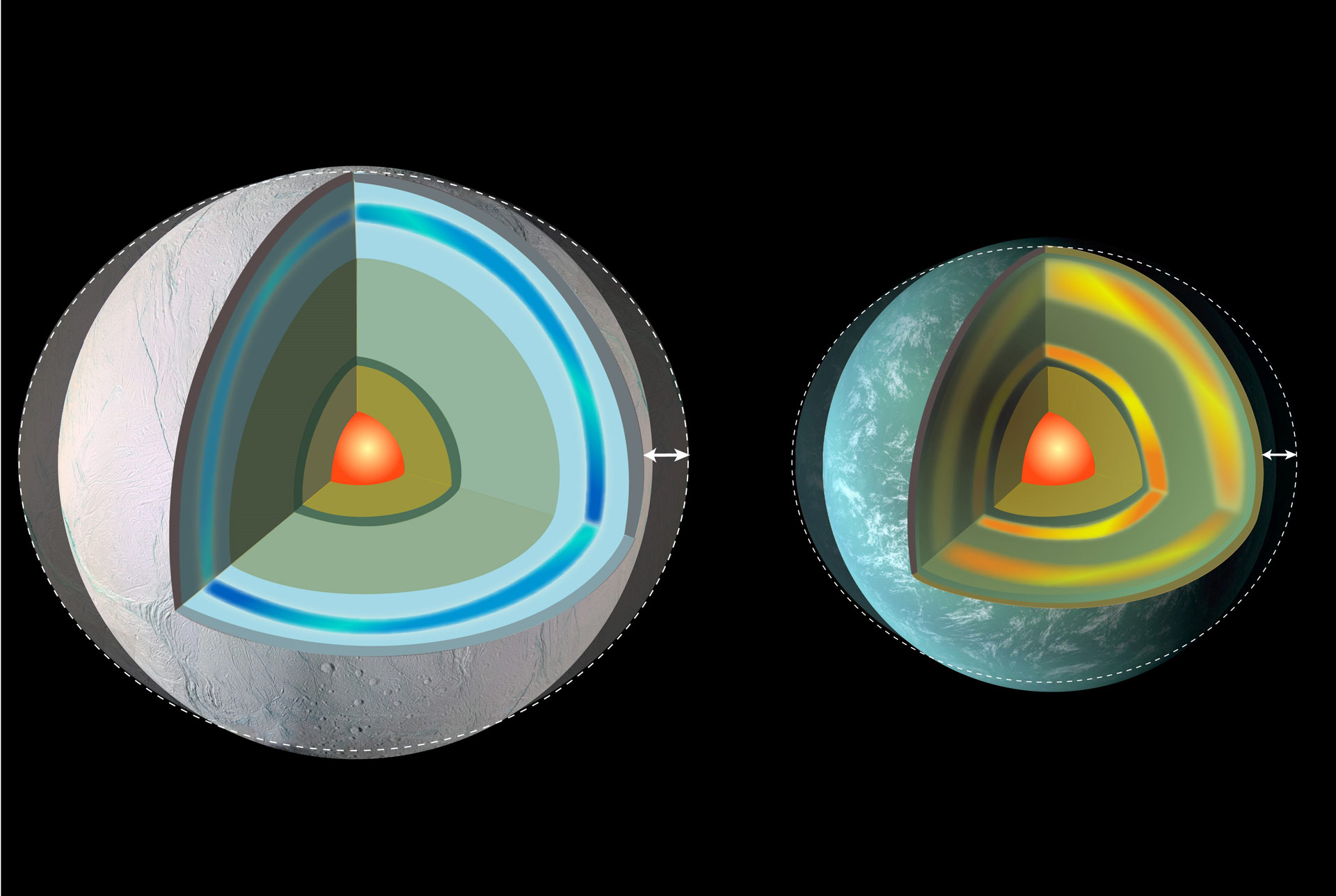
In a newly published study, NASA scientists use computer models to show that friction could be the key to survival for some distant Earth-sized planets.
As anybody who has started a campfire by rubbing sticks knows, friction generates heat. Now, computer modeling by NASA scientists shows that friction could be the key to survival for some distant Earth-sized planets traveling in dangerous orbits.
The findings are consistent with observations that Earth-sized planets appear to be very common in other star systems. Although heat can be a destructive force for some planets, the right amount of friction, and therefore heat, can be helpful and perhaps create conditions for habitability.
“We found some unexpected good news for planets in vulnerable orbits,” said Wade Henning, a University of Maryland scientist working at NASA’s Goddard Space Flight Center in Greenbelt, Maryland, and lead author of the new study. “It turns out these planets will often experience just enough friction to move them out of harm’s way and into safer, more circular orbits more quickly than previously predicted.”
Simulations of young planetary systems indicate that giant planets often upset the orbits of smaller inner worlds. Even if those interactions aren’t immediately catastrophic, they can leave a planet in a treacherous eccentric orbit – a very elliptical course that raises the odds of crossing paths with another body, being absorbed by the host star, or getting ejected from the system.
Another potential peril of a highly eccentric orbit is the amount of tidal stress a planet may undergo as it draws very close to its star and then retreats away. Near the star, the gravitational force is powerful enough to deform the planet, while in more distant reaches of the orbit, the planet can ease back into shape. This flexing action produces friction, which generates heat. In extreme cases, tidal stress can produce enough heat to liquefy the planet.
In this new study, available online in the July 1, 2014, issue of the Astrophysical Journal, Henning and his colleague Terry Hurford, a planetary scientist at Goddard, explored the effects of tidal stresses on planets that have multiple layers, such as rocky crust, mantle or iron core.
One conclusion of the study is that some planets could move into a safer orbit about 10 to 100 times faster than previously expected – in as little as a few hundred thousand years, instead of the more typical rate of several million years. Such planets would be driven close to the point of melting or, at least, would have a nearly melted layer, similar to the one right below Earth’s crust. Their interior temperatures could range from moderately warmer than our planet is today up to the point of having modest-sized magma oceans.
The transition to a circular orbit would be speedy because an almost-melted layer would flex easily, generating a lot of friction-induced heat. As the planet threw off that heat, it would lose energy at a fast rate and relax quickly into a circular orbit. (Later, tidal heating would turn off, and the planet’s surface could become safe to walk on.)
In contrast, a world that had completely melted would be so fluid that it would produce little friction. Before this study, that is what researchers expected to happen to planets undergoing strong tidal stresses.
Cold, stiff planets tend to resist tidal stress and release energy very slowly. In fact, Henning and Hurford found that many of them actually generate less friction than previously thought. This may be especially true for planets farther from their stars. If these worlds are not crowded by other bodies, they may be stable in their eccentric orbits for a long time.
“In this case, the longer, non-circular orbits could increase the ‘habitable zone,’ because the tidal stress will remain an energy source for longer periods of time,” said Hurford. “This is great for dim stars or ice worlds with subsurface oceans.”
Surprisingly, another way for a terrestrial planet to achieve high amounts of heating is to be covered in a very thick ice shell, similar to an extreme “snowball Earth.” Although a sheet of ice is a slippery, low-friction surface, an ice layer thousands of miles thick would be very springy. A shell like this would have just the right properties to respond strongly to tidal stress, generating a lot of heat. (The high pressures inside these planets could prevent all but the topmost layers from turning into liquid water.)
The researchers found that the very responsive layers of ice or almost-melted material could be relatively thin, just a few hundred miles deep in some cases, yet still dominate the global behavior.
The team modeled planets that are the size of Earth and up to two-and-a-half times larger. Henning added that superEarths – planets at the high end of this size range – likely would experience stronger tidal stresses and potentially could benefit more from the resulting friction and heating.
Now that the researchers have shown the importance of the contributions of different layers of a planet, the next step is to investigate how layers of melted material flow and change over time.
Reference: “Tidal Heating in Multilayered Terrestrial Exoplanets” by Wade G. Henning and Terry Hurford, 11 June 2014, The Astrophysical Journal.
DOI: 10.1088/0004-637X/789/1/30
Never miss a breakthrough: Join the SciTechDaily newsletter.
Follow us on Google and Google News.