
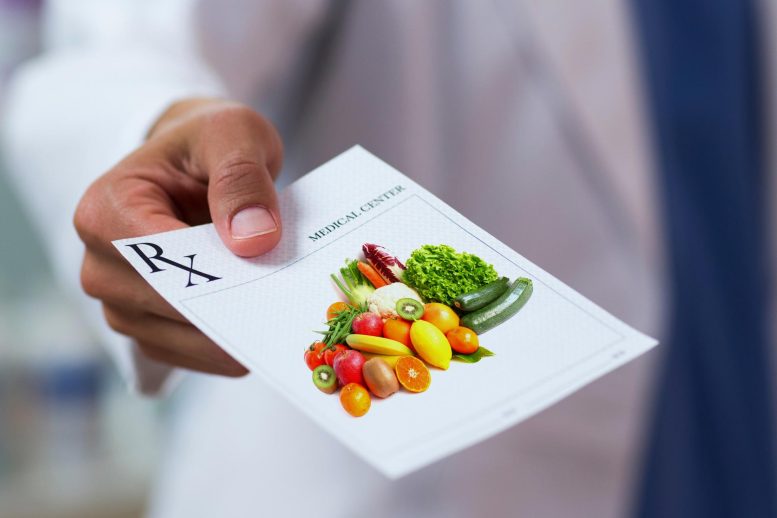
In the largest known such study to date, an analysis of participant records by Tufts University researchers found programs that provide free fruits and vegetables have measurable benefits for health and food security.
Around the country, non-profits and local governments are testing the idea of food as medicine through “produce prescription programs”—with promising results, according to researchers from the Friedman School of Nutrition Science and Policy at Tufts University.
Produce Prescription Programs
By prescribing free, healthy foods similar to how doctors prescribe medications, clinicians and policymakers hope to remove financial barriers to accessing fruits and vegetables to individuals with diet-related illness. Specifically, produce prescriptions offer vouchers, debit cards, or loyalty cards to access free or discounted produce at grocery retail and farmer’s markets and typically enroll food-insecure households. A Tufts-led pooled analysis of nine such programs found these programs were associated with positive benefits, from halving food insecurity to lowering blood pressure. The study, which is the largest known evaluation of these programs to date, was published on August 29 in the American Heart Association journal Circulation: Cardiovascular Quality and Outcomes.
Research Details
The researchers analyzed surveys and medical records from over 1,800 children and 2,000 adults who had been identified as low-income and at risk for cardiometabolic diseases. Study participants had been enrolled in produce prescription programs operating across 22 sites in 12 U.S. states from 2014 to 2020. Each program was operated by Wholesome Wave, a national nonprofit that works to address disparities in diet-related disease and enhance nutrition equity by making fruits and vegetables more accessible and affordable to low-income community members through systems change.
The data showed an increase in fruit and vegetable intake (by about a serving per day among adults) as well as improved clinical biomarkers of cardiometabolic health for adults. For example, diabetic patients saw a 0.3 percentage point drop in hemoglobin A1C, an indicator for average blood sugar levels in the previous three months, and a decrease in body mass index by 0.4 kg/m2 among those with overweight or obesity. In patients with hypertension, blood pressure also dropped by 5-to-8 millimeters of mercury. The improvement for these clinical biomarkers of cardiometabolic health were greater among participants with uncontrolled diabetes, obesity, or stage 2 hypertension.
Child Participants and Impacts
The study also revealed improvements in fruit and vegetable intake, food security, and self-reported health status among child participants. While body mass index was not noticeably reduced in children, the researchers say these benefits reflect critical measures for their development, long-term health and well-being.
Comments From the Researchers
“We were excited to see the results, which showed that participants who receive this incentive consume more fruits and vegetables, yielding clinically relevant outcomes,” says senior study author Fang Fang Zhang, a nutritional epidemiologist and Neely Family Professor at the Friedman School. “We need larger-scale implementation of these programs, which may play a role in improving care, in particular for lower-income adults with obesity, diabetes, or hypertension.”
Program Details and Recommendations
The records reviewed were from patients who were enrolled in the nine produce prescription programs for an average of six months, usually after being referred by their physician. Most participants received a voucher or card that could be redeemed at selected grocery stores and/or farmers’ markets. Prescriptions covered an average of $43 per household per month in adult programs, and $112 per household per month in programs for children.
“Our findings provide important new evidence from a diverse set of programs for meaningful benefits of produce prescriptions, highlighting the need for clinical, policy, and healthcare payer and providers’ efforts to implement produce prescription programs,” says Zhang.
“There is much we still need to learn about which programs are likely to be effective, how long they should operate, what happens to patient health outcomes when they end, and more,” says first author Kurt Hager, who completed the work as a doctoral student at the Friedman School and is now an instructor at the University of Massachusetts Chan Medical School. “The future of Food is Medicine will likely see pilots and expansion occurring alongside ongoing evaluations that will continually improve the quality of services provided.”
Researchers across institutions have been conducting analyses of these and similar programs, with most finding net positive benefits for patients, but differences in the extent of those gains and how the programs were implemented. Such studies can help to guide the implementation of the Biden-Harris Administration’s National Strategy on Hunger, Nutrition and Health, which, among other things, calls for expanded produce prescription programs for people enrolled in Medicaid, Medicare, Veterans Affairs, and the Indian Health Service.
Concluding Remarks and Future Research
“This research is a step in the right direction and in alignment with the comprehensive National Strategy on Hunger, Nutrition, and Health,” says Alison Brown, a registered dietician and program director in the Prevention and Population Science Program in the Division of Cardiovascular Sciences at the National Heart, Lung, and Blood Institute, part of the National Institutes of Health. “However, more rigorous ‘food is medicine’ studies are needed to add to our scientific knowledge and inform evidence-based policies.”
Further research will help to fill some existing information gaps. While the observed gains for participants were clinically and statistically meaningful, the new study lacked a control group, which means the benefits could be attributed to other factors. Some of the programs were also in place during the COVID-19 pandemic, which may have impacted their efficacy, as participants were less likely to redeem their vouchers.
For more on this research, see Prescription for Free Fruits and Vegetables Linked to Better Heart Health.
Reference: “Impact of Produce Prescriptions on Diet, Food Security, and Cardiometabolic Health Outcomes: A Multisite Evaluation of 9 Produce Prescription Programs in the United States” by Kurt Hager, Mengxi Du, Zhongyu Li, Dariush Mozaffarian, Kenneth Chui, Peilin Shi, Brent Ling, Sean B. Cash, Sara C. Folta and Fang Fang Zhang, 29 August 2023, Circulation Cardiovascular Quality and Outcomes.
DOI: 10.1161/CIRCOUTCOMES.122.009520
Research reported in this article was supported by the Rockefeller Foundation and Kaiser Permanente, and by the National Institutes of Health’s National Heart, Lung and Blood Institute under award R01HL115189. Complete information on authors, funders, and conflicts of interest is available in the published paper. This content is solely the responsibility of the authors and does not necessarily represent the official views of the National Institutes of Health.
Never miss a breakthrough: Join the SciTechDaily newsletter.
Follow us on Google and Google News.
1 Comment
Prescribing vegetables? LMAO what has our society come to.
Amazed at health benefits from eating them? WTF? What happened to common sense.
A study like this is a clear sign that we live in a true idiocracy.
Far too many idiots walking around that have no clue about anything other than go to {insert fast food place} and look at phone to post on social media.