

A team of researchers has developed a miniature, energy-efficient device capable of creating photon pairs that maintain quantum entanglement across any distance.
Utilizing innovative materials and methods, this achievement marks a major step forward in quantum technology, with potential to revolutionize computing, telecommunications, and high-precision sensing systems.
Advancements in Photon Pair Generation
For over a century, physicists have been unraveling the mysteries of how photons, electrons, and other subatomic particles behave at incredibly tiny scales. Engineers, in turn, have spent decades transforming these discoveries into practical technologies.
One of the most fascinating phenomena in this realm is quantum entanglement. When two photons become entangled, their states are linked in such a way that any change in one photon’s state is instantly mirrored by the other, no matter how far apart they are.
Nearly 80 years ago, Albert Einstein famously called this phenomenon “spooky action at a distance.” Today, quantum entanglement is a major focus of global research and is emerging as a preferred method for implementing the qubit, the basic unit of quantum information.
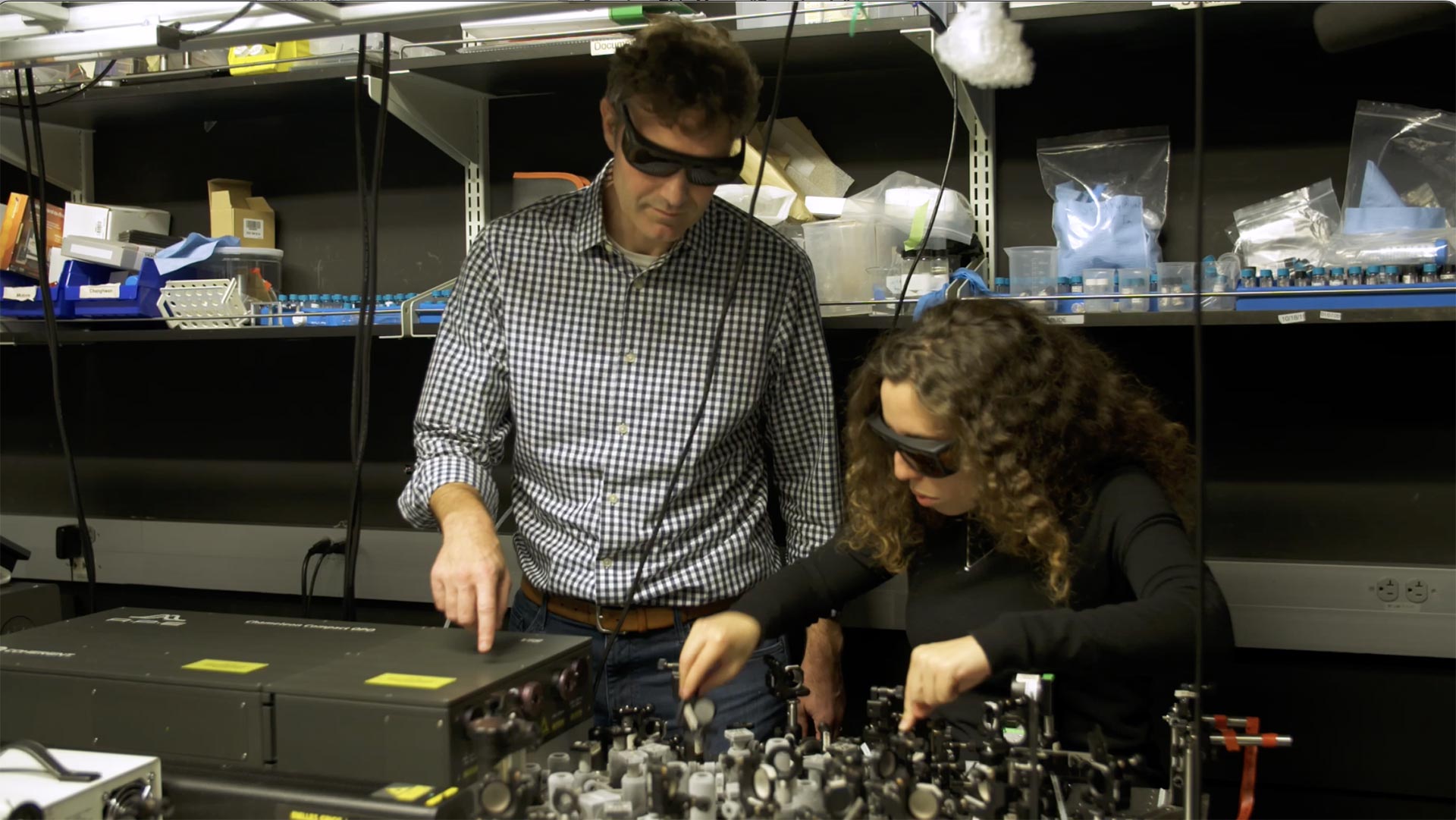
Currently, the most efficient way to create photon pairs requires sending light waves through a crystal large enough to see without a microscope. In a paper published on January 13 in Nature Photonics, a team led by Columbia Engineering researchers and collaborators, describe a new method for creating these photon pairs that achieves higher performance on a much smaller device using less energy. P. James Schuck, associate professor of mechanical engineering at Columbia Engineering, helped lead the research team.
Innovations in Nonlinear Optics
These findings represent a significant step forward in the field of nonlinear optics, which is concerned with using technologies to change the properties of light for applications including lasers, telecommunications, and laboratory equipment.
“This work represents the embodiment of the long-sought goal of bridging macroscopic and microscopic nonlinear and quantum optics,” says Schuck, who co-directs Columbia’s MS in Quantum Science and Technology. “It provides the foundation for scalable, highly efficient on-chip integrable devices such as tunable microscopic entangled-photon-pair generators.”
Revolutionizing Quantum Devices
Measuring just 3.4 micrometers thick, the new device points to a future where this important component of many quantum systems can fit onto a silicon chip. This change would enable significant gains in the energy efficiency and overall technical capabilities of quantum devices.
To create the device, the researchers used thin crystals of a so-called van der Waals semiconducting transition metal called molybdenum disulfide. Then they layered six of these crystal pieces into a stack, with each piece rotated 180 degrees relative to the crystal slabs above and below. As light travels through this stack, a phenomenon called quasi-phase-matching manipulates properties of the light, enabling the creation of paired photons.
Breakthrough in Photon Pair Generation
This paper represents the first time that quasi-phase-matching in any van der Waals material has been used to generate photon pairs at wavelengths that are useful for telecommunications. The technique is significantly more efficient than previous methods and far less prone to error.
“We believe this breakthrough will establish van der Waals materials as the core of next-generation nonlinear and quantum photonic architectures, with them being ideal candidates for enabling all future on-chip technologies and replacing current bulk and periodically poled crystals,” Schuck says.
“These innovations will have an immediate impact in diverse areas including satellite-based distribution and mobile phone quantum communication.”
Development of a New Quantum Device
Schuck and his team built on their previous work to develop the new device. In 2022, the group demonstrated that materials like molybdenum disulfide possess useful properties for nonlinear optics — but performance was limited by the tendency of light waves to interfere with one another while traveling through this material.
The team turned to a technique called periodic poling to counteract this problem, which is known as phase matching. By alternating the direction of the slabs in the stack, the device manipulates light in a way that enables photon pair generation at miniscule length scales.
“Once we understood how amazing this material was, we knew we had to pursue the periodic poling, which could allow for the highly efficient generation of photon pairs,” Schuck says.
Reference: “Quasi-phase-matched up- and down-conversion in periodically poled layered semiconductors” by Chiara Trovatello, Carino Ferrante, Birui Yang, Josip Bajo, Benjamin Braun, Zhi Hao Peng, Xinyi Xu, Philipp K. Jenke, Andrew Ye, Milan Delor, D. N. Basov, Jiwoong Park, Philip Walther, Cory R. Dean, Lee A. Rozema, Andrea Marini, Giulio Cerullo and P. James Schuck, 13 January 2025, Nature Photonics.
DOI: 10.1038/s41566-024-01602-z
This work occurred within Programmable Quantum Materials, a Department of Energy energy frontier research center (EFRC) at Columbia, as part of a larger effort to understand and exploit quantum materials. This work was possible due to contributions from the Baso, Delor, and Dean labs. Postdoctoral researcher Chiara Trovatello led the effort.
Authors: Chiara Trovatello, Carino Ferrante, Birui Yang, Josip Bajo, Benjamin Braun, Zhi Hao Peng, Xinyi Xu, Philipp K. Jenke, Andrew Ye, Milan Delor, D. N. Basov, Jiwoong Park, Philip Walther, Cory R. Dean, Lee A. Rozema, Andrea Marini, Giulio Cerullo, P. James Schuck
Funding/Acknowledgements: We thank B. Ursprung for the useful discussions. This work was supported by Programmable Quantum Materials, an Energy Frontier Research Center funded by the US Department of Energy, Office of Science, Basic Energy Sciences, under award DE-SC0019443. C.T. acknowledges the European Union’s Horizon Europe research and innovation program under the Marie Skłodowska-Curie PIONEER HORIZON-MSCA-2021-PF-GF grant agreement no. 101066108. C.T. also acknowledges the Optica Foundation and Coherent Inc. for supporting this research through the Bernard J. Couillaud Prize 2022. G.C. acknowledges support by the Progetti di ricerca di Rilevante Interesse Nazionale (PRIN) of the Italian Ministry of Research 2022HL9PRP Overcoming the Classical limits of ultRafast spEctroSCopy with ENtangleD phOtons (CRESCENDO). C.T. and G.C. acknowledge funding from the European Union–NextGenerationEU under the National Quantum Science and Technology Institute (NQSTI) grant no. PE00000023-q-ANTHEM-CUP H43C22000870001. A.M. acknowledges funding from the European Union–NextGenerationEU under the Italian Ministry of University and Research (MUR) National Innovation Ecosystem grant no. ECS00000041-VITALITY-CUP E13C22001060006, and Progetti di ricerca di Rilevante Interesse Nazionale (PRIN) of the Italian Ministry of Research PHOTO (Photonic Terahertz devices based on topological materials) no. 316 2020RPEPNH. A.Y. acknowledges support from the Department of Defense (DoD) through the National Defense Science and Engineering Graduate (NDSEG) Fellowship Program. J.P. acknowledges funding from the Air Force Office of Scientific Research (FA9550-21-1-0323) and the Office of Naval Research (N000142212841). P.W. acknowledges support from the Air Force Office of Scientific Research under award number FA8655-20-1-7030 (PhoQuGraph) and FA8655-23-1-7063 (TIQI). This research was funded in whole or in part by the Austrian Science Fund (FWF) (10.55776/F71). The financial support by the Austrian Federal Ministry of Labour and Economy, the National Foundation for Research, Technology and Development and the Christian Doppler Research Association is gratefully acknowledged. L.A.R. acknowledges support from the Erwin Schrödinger Center for Quantum Science and Technology (ESQ Discovery).
Never miss a breakthrough: Join the SciTechDaily newsletter.
Follow us on Google and Google News.
7 Comments
For over a century, physicists have been unraveling the mysteries of how photons, electrons, and other subatomic particles behave at incredibly tiny scales. One of the most fascinating phenomena in this realm is quantum entanglement.
VERY GOOD!
Please ask researchers to think deeply:
1. What is the physical reality of quantum?
2. Is quantum mechanics mathematics?
3. How do you understand that quantum mechanics is mathematics?
4. Is the universe algebra, formula, or fraction?
5. What is the difference between the universe and algebra, formulas, or fractions?
The physical phenomena we observed in scientific research are often one-sided. Although light is an important way for humans to understand nature, it is definitely not the natural essence of the universe. In the process of exploring nature, there are significant differences between what humans see, hear, and touch. The biggest difference between humans and other animals is the ability to elevate these sensory understandings to rational ones. Scientific research guided by correct theories can enable researchers to think more.
According to the Topological Vortex Theory (TVT), spins create everything, spins shape the world. There are substantial distinctions between Topological Vortex Theory (TVT) and traditional physical theories. Grounded in the inviscid and absolutely incompressible spaces, TVT introduces the concept of topological phase transitions and employs topological principles to elucidate the formation and evolution of matter in the universe, as well as the impact of interactions between topological vortices and anti-vortices on spacetime dynamics and thermodynamics.
Within TVT, low-dimensional spacetime matter serves as the foundation for high-dimensional spacetime matter, and the hierarchical structure of matter and its interaction mechanisms challenge conventional macroscopic and microscopic interpretations. The conflict between Quantum Physics and Classical Physics can be attributed to their differing focuses: Quantum Physics emphasizes low-dimensional spacetime matter, whereas Classical Physics centers on high-dimensional spacetime matter.
Subatomic particles in the quantum world often defy the familiar rules of the physical world. The fact repeatedly suggests that the familiar rules of the physical world are pseudoscience. In the familiar rules of the physical world, two sets of cobalt-60 can form the mirror image of each other by rotating in opposite directions, and can receive heavy rewards.
Please witness the grand performance of physics today. https://scitechdaily.com/microscope-spacecrafts-most-precise-test-of-key-component-of-the-theory-of-general-relativity/#comment-854286.
If the researchers are truly interested in science, please read: The Application of Inviscid and Absolutely Incompressible Spaces in Engineering Simulation (https://scitechdaily.com/microscope-spacecrafts-most-precise-test-of-key-component-of-the-theory-of-general-relativity/#comment-870077).
For over a century, physicists have been unraveling the mysteries of how photons, electrons, and other subatomic particles behave at incredibly tiny scales. One of the most fascinating phenomena in this realm is quantum entanglement.
VERY GOOD!
Please ask researchers to think deeply:
1. What is the physical reality of quantum?
2. Is quantum mechanics mathematics?
3. How do you understand that quantum mechanics is mathematics?
4. Is the universe algebra, formula, or fraction?
5. What is the difference between the universe and algebra, formulas, or fractions?
This statement is just plain wrong:
“When two photons become entangled, their states are linked in such a way that any change in one photon’s state is instantly mirrored by the other, no matter how far apart they are.”
Their states are correlated such that measuring the state of one reveals the state of the other. But “changing” that state of one does not propagate a change of state in the other implying faster than light communication.
If I have two marbles, one red and one blue and I put them together in a small box, shack them up, pick one and without looking at it put it in my pocket. I go ten miles away and then look at my marble and see that it is red. I then know the marble I left behind is blue. How is that “spoky action at a distance”.
Your thinking is the usual way of thinking in classical physics. Quantum mechanics is mathematics, emphasizes low-dimensional spacetime matter, such as the spin of topological vortex, whereas Classical Physics centers on high-dimensional spacetime matter.
These sorts of internet comments, essentially objecting to claims amounting to causality violation, have been going on for decades, and never once will you ever see an article that cuts right to the chase about what keeps driving such queer timing claims. Thus, it seems it’s all about providing a new flimsy excuse to drop the vaguely anti-science glow-tribe science word “spooky” again like it’s some science light-clock frequency mob market timing codeword.
“Nearly 80 years ago, Albert Einstein famously called this phenomenon ‘spooky action at a distance.’”
Physics for those pretending to lack memory since childhood, with the most overused rainbow factoid of all time. It’s the first rule of social civil smite club in action: “Never stop being annoying for the children.”