
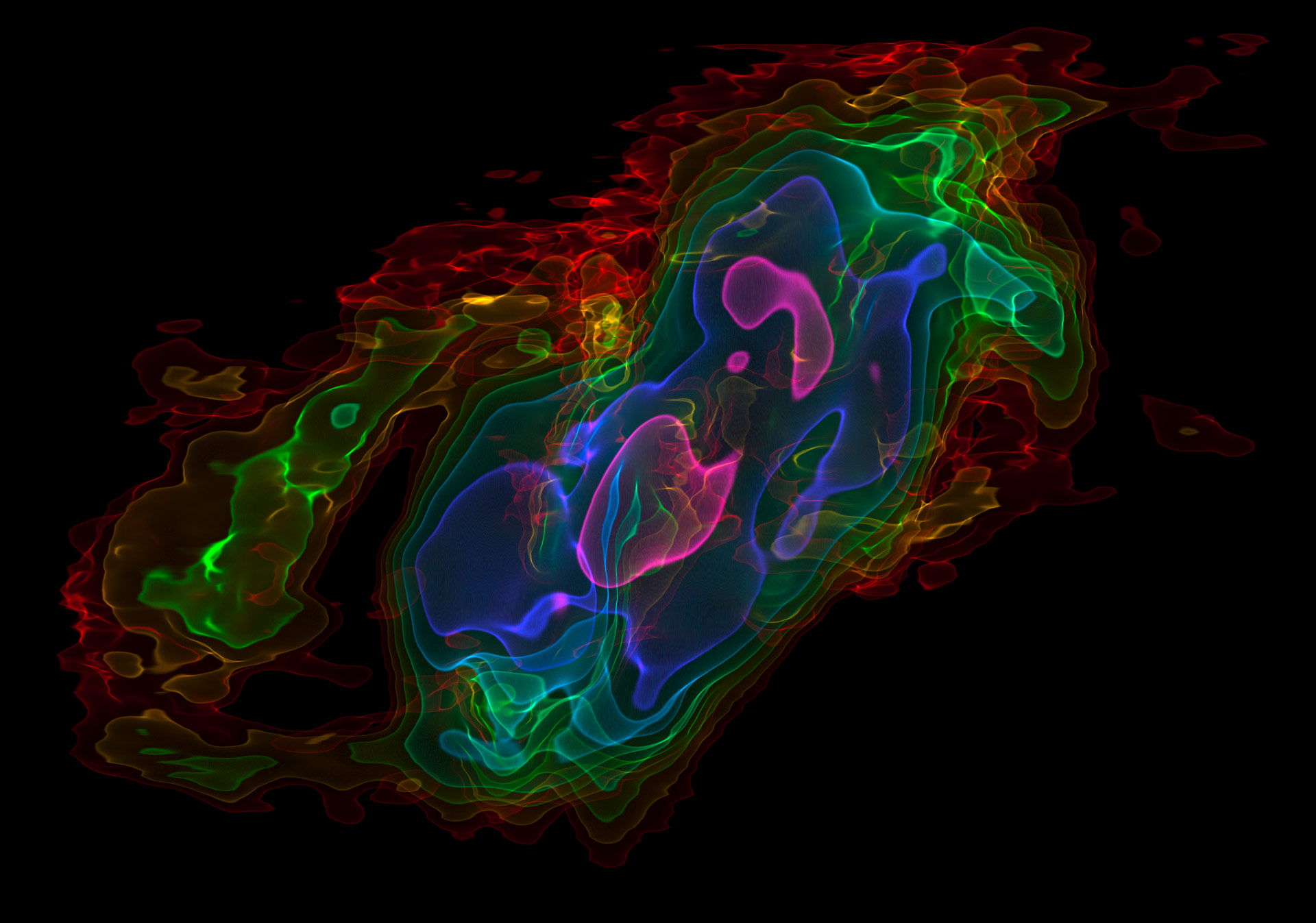
From Cells To Galaxies And Beyond: Scientists in radio astronomy and medical imaging find common ground.
“We are star stuff,” famous astronomer Carl Sagan once said. The atoms of our bodies were forged in the hearts of long dead stars, and so when we look upon the universe we see ourselves. It’s a poetic notion, but when it comes to how we imagine both the universe and ourselves, there is some truth to it.
Radio astronomy gives us a unique view of the cosmos. Astronomers capture faint radio light and through computer software assemble their data into images we can understand. (For example, see ALMA Sheds Light on the Mystery of Missing Massive Galaxies.) Likewise, the human body is studied in part through medical images. Techniques such as magnetic resonance imaging (MRI) capture data about the inside of our bodies without invasive surgery, and this data is used to create images useful to doctors and scientists. Although medical and astronomical imaging are quite different in many ways, their methods of gathering and analyzing data are quite similar. Experts in both fields face similar challenges, so it would be useful if they could learn from each other.
This is the goal of the Cells to Galaxies project: finding a way to build a bridge between the two fields. As a method is developed in one field, it might be applied to challenges in the other. Collaboration could also provide a way for the two disciplines to work together on some of the largest problems in both fields.
The idea holds a lot of promise, but it’s not without challenges. As Daniel Weller, Assistant Professor of Electrical and Computer Engineering at the University of Virginia, points out, one of the biggest challenges is the differences between terminology and culture. Each field has an established way of gathering and analyzing data, with its own lingo and style. For collaboration to be fruitful, each group will need to become familiar with the other. As the researchers in these fields become aware of cultural differences, they can better see the similarities in their work.
The similarities are there. After all, both rely upon the same physics. But there are also significant differences. Beatriz Paniagua, Technical Leader in medical computing at Kitware, points out one of the big ones. In bioimaging you can “touch the source.” If there is a question about an image of a patient, it is possible to confirm the data physically. This isn’t possible in radio astronomy, where the “patient” is light years away. But Sanjay Bhatnagar, a Scientist with NRAO, sees an opportunity in this. Modern radio telescopes and medical imaging devices gather enormous amounts of data. The great challenge in indirect imaging techniques like radio imaging and MRI is accurate image reconstruction. On the other hand, scientific inference relies on advanced image analysis techniques such as the ones used in medical tomographic imaging, where data is used to create layers of images, virtually slicing through the human body. Collaboration between radio astronomy, MRI, and tomographic imaging communities therefore offers great potential.
In April of 2019, a small group of experts in radio astronomy and medical imaging met at NRAO in Charlottesville VA to discuss their research, and whether the two fields have some common ground. The meeting generated a lot of excitement. “I really enjoyed this meeting,” said Sanjay Bhatnagar, “Almost everyone I spoke to shares the feeling that it was a rather interesting meeting already.” There are tentative plans to have a more formal collaborative meeting in the Spring of 2020.
Never miss a breakthrough: Join the SciTechDaily newsletter.
Follow us on Google and Google News.