
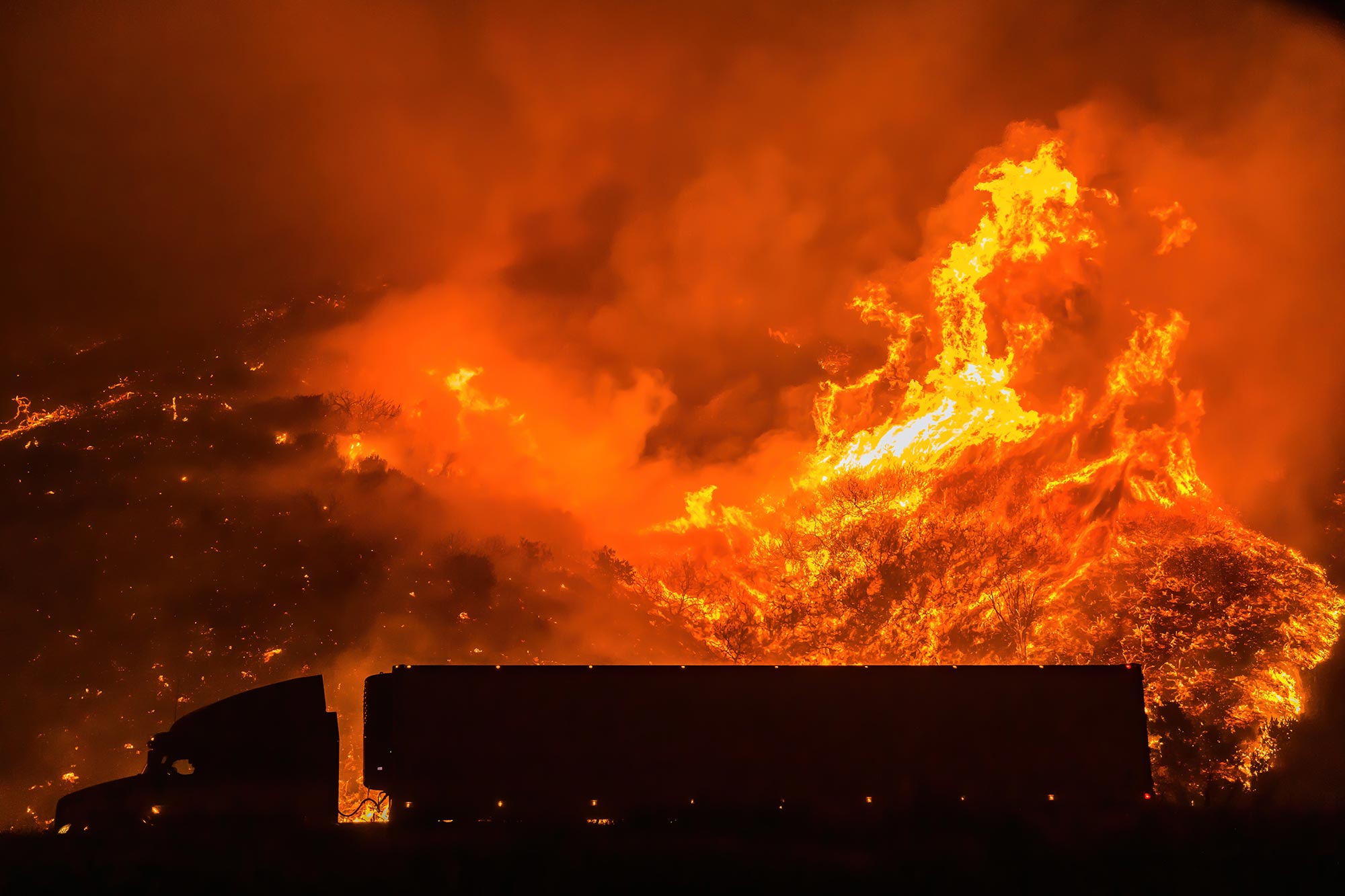
As California oscillates between drought and deluge, wildfires rage due to “hydroclimate whiplash” driven by global warming.
- Hydroclimate whiplash—the rapid shifts between extreme wet and dry weather — has already intensified globally due to climate change. This trend is expected to accelerate as the planet continues to warm, according to a research team led by UCLA’s Daniel Swain.
- The “expanding atmospheric sponge” is a major factor driving hydroclimate whiplash. This refers to the atmosphere’s increasing ability to evaporate, absorb, and release 7% more water with each degree Celsius of warming, amplifying extreme weather events.
- Addressing these challenges requires a co-management approach to extreme rainfall and droughts. Tackling these events together, rather than treating them as isolated issues, is essential for developing effective interventions and solutions, researchers emphasize.
Hydroclimate Whiplash in California
Los Angeles is burning, and an accelerating phenomenon called hydroclimate whiplash is the key climate connection.
After enduring years of severe drought, California experienced an onslaught of atmospheric rivers during the winter of 2022-23. These weather systems delivered record-breaking precipitation, blanketing mountain towns in snow, flooding valleys with rain and snowmelt, and triggering hundreds of landslides.
The pattern continued with another exceptionally wet winter in southern California, which fueled the growth of dense grass and brush. By 2024, a record-breaking summer heatwave and an unusually dry start to the 2025 rainy season left this vegetation parched and primed to ignite, resulting in a series of destructive wildfires.
This series of events highlights “hydroclimate whiplash” — the rapid shifts between extreme wet and dry conditions. According to a study published on January 9 in Nature Reviews Earth & Environment, this phenomenon is becoming increasingly common worldwide, fueled by climate change.
Global Trends and Predictions: The Expanding Atmospheric Sponge
“The evidence shows that hydroclimate whiplash has already increased due to global warming, and further warming will bring about even larger increases,” said lead author Daniel Swain, a climate scientist with UCLA and UC Agriculture and Natural Resources. “This whiplash sequence in California has increased fire risk twofold: first, by greatly increasing the growth of flammable grass and brush in the months leading up to fire season, and then by drying it out to exceptionally high levels with the extreme dryness and warmth that followed.”
Global weather records show hydroclimate whiplash has swelled globally by 31% to 66% since the mid-20th century, the international team of climate researchers found – even more than climate models suggest should have happened. Climate change means the rate of increase is speeding up. The same potentially conservative climate models project that the whiplash will more than double if global temperatures rise 3 degrees Celsius above pre-industrial levels. The world is already poised to blast past the Paris Agreement’s targeted limit of 1.5 C. The researchers synthesized hundreds of previous scientific papers for the review, layering their own analysis on top.
Unpredictable Weather Patterns and Their Consequences
Anthropogenic climate change is the culprit behind the accelerating whiplash, and a key driver is the “expanding atmospheric sponge” – the growing ability of the atmosphere to evaporate, absorb, and release 7% more water for every degree Celsius the planet warms, researchers said.
“The problem is that the sponge grows exponentially, like compound interest in a bank,” Swain said. “The rate of expansion increases with each fraction of a degree of warming.”
The global consequences of hydroclimate whiplash include not only floods and droughts, but the heightened danger of whipsawing between the two, including the bloom-and-burn cycle of overwatered then overdried brush, and landslides on oversaturated hillsides where recent fires removed plants with roots to knit the soil and slurp up rainfall. Every fraction of a degree of warming speeds the growing destructive power of the transitions, Swain said.
New Paradigms in Water Management
Many previous studies of climate whiplash have only considered the precipitation side of the equation, and not the growing evaporative demand. The thirstier atmosphere pulls more water out of plants and soil, exacerbating drought conditions beyond simple lack of rainfall.
“The expanding atmospheric sponge effect may offer a unifying explanation for some of the most visible, visceral impacts of climate change that recently seem to have accelerated,” Swain said. “The planet is warming at an essentially linear pace, but in the last 5 or 10 years there has been much discussion around accelerating climate impacts. This increase in hydroclimate whiplash, via the exponentially expanding atmospheric sponge, offers a potentially compelling explanation.”
That acceleration, and the anticipated increase in boom-and-bust water cycles, has important implications for water management.
“We can’t look at just extreme rainfall or extreme droughts alone, because we have to safely manage these increasingly enormous influxes of water, while also preparing for progressively drier interludes,” Swain said. “That’s why ‘co-management’ is an important paradigm. It leads you to more holistic conclusions about which interventions and solutions are most appropriate, compared to considering drought and flood risk in isolation.”
Navigating the Extremes: California’s Water Challenges
In many regions, traditional management designs include shunting flood waters to flow quickly into the ocean, or slower solutions like allowing rain to percolate into the water table. However, taken alone, each option leaves cities vulnerable to the other side of climate whiplash, the researchers noted.
“Hydroclimate in California is reliably unreliable,” said co-author John Abatzoglou, a UC Merced climate scientist. “However, swings like we saw a couple years ago, going from one of the driest three-year periods in a century to the once-in-a-lifetime spring 2023 snowpack, both tested our water infrastructure systems and furthered conversations about floodwater management to ensure future water security in an increasingly variable hydroclimate.”
Increasing Global Impact: A Warming Earth’s Response
Hydroclimate whiplash is projected to increase most across northern Africa, the Middle East, South Asia, northern Eurasia, the tropical Pacific, and the tropical Atlantic, but most other regions will also feel the shift.
“Increasing hydroclimate whiplash may turn out to be one of the more universal global changes on a warming Earth,” Swain said.
The Urgent Need for Climate Action
In California this week, although winds are fanning the extreme fires, it’s the whiplash-driven lack of rain that suspended Southern California in fire season.
“There’s not really much evidence that climate change has increased or decreased the magnitude or likelihood of the wind events themselves in Southern California,” Swain said. “But climate change is increasing the overlap between extremely dry vegetation conditions later in the season and the occurrence of these wind events. This, ultimately, is the key climate change connection to Southern California wildfires.”
Under a high warming scenario, California will see an increase in both the wettest and driest years and seasons by later this century.
“The less warming there is, the less of an increase in hydroclimate whiplash we’re going to see,” Swain said. “So anything that would reduce the amount of warming from climate change will directly slow or reduce the increase in whiplash. Yet we are currently still on a path to experience between 2 degrees and 3 degrees Celsius of global warming this century — so substantial further increases in whiplash are likely in our future, and we really need to be accounting for this in risk assessments and adaptation activities.”
Reference: “Hydroclimate volatility on a warming Earth” by Daniel L. Swain, Andreas F. Prein, John T. Abatzoglou, Christine M. Albano, Manuela Brunner, Noah S. Diffenbaugh, Deepti Singh, Christopher B. Skinner and Danielle Touma, 9 January 2025, Nature Reviews Earth & Environment.
DOI: 10.1038/s43017-024-00624-z
The research was supported with funding from The Nature Conservancy of California and the Swiss National Science Foundation.
Never miss a breakthrough: Join the SciTechDaily newsletter.
Follow us on Google and Google News.
2 Comments
Atmospheric sponge. Hydroclimate whiplash.
Nothing to do with the incompetence of officials already being forced to resign. Nothing to do with building tar-shingle-roof mansions atop mountains I’ve personally seen burnt in a wildfire, on winding inclined roads inaccessible to firetrucks, with infrastructure incapable of pumping water up, in the beautiful trees with no firebreaks. Ignore the second-deadliest California wildfire being in 1933 in LA, the enormous Santiago wildfire of 1889 in LA, and the incredibly expensive and third-deadliest 1991 Alameda wildfire, because wildfire is new because of climate change. Today’s fires are strangely localized to Los Angeles county, because the whole world’s atmosphere is now spongy. It’s everyone else’s fault, you see. Wherever you are, it’s your fault. You caused there to be rain on their coastline, and you also stopped it from raining on their coastline. You gave them hydroclimate whiplash. There is an “Urgent Need For Climate Action” to stop you.
“The ‘expanding atmospheric sponge”’ is a major factor driving hydroclimate whiplash. This refers to the atmosphere’s increasing ability to evaporate, absorb, and release 7% more water with each degree Celsius of warming, amplifying extreme weather events.”
The Clausius-Clapeyron relationship predicts an increase in the POTENTIAL for holding more water vapor with warming of the atmosphere. However, it does NOT mean that it will necessarily happen. It does not predict an increase in precipitation.
If the water vapor source is the ocean, windiness is an important factor in how much will be evaporated because the surface air can become saturated — preventing evaporation — unless it is disturbed by wind. Over deserts, there is very little free water vapor to be evaporated or transpired and the atmosphere is rarely near saturation. Warming when the available water vapor is limited, will result in failing to follow the Clausius-Clapeyron relationship. Even orographic uplift may be insufficient to provide condensation to result in precipitation. Anyone familiar with hot deserts knows that sometimes any precipitation that results is evaporated before it even reaches the ground; it is known as virga.
Lastly, precipitation is controlled not only by the Clausius-Clapeyron relationship, which affects the condensation temperature, but the availability of condensation nuclei also impacts how much water can condense out, even if the air is saturated.
This article is drawing conclusions from a simplistic reliance on a relationship that establishes an upper bound on what the atmosphere can hold, not what it will hold.
“These weather systems delivered record-breaking precipitation, blanketing mountain towns in snow, flooding valleys with rain and snowmelt, and triggering hundreds of landslides.”
If you want to know what “record-breaking” precipitation is for California, search for the “Great Flood of 1862.” 2023 comes nowhere close to what the West Coast experienced in 1862. The authors should do a little historical research before making such claims. The problems associated with atmospheric rivers existed long before the recent warming.