
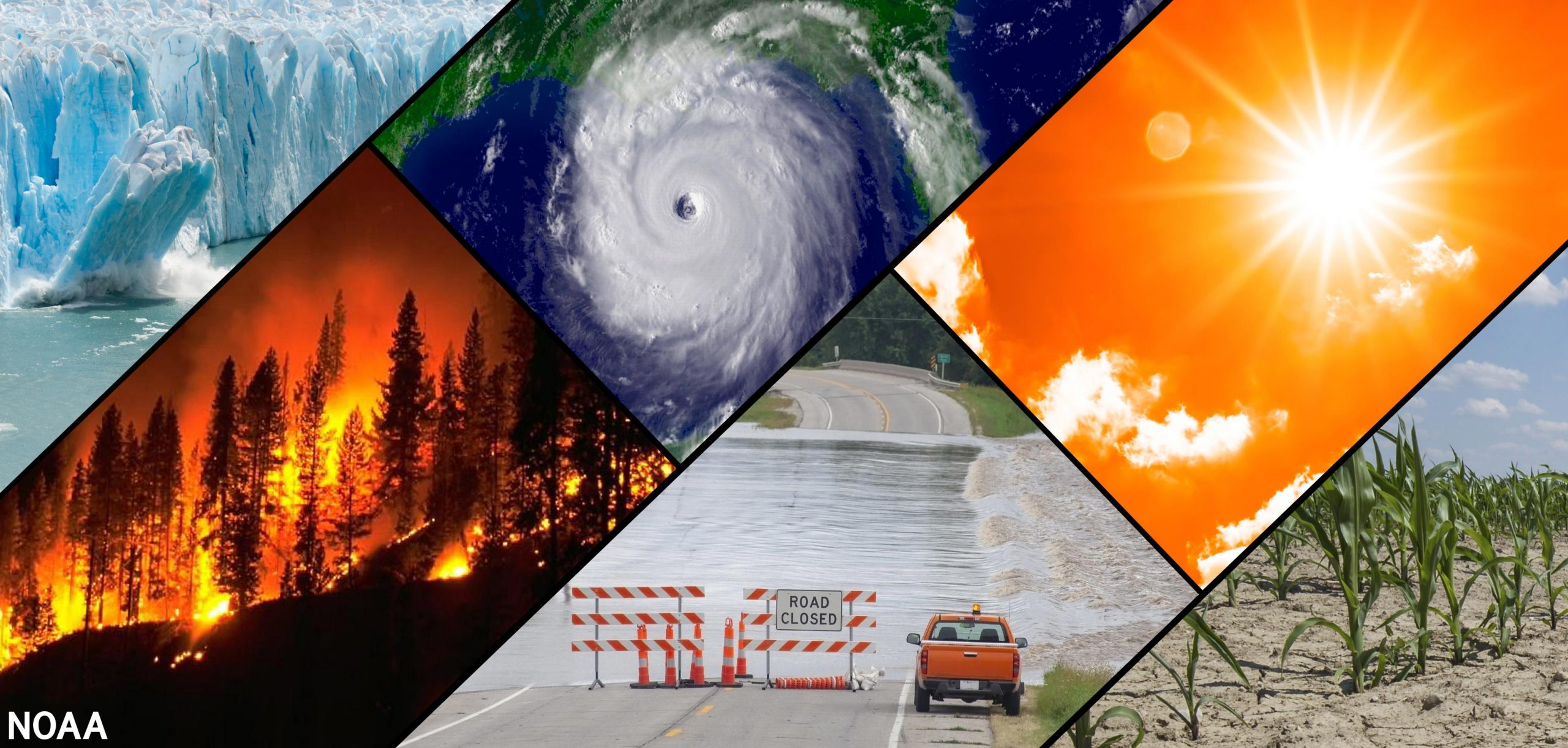
July 2021 has earned the unenviable distinction as the world’s hottest month ever recorded, according to new global data released by NOAA’s National Centers for Environmental Information.
“In this case, first place is the worst place to be,” said NOAA Administrator Rick Spinrad, Ph.D. “July is typically the world’s warmest month of the year, but July 2021 outdid itself as the hottest July and month ever recorded. This new record adds to the disturbing and disruptive path that climate change has set for the globe.”
July 2021 by the numbers
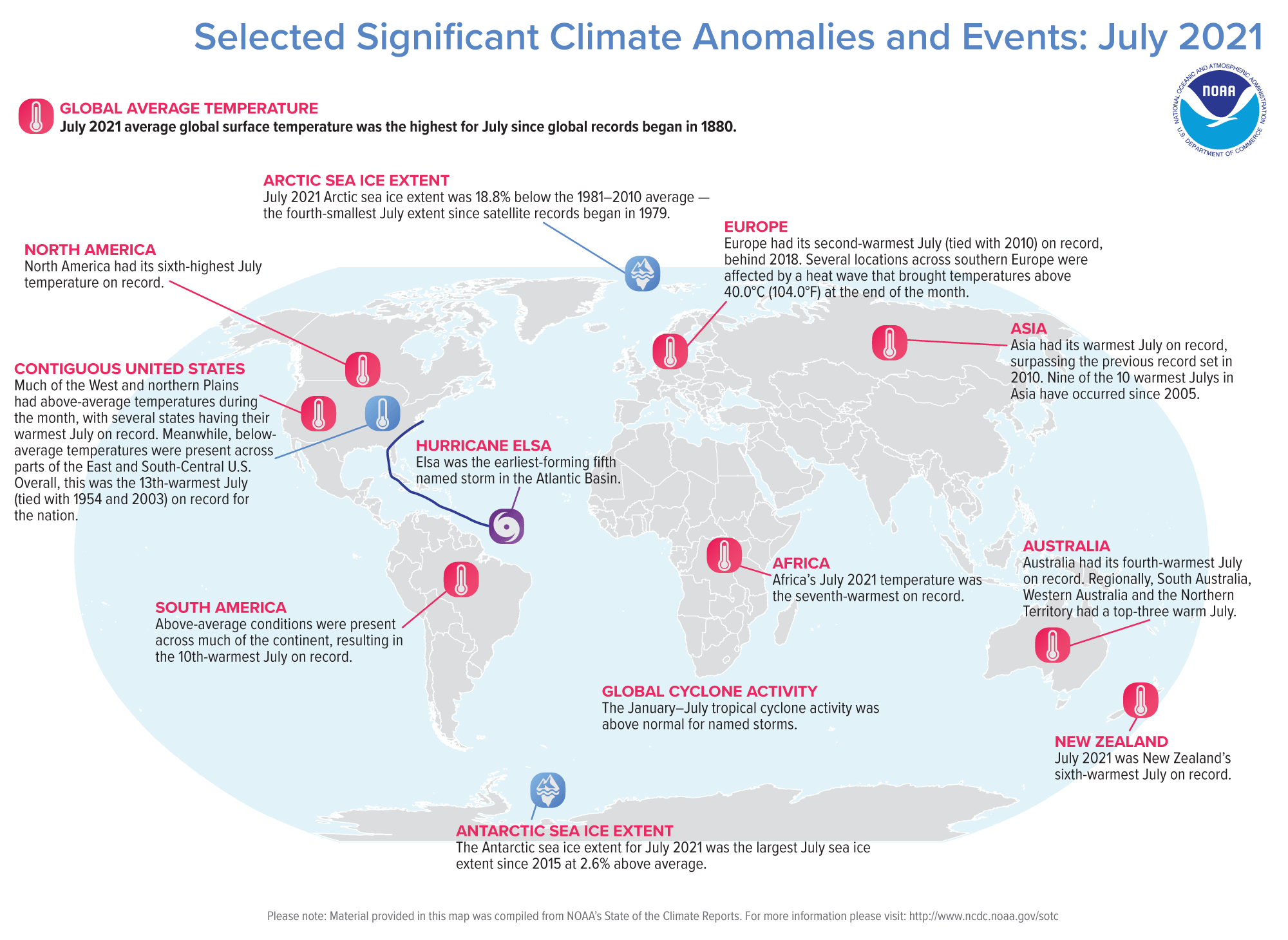
- Around the globe: the combined land and ocean-surface temperature was 1.67 degrees F (0.93 of a degree C) above the 20th-century average of 60.4 degrees F (15.8 degrees C), making it the hottest July since records began 142 years ago. It was 0.02 of a degree F (0.01 of a degree C) higher than the previous record set in July 2016, which was then tied in 2019 and 2020.
- The Northern Hemisphere: the land-surface only temperature was the highest ever recorded for July, at an unprecedented 2.77 degrees F (1.54 degrees C) above average, surpassing the previous record set in 2012.
- Regional records: Asia had its hottest July on record, besting the previous record set in 2010; Europe had its second-hottest July on record—tying with July 2010 and trailing behind July 2018; and North America, South America, Africa and Oceania all had a top-10 warmest July.
Extreme heat and global climate change
With last month’s data, it remains very likely that 2021 will rank among the world’s 10-warmest years on record, according to NCEI’s Global Annual Temperature Rankings Outlook.
Extreme heat detailed in NOAA’s monthly NCEI reports is also a reflection of the long-term changes outlined in a major report released this week by the Intergovernmental Panel on Climate Change.
“Scientists from across the globe delivered the most up-to-date assessment of the ways in which the climate is changing,” Spinrad said in a statement. “It is a sobering IPCC report that finds that human influence is, unequivocally, causing climate change, and it confirms the impacts are widespread and rapidly intensifying.”
Other notable highlights from NOAA’s July global climate report
- Sea ice coverage varied by hemisphere: The Arctic sea ice coverage (extent) for July 2021 was the fourth-smallest for July in the 43-year record, according to analysis by the National Snow and Ice Data Center. Only July 2012, 2019 and 2020 had a smaller sea ice extent. Antarctic sea ice extent was above average in July — the largest July sea ice extent since 2015 and the eighth highest on record.
- The tropics were busier than average: In the Atlantic basin, the season’s earliest fifth-named storm, Elsa, formed on July 1. The Eastern North and Western Pacific basins each logged three named storms. Overall, global tropical cyclone activity this year so far (through July) has been above-normal for the number of named storms.
Never miss a breakthrough: Join the SciTechDaily newsletter.
Follow us on Google and Google News.
1 Comment
What is the uncertainty of the temperature measurements (i.e. precision) and the annual means? What is the probability that the 0.01 deg C temperature difference is statistically significant?
Taking the diurnal mid-range value of temperatures is not an arithmetic mean in the usual meaning of the word where several measurements of stationary data are averaged. Averaging non-stationary data with a trend introduces the problem of a moving mean and standard deviation in a time-series that doesn’t allow the improvement of precision by diving by the square-root of the number of observations. It is illogical to claim that non-stationary data that has a different mean with the addition of every new measurement can have its precision improved by just taking more measurements that change the mean.
Assuming that the claim can be justified, what is the practical significance of such a small difference?