
Close Menu
    Facebook X (Twitter) Instagram
    SciTechDaily
    • Biology
    • Chemistry
    • Earth
    • Health
    • Physics
    • Science
    • Space
    • Technology
    Facebook X (Twitter) Pinterest YouTube RSS
    SciTechDaily
    Home»Biology»Fungus Transforms North American Red Turpentine Beetle into Tree Killer in Asia
    Biology

    Fungus Transforms North American Red Turpentine Beetle into Tree Killer in Asia

    By SciTechDailyFebruary 5, 20121 Comment2 Mins Read
    Facebook Twitter Pinterest Telegram LinkedIn WhatsApp Email Reddit
    Share
    Facebook Twitter LinkedIn Pinterest Telegram Email Reddit
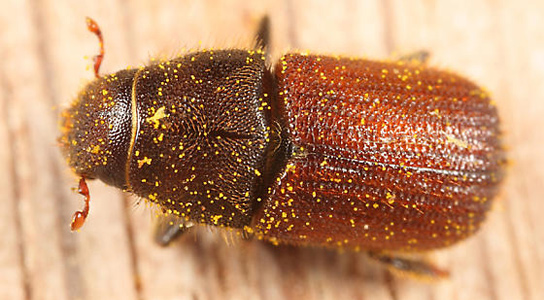
    Red Turpentine Beetle
    Red turpentine beetle, Dendroctonus valens. Credit: Tom Murray (Bug Guide)

    Microbial evolution has turned a mild-mannered North American beetle into a tree killer in Asia. The red turpentine beetle, Dendroctonus valens, is a wood-boring species native to North America. D. valens is unremarkable and harmless in its native region. However once it migrated to China, it wiped out more than seven million pines in the past 12 years, and it’s poised to spread throughout much of Asia and Europe.

    D. valens stows away in internationally traded timber products, which explains how the species, and 50 other Scolytinae species ended up in China. D. valens takes with it some bacteria, fungi and mites on its body. Once the insect drills into the bark of a tree to lay its eggs, the microorganisms are transferred to the plant’s vascular tissues. The fungus, Leptographium procerum, breaks down the phloem, the innermost layer of bark, and the insects consume both the fungus and the phloem.
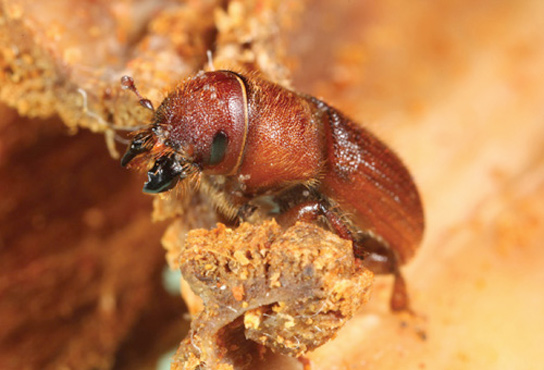
    Red Turpentine Beetle Eating Pine
    Red turpentine beetle eating pine. Credit: Tom Murray (Bug Guide)

    D. valens‘ most common fungal partner has evolved new strains to make trees even sicker, and in turn attract more beetles. Jiang-Hua Sun, a biologist at the Institute of Zoology at the Chinese Academy of Sciences et al. published a study in the journal Ecology and worked with samples of L. procerum from China and North America. The Chinese strains are a subset of the ones found in the USA, confirming that the killer fungus stems from America.

    However, there are new genotypes in the strains found in China, which are much more damaging than the ones originally found in America. The studied tree seedlings’ aroma even changed, once they were infected with the Chinese variants of the fungus.

    The aroma is what attracted even more D. valens to the infected trees. This in turn develops a feedback loop until the trees succumb to the damage from the beetles and fungi. If D. valens manages to return to the US, there’s no telling how many pines will succumb to it.

    Never miss a breakthrough: Join the SciTechDaily newsletter.
    Follow us on Google and Google News.

    Beetle China Entomology Fungus Microbial Evolution North America
    Share. Facebook Twitter Pinterest LinkedIn Email Reddit

    Related Articles

    Scientists Discover New Species of Weevils in Japan’s Pristine Subtropical Forests

    Rare Beetle Rediscovered After 55 Years

    Is It Cheaper To Be Bigger? Evolutionary Lessons From the Extreme Weapons of Giraffe Weevil Warriors

    New Species of Beetle Discovered in Dinosaur Ancestor’s 230 Million-Year-Old Poop

    Mushroom Growing Out of 50-Million-Year-Old Fossilized Ant Reveals New Species of Fungal Parasite

    Horseradish Flea Beetle: Protected With the Chemical Weapons of Its Food Plant

    Ambrosia Beetles Have Developed Sophisticated Social Systems

    New Species of Flea Beetle Discovered, Burumoseria Yuae

    Hyperparasite Fungus Limits the Effects of ‘Zombie-Ant’ Fungus

    1 Comment

    1. Abdelrhman E lbasheer on January 27, 2018 5:12 am

      Appretiations are due to your valuable sciantific efforts.

      Reply
    Leave A Reply Cancel Reply

    • Facebook
    • Twitter
    • Pinterest
    • YouTube

    Don't Miss a Discovery

    Subscribe for the Latest in Science & Tech!

    Trending News

    Your Blood Pressure Reading Could Be Wrong Because of One Simple Mistake

    Astronomers Stunned by Ancient Galaxy With No Spin

    Physicists May Be on the Verge of Discovering “New Physics” at CERN

    Scientists Solve 320-Million-Year Mystery of Reptile Skin Armor

    Scientists Say This Daily Walking Habit May Be the Secret to Keeping Weight Off After Dieting

    New Therapy Rewires the Brain To Restore Joy in Depression Patients

    Giant Squid Detected off Western Australia in Stunning Deep-Sea Discovery

    Popular Sugar-Free Sweetener Linked to Liver Disease, Study Warns

    Follow SciTechDaily
    • Facebook
    • Twitter
    • YouTube
    • Pinterest
    • Newsletter
    • RSS
    SciTech News
    • Biology News
    • Chemistry News
    • Earth News
    • Health News
    • Physics News
    • Science News
    • Space News
    • Technology News
    Recent Posts
    • Scientists Create Laser “Whirlpools” That Spin Tiny Cells Without Touching Them
    • Scientists Discover “Hidden” Materials That Could Transform Clean Energy and Batteries
    • Scientists Just Measured an Energy Pulse Smaller Than a Trillionth of a Billionth of a Joule
    • 540-Million-Year-Old Fossils Reveal a Huge Surprise About Early Life on Earth
    • Scientists Create “Living” Materials That Crawl, Walk, and Dig on Their Own
    Copyright © 1998 - 2026 SciTechDaily. All Rights Reserved.
    • Science News
    • About
    • Contact
    • Editorial Board
    • Privacy Policy
    • Terms of Use

    Type above and press Enter to search. Press Esc to cancel.