
Close Menu
    Facebook X (Twitter) Instagram
    SciTechDaily
    • Biology
    • Chemistry
    • Earth
    • Health
    • Physics
    • Science
    • Space
    • Technology
    Facebook X (Twitter) Pinterest YouTube RSS
    SciTechDaily
    Home»Space»Further Evidence Discovered for Dwarf Galaxies That Are Inexplicably Deficient in Dark Matter
    Space

    Further Evidence Discovered for Dwarf Galaxies That Are Inexplicably Deficient in Dark Matter

    By Chinese Academy of Sciences HeadquartersDecember 9, 2019No Comments3 Mins Read
    Facebook Twitter Pinterest Telegram LinkedIn WhatsApp Email Reddit
    Share
    Facebook Twitter LinkedIn Pinterest Telegram Email Reddit
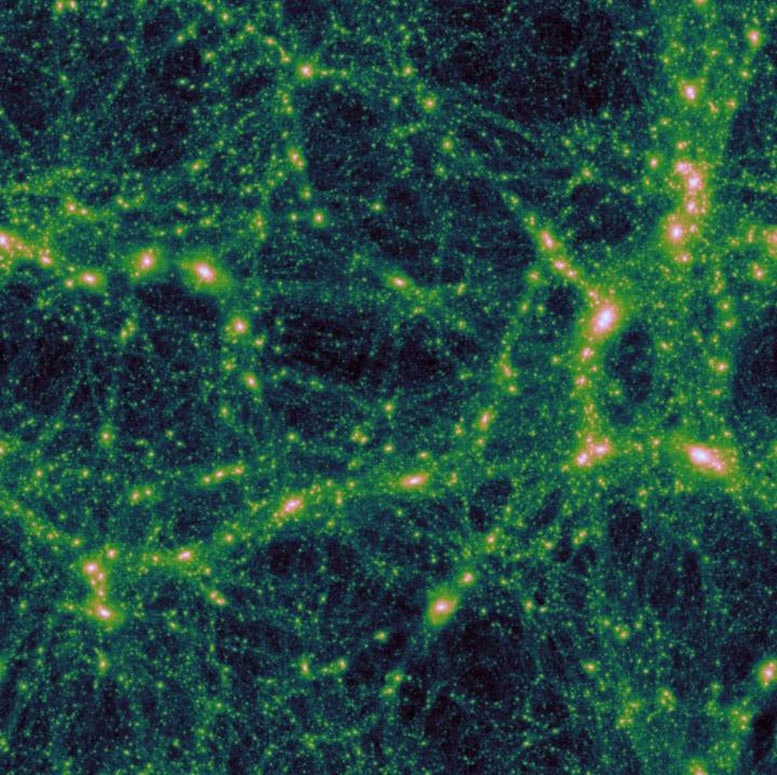
    Simulated Universe Structure
    Figure 1. Dark matter drives structural formation and constructs potential wells where galaxies may form. This figure illustrates structure in the simulated universe, in a box 200 million light-years on each side. It is color coded, using black, green, yellow, pink and white to represent low- to high-density regions, respectively. Credit: NAOC

    Researchers from the National Astronomical Observatories of the Chinese Academy of Science (NAOC), Peking University and Tsinghua University have found a special population of dwarf galaxies that could mainly consist of baryons within radii of up to tens of thousands of light-years. This contrasts with the normal expectation that such regions should instead be dominated by dark matter. 

    This study may challenge the formation theory of dwarf galaxies in the framework of standard cosmology and may provide new clues to the nature of dark matter. The results were published in Nature Astronomy on November 26, 2019. 

    In standard cosmology, the Universe is dominated by cold dark matter and dark energy, while baryons only occupy 4.6% by mass. Galaxies form and evolve in systems dominated by dark matter (Figure 1). In high-mass systems, the baryonic fraction may reach the universal value, i.e., 4.6%. In low-mass systems, the baryonic fraction may be much lower due to their shallow gravitational potential. 
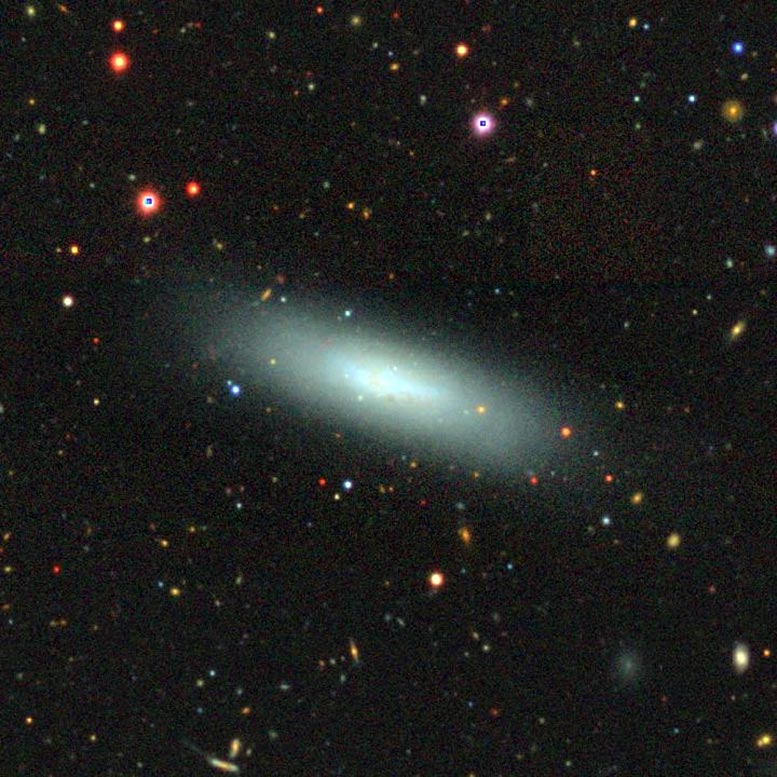
    UGC7920
    Figure 2. An example of the baryonic-dominated dwarf galaxies-UGC7920. Credit: DECaLS-DR8

    The satellite dwarf galaxies in our Local Group are found to be dominated by dark matter down to radii of a few thousand light-years. However, statistical studies of the dynamics of dwarf galaxies beyond the Local Group previously had been hampered by the extreme faintness of such systems. 

    Multi-wavelength data have recently made such studies possible, however.  

    By taking advantage of the release of 40% of the data from the Arecibo Legacy Fast (ALFA) catalogue and the Seventh Data Release of the Sloan Digital Sky Survey, a research group led by Prof. GUO Qi from NAOC has found 19 dwarf galaxies that are dominated by baryons at radii far beyond their half-optical radii ( typically a few thousand light-years). Normally, the dark matter-to-baryon mass ratio reaches 10-1000 for “typical” dwarf galaxies. Notably, most of these baryon-dominated dwarf galaxies are isolated galaxies, free from the influence of nearby bright galaxies and high-density environments. 

    “This result is very hard to explain using the standard galaxy formation model in the context of concordance cosmology, and thus encourages people to revisit the nature of dark matter,” said Prof. GUO. 

    Instead of the standard cold dark matter model, a warm dark matter model or fuzzy dark matter model might be more in line with the formation of this particular population of dwarf galaxies. Alternatively, some extreme astrophysical processes may also be responsible. 

    Further observations are required to understand the formation of these particular baryon-dominated dwarf galaxies.

    Reference: “Further evidence for a population of dark-matter-deficient dwarf galaxies” by Qi Guo, Huijie Hu, Zheng Zheng, Shihong Liao, Wei Du, Shude Mao, Linhua Jiang, Jing Wang, Yingjie Peng, Liang Gao, Jie Wang and Hong Wu, 25 November 2019, Nature Astronomy.
    DOI: 10.1038/s41550-019-0930-9

    Never miss a breakthrough: Join the SciTechDaily newsletter.
    Follow us on Google and Google News.

    Astrophysics Chinese Academy of Sciences Dark Matter
    Share. Facebook Twitter Pinterest LinkedIn Email Reddit

    Related Articles

    Are We Wrong About Dark Matter? Dwarf Galaxies Suggest So

    Revealing the Milky Way’s Warp: How Cepheid Stars Map Our Dark Matter Halo

    Revolutionizing Cosmology: The 21-cm Forest Probe’s Role in Deciphering Dark Matter

    Zooming In on Dark Matter Haloes

    Study Challenges Prevailing Ideas About How Supermassive Black Holes Grow

    Astrophysicists Zero In on How the Universe Responds to Gravity

    The Bolshoi Simulation: Boxing the Universe

    Baryon Oscillation Spectroscopic Survey Measures the Universe’s Expansion and Dark Energy

    SN Primo Is Farthest Type Ia Supernova Discovered

    Leave A Reply Cancel Reply

    • Facebook
    • Twitter
    • Pinterest
    • YouTube

    Don't Miss a Discovery

    Subscribe for the Latest in Science & Tech!

    Trending News

    First-of-Its-Kind Discovery: Homer’s Iliad Found Embedded in a 1,600-Year-Old Egyptian Mummy

    Beyond Inflammation: Scientists Uncover New Cause of Persistent Rheumatoid Arthritis

    A Simple Molecule Could Unlock Safer, Easier Weight Loss

    Scientists Just Built a Quantum Battery That Charges Almost Instantly

    Researchers Unveil Groundbreaking Sustainable Solution to Vitamin B12 Deficiency

    Millions of People Have Osteopenia Without Realizing It – Here’s What You Need To Know

    Researchers Discover Boosting a Single Protein Helps the Brain Fight Alzheimer’s

    World-First Study Reveals Human Hearts Can Regenerate After a Heart Attack

    Follow SciTechDaily
    • Facebook
    • Twitter
    • YouTube
    • Pinterest
    • Newsletter
    • RSS
    SciTech News
    • Biology News
    • Chemistry News
    • Earth News
    • Health News
    • Physics News
    • Science News
    • Space News
    • Technology News
    Recent Posts
    • After Decades, MIT Researchers Capture the First 3D Atomic View of a Mysterious Material
    • Your Favorite Fishing Spot Is Turning Brown – and the Fish Are Changing
    • 380-Million-Year-Old Fish Fossil Reveals Secrets of Life’s First Steps Onto Land
    • Mezcal “Worm” in a Bottle Mystery: DNA Testing Reveals a Surprise
    • Scientists Turn Red Lettuce Green, Unlocking Hidden Nutrients
    Copyright © 1998 - 2026 SciTechDaily. All Rights Reserved.
    • Science News
    • About
    • Contact
    • Editorial Board
    • Privacy Policy
    • Terms of Use

    Type above and press Enter to search. Press Esc to cancel.