
Close Menu
    Facebook X (Twitter) Instagram
    SciTechDaily
    • Biology
    • Chemistry
    • Earth
    • Health
    • Physics
    • Science
    • Space
    • Technology
    Facebook X (Twitter) Pinterest YouTube RSS
    SciTechDaily
    Home»Space»Galactic Bars: Feeding a Galaxy’s Nuclear Black Hole
    Space

    Galactic Bars: Feeding a Galaxy’s Nuclear Black Hole

    By Harvard-Smithsonian Center for Astrophysics,November 12, 2020No Comments4 Mins Read
    Facebook Twitter Pinterest Telegram LinkedIn WhatsApp Email Reddit
    Share
    Facebook Twitter LinkedIn Pinterest Telegram Email Reddit
    Billion Solar Mass Black Hole Crop
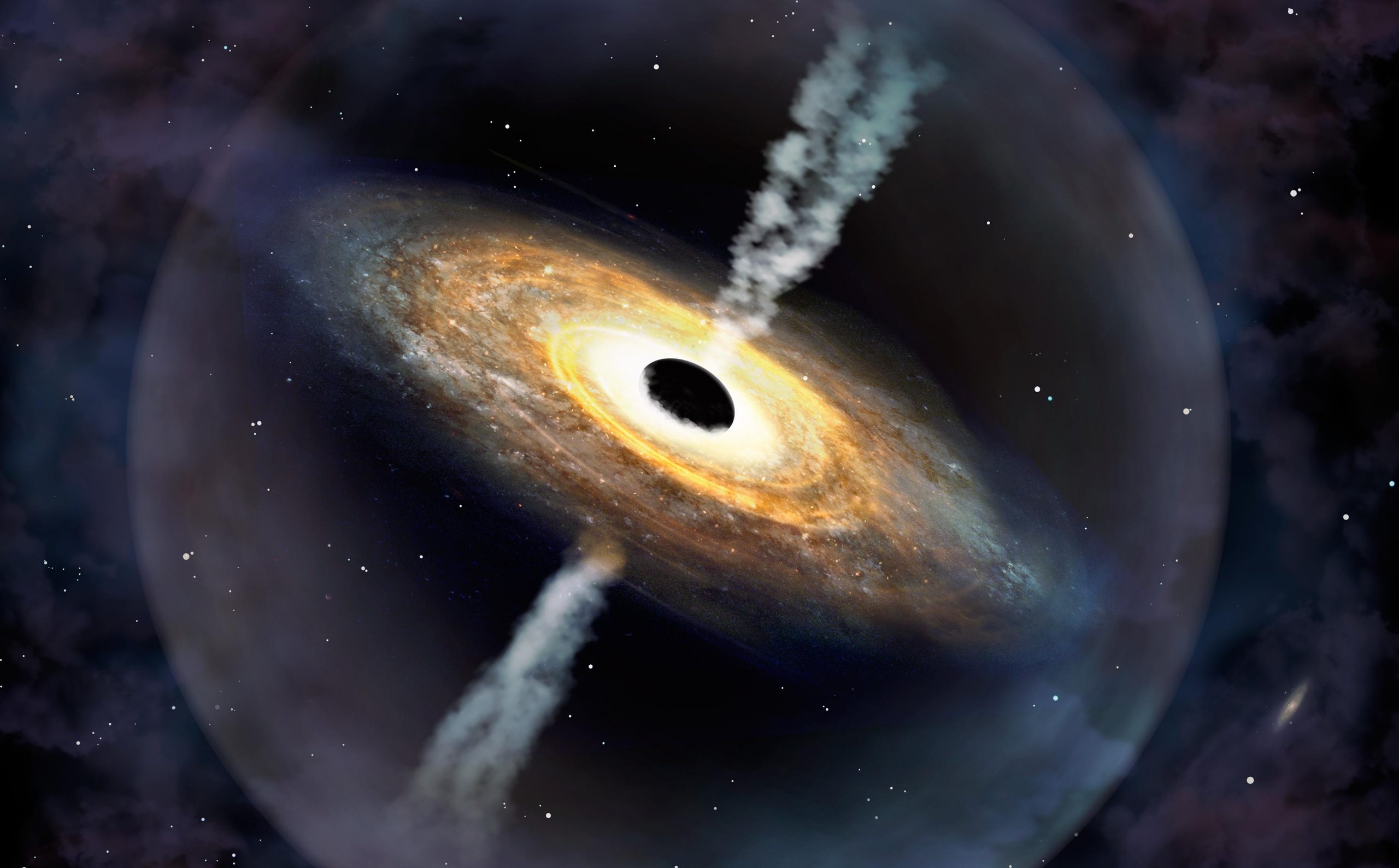
    An artist’s impression of a black hole. Credit: International Gemini Observatory/NOIRLab/NSF/AURA/P. Marenfeld

    A galactic bar is the approximately linear structure of stars and gas that stretches across the inner regions of some galaxies. The bar stretches from one inner spiral arm, across the nuclear region, to an arm on the other side. Found in about half of spiral galaxies, including the Milky Way, bars are thought to funnel large amounts of gas into the nuclear regions, with profound consequences for the region including bursts of star formation and the rapid growth of the supermassive black hole at the center. Quasars, for example, have been suggested as one result of this kind of activity. Eventually, however, feedback from such energetic events (supernovae, for example) terminates the inflow and stalls the black hole’s growth.

    How bars and gas inflows form and evolve are not well understood — galaxy mergers are thought to play a role — nor are the physical properties of galactic nuclei that are still actively accumulating gas. A serious difficulty is that dust in the dense material around the nucleus is opaque to optical radiation and, depending in part on the geometry, can obscure observations. Infrared and submillimeter wavelength measurements that can peer through the dust offer the best way forward.
    Galaxy ESO320-G030
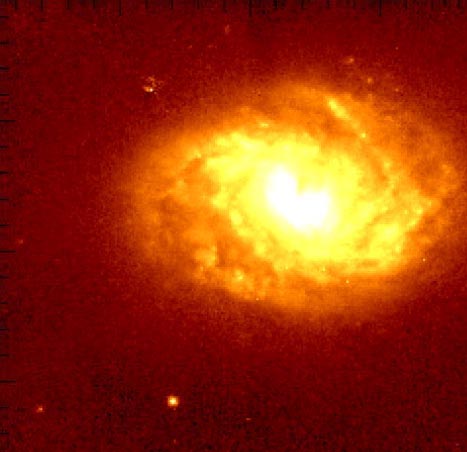
    A near-infrared Hubble image of the luminous, barred spiral galaxy ESO320-G030. Infrared observations and modeling of over a dozen molecular species at its center reveal massive inflows of gas to a nuclear region undergoing a burst of star formation and dominated by three-components, a small warm core, a disk, and an outer envelope. Credit: NASA/HST; Alonso-Herrero et al.

    The luminous, barred galaxy ESO 320-G030 is about one hundred and fifty thousand light-years away and shows no signs of having been in a merger, yet this galaxy has a bar nearly sixty thousand light-years long, as well as a second bar about ten times smaller perpendicular to it. This galaxy shows high star formation activity in the nuclear region, but no clear evidence of an active nucleus, perhaps because of the high extinction. The galaxy is also seen with inflowing gas (and evidence of outflows simultaneously), making it a nearby prototype of isolated, rapidly evolving galaxies driven by their bars.

    CfA astronomers Eduardo Gonzalez-Alfonso, Matt Ashby, and Howard Smith led a program of far infrared Herschel spectroscopy of this object coupled with ALMA submillimeter observations of the gas. By carefully modeling the shapes of the infrared absorption lines of water and several of its ionized and isotopic variations, with fifteen other molecular species including ammonia, OH and NH, they conclude that a nuclear starburst of about twenty solar-masses of stars per year is being sustained by gas inflow with short (twenty million year) lifetime.

    They find evidence for three structural components: an envelope about five hundred light-years across, a dense circumnuclear disk about one hundred twenty light-years in radius, and a compact core or torus forty light-years in size and characterized by its very warm dust. These three components are responsible for about 70% of the galaxy’s luminosity.

    Although ESO 320-G030 is an exceptional example, being both bright and nearby, the results suggest that similar complex nuclear structures, with inflows and outflows, may be common in luminous galaxies in the more distant universe including those during its most active epoch of star formation.

    Reference: “A proto-pseudobulge in ESO 320-G030 fed by a massive molecular inflow driven by a nuclear bar” by E. González-Alfonso, M. Pereira-Santaella, J. Fischer, S. García-Burillo, C. Yang, A. Alonso-Herrero, L. Colina, M. L. N. Ashby, H. A. Smith, F. Rico-Villas, J. Martín-Pintado, S. Cazzoli and K. P. Stewart, Accepted 27 October 2020, Astronomy & Astrophysics.
    DOI: 10.1051/0004-6361/202039047
    arXiv: 2011.00347

    Never miss a breakthrough: Join the SciTechDaily newsletter.
    Follow us on Google and Google News.

    Astrophysics Black Hole Harvard-Smithsonian Center for Astrophysics
    Share. Facebook Twitter Pinterest LinkedIn Email Reddit

    Related Articles

    Researchers Study Mysterious Gamma Ray Source with No Known Counterpart

    Researchers Trace the Evolution of Galaxies that Host Massive Black Holes

    Distinguishing Black Holes from Naked Singularities

    A Link Between Black Hole Accretion Rate and Star Formation Rate

    Astronomers Measure a Black Hole’s “Point of No Return”

    Cloud of Hydrogen and Helium Plunging Toward the Galactic Center

    Study Challenges Prevailing Ideas About How Supermassive Black Holes Grow

    Gamma-Ray Beams Suggest Milky Way’s Central Black Hole Had Active Past

    Astronomers Observed Evolved Star Being Devoured

    Leave A Reply Cancel Reply

    • Facebook
    • Twitter
    • Pinterest
    • YouTube

    Don't Miss a Discovery

    Subscribe for the Latest in Science & Tech!

    Trending News

    Popular Supplement Ingredient Linked to Shorter Lifespan in Men

    Scientists May Have Found a Way To Repair Nerve Damage in Multiple Sclerosis

    “Totally Unexpected” – Scientists Discover Pancreatic Cancer’s Fatal Addiction

    A Strange Quantum Effect May Explain One of Biology’s Greatest Mysteries

    James Webb Telescope Reveals the Universe’s Hidden Cosmic Web in Stunning Detail

    Scientists Identify Simple Supplement That Greatly Reduces Alzheimer’s Damage

    You May Have a Dangerous Type of Cholesterol Even if Your Tests Look Normal

    Your Blood Pressure Reading Could Be Wrong Because of One Simple Mistake

    Follow SciTechDaily
    • Facebook
    • Twitter
    • YouTube
    • Pinterest
    • Newsletter
    • RSS
    SciTech News
    • Biology News
    • Chemistry News
    • Earth News
    • Health News
    • Physics News
    • Science News
    • Space News
    • Technology News
    Recent Posts
    • Scientists Discover Hidden “Switch” That Burns Fat and Could Treat Bone Disease
    • Deadly Hantavirus Outbreak on Cruise Ship Sparks Global Health Alert
    • New Research Reveals Certain Fats Can Either Trigger or Suppress Cancer
    • After 50 Years of Mystery, Researchers Identify New Human Blood Group
    • Leading Climate Scientist Rebuts “Factually Incorrect” US Government Climate Claims
    Copyright © 1998 - 2026 SciTechDaily. All Rights Reserved.
    • Science News
    • About
    • Contact
    • Editorial Board
    • Privacy Policy
    • Terms of Use

    Type above and press Enter to search. Press Esc to cancel.