
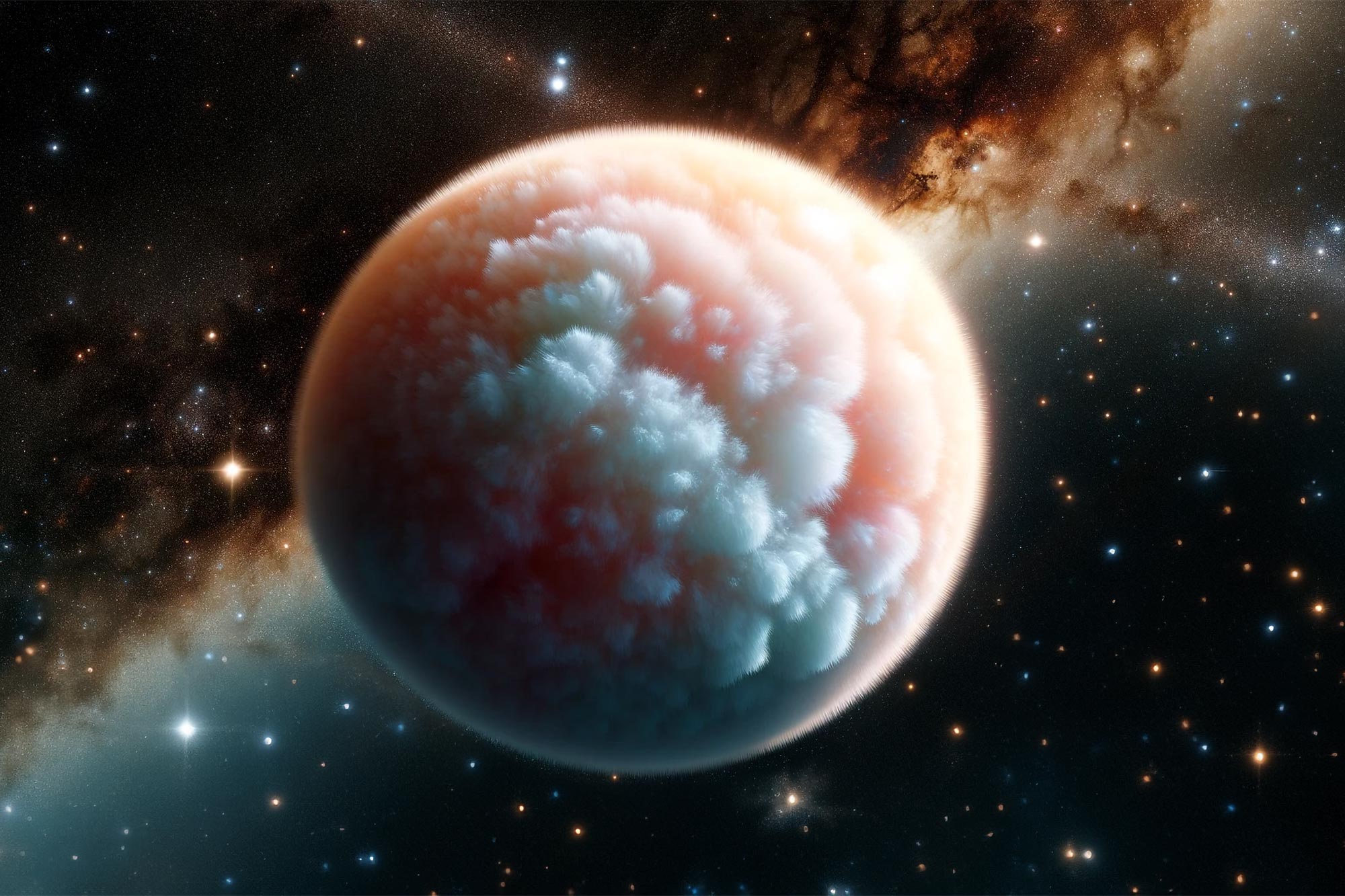
Astronomers have discovered WASP-193b, an extraordinarily light planet orbiting a distant star in our galaxy. It outstrips Jupiter in size but matches the density of cotton candy, presenting a mystery in planetary science.
The new planet, named WASP-193b, appears to dwarf Jupiter in size, yet it is a fraction of its density. The scientists found that the gas giant is 50 percent bigger than Jupiter, and about a tenth as dense — an extremely low density that is comparable to cotton candy.
WASP-193b is the second lightest exoplanet discovered to date, after the smaller, Neptune-like world, Kepler 51d. The new planet’s much larger size, combined with its super-light density, make WASP-193b something of an oddity among the more than 5,500 exoplanets discovered to date.
“To find these giant objects with such a small density is really, really rare,” says lead author and MIT postdoc Khalid Barkaoui. “There’s a class of planets called puffy Jupiters, and it’s been a mystery for 15 years now, as to what they are. And this is an extreme case of that class.”
“We don’t know where to put this planet in all the formation theories we have right now, because it’s an outlier of all of them,” adds co-lead author Francisco Pozuelos, a senior researcher at the Instituto de Astrofísica de Andalucía-CSIC (Spain). “We cannot explain how this planet was formed, based on classical evolution models. Looking more closely at its atmosphere will allow us to obtain an evolutionary path of this planet.”

Discovery by WASP
The new planet was initially spotted by the Wide Angle Search for Planets, or WASP — an international collaboration of academic institutions that together operate two robotic observatories, one in the northern hemisphere and the other in the south. Each observatory uses an array of wide-angle cameras to measure the brightness of thousands of individual stars across the entire sky.
In surveys taken between 2006 and 2008, and again from 2011 to 2012, the WASP-South observatory detected periodic transits, or dips in light, from WASP-193 — a bright, nearby, sun-like star located 1,232 light years from Earth. Astronomers determined that the star’s periodic dips in brightness were consistent with a planet, circling the star and blocking its light, every 6.25 days. The scientists measured the total amount of light the planet blocked with each transit, which gave them an estimate of the planet’s giant, super-Jupiter size.
The astronomers then looked to pin down the planet’s mass — a measure that would then reveal its density and potentially also clues to its composition. To get a mass estimate, astronomers typically employ radial velocity, a technique in which scientists analyze a star’s spectrum, or various wavelengths of light, as a planet circles the star. A star’s spectrum can be shifted in specific ways depending on whatever is pulling on the star, such as an orbiting planet. The more massive a planet is, and the closer it is to its star, the more its spectrum can shift — a distortion that can give scientists an idea of a planet’s mass.
For WASP-193 b, astronomers obtained additional high-resolution spectra of the star taken by various ground-based telescopes, and attempted to employ radial velocity to calculate the planet’s mass. But they kept coming up empty — precisely because, as it turned out, the planet was far too light to have any detectable pull on its star.
“Typically, big planets are pretty easy to detect because they are usually massive, and lead to a big pull on their star,” explains Julien de Wit, a reseracher at the Massachusetts Institute of Technology (MIT). “But what was tricky about this planet was, even though it’s big — huge — its mass and density are so low that it was actually very difficult to detect with just the radial velocity technique. It was an interesting twist.”
Density of Cotton Candy
Calculations confirm that WASP-193b has a mass of roughly 0.14 times that of Jupiter and a density of approximately 0.059 grams per cubic centimeter, considerably lower than that of Jupiter and Earth, but similar to the 0.05 grams per cubic centimeter of cotton candy.
“It took us almost four years to collect all the data needed to obtain the mass of WASP-193b,” says Barkaoui. “The planet is so light that it’s difficult to think of an analogous, solid-state material. The reason why it’s close to cotton candy is because both are mostly made of light gases rather than solids. The planet is basically super fluffy.”
The researchers suspect that the new planet is made mostly from hydrogen and helium, like most other gas giants in the galaxy. For WASP-193b, these gases likely form a hugely inflated atmosphere that extends tens of thousands of kilometers farther than Jupiter’s own atmosphere. Exactly how a planet can inflate so far, while maintaining a super-light density, is a question that no existing theory of planetary formation can yet answer.
“WASP-193b is a cool mystery,” concludes Barkaoui. “Solving it will require some more observational and theoretical work, notably to measure its atmospheric properties with the JWST space telescope and to confront them to different theoretical mechanisms that possibly result in such an extreme inflation.”
For more on this discovery:
- Super Fluffy “Cotton Candy” Exoplanet Discovery Shocks Scientists
- Astronomers Uncover a “Cosmic Mystery” – A Giant Planet As Fluffy as Cotton Candy
Reference: “An extended low-density atmosphere around the Jupiter-sized planet WASP-193 b” by Khalid Barkaoui, Francisco J. Pozuelos, Coel Hellier, Barry Smalley, Louise D. Nielsen, Prajwal Niraula, Michaël Gillon, Julien de Wit, Simon Müller, Caroline Dorn, Ravit Helled, Emmanuel Jehin, Brice-Olivier Demory, Valerie Van Grootel, Abderahmane Soubkiou, Mourad Ghachoui, David. R. Anderson, Zouhair Benkhaldoun, Francois Bouchy, Artem Burdanov, Laetitia Delrez, Elsa Ducrot, Lionel Garcia, Abdelhadi Jabiri, Monika Lendl, Pierre F. L. Maxted, Catriona A. Murray, Peter Pihlmann Pedersen, Didier Queloz, Daniel Sebastian, Oliver Turner, Stephane Udry, Mathilde Timmermans, Amaury H. M. J. Triaud and Richard G. West, 14 May 2024, Nature Astronomy.
DOI: 10.1038/s41550-024-02259-y
Never miss a breakthrough: Join the SciTechDaily newsletter.
Follow us on Google and Google News.
1 Comment
What’s the odds that planets are being manufactured