
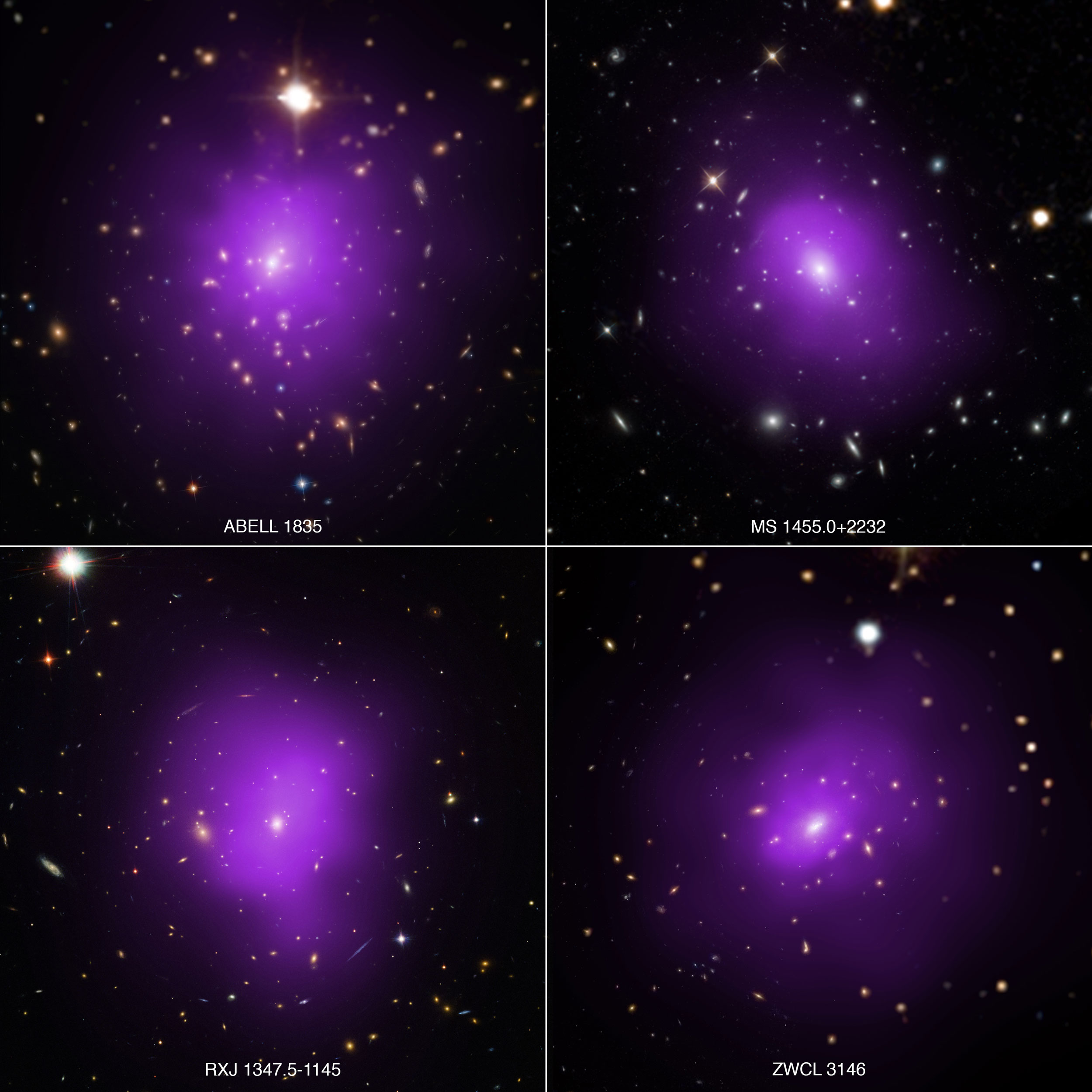
Researchers are using a large sample of galaxy cluster to investigate dark energy, showing that dark energy has not changed over billions of years.
Astronomers have used data from NASA’s Chandra X-ray Observatory, ESA’s Planck, and a large list of optical telescopes to develop a powerful new method for investigating dark energy, the mysterious energy that is currently driving the accelerating expansion of the universe.
The technique takes advantage of the observation that the outer reaches of galaxy clusters, the largest structures in the universe held together by gravity, show similarity in their X-ray emission profiles and sizes. More massive clusters are simply scaled-up versions of less massive ones.
“In this sense, galaxy clusters are like Russian dolls, with smaller ones having a similar shape to the larger ones,” said Andrea Morandi of the University of Alabama at Huntsville, who led the study. “Knowing this lets us compare them and accurately determine their distances across billions of light years.”
By using these galaxy clusters as distance markers, astronomers can measure how quickly the Universe was expanding at different times since the Big Bang. According to Einstein’s theory of general relativity, the rate of expansion is determined by the properties of dark energy plus the amount of matter in the Universe, where the latter is mostly made up of unseen material called dark matter.
If the assumed cosmological parameters (e.g., the properties of dark energy or dark matter) are incorrect, then distant clusters will not appear to be similar, that is their sizes will be larger or smaller than expected. The cosmological parameters are then adjusted so that all of the different clusters, with different masses and different distances, appear to be similar. The process is akin to determining the unknown weight of an object by adding or subtracting known weights to a balance scale until the two sides balance.
These latest results confirm earlier studies that the properties of dark energy have not changed over billions of years. They also support the idea that dark energy is best explained by the “cosmological constant,” which Einstein first proposed and is equivalent to the energy of empty space.
“Although we’ve looked hard at other explanations,” said co-author Ming Sun, also of the University of Alabama at Huntsville, “it still appears that dark energy behaves just like Einstein’s cosmological constant.”
The researchers studied 320 galaxy clusters with distances from Earth that ranged from about 760 million light-years to about 8.7 billion light-years. This spans the era where dark energy caused the once-decelerating universe to accelerate, a discovery that shocked many astronomers when it was made almost two decades ago.
To determine more precise results than with the Chandra X-ray data alone, the researchers combined this data with information on the expansion rate of the universe from optical observations of supernovas, and work from Planck on the cosmic microwave background, the leftover radiation from the Big Bang.
“The nature of dark energy is one of the biggest mysteries in physics, so it’s crucial to invent new tools for studying its properties since different methods can have very different assumptions, strengths, and weaknesses,” said Morandi. “We think this new technique has the ability to provide a big leap forward in our understanding of dark energy.”
A paper describing these results appeared in the April 11th, 2016 issue of the Monthly Notices of the Royal Astronomical Society journal. NASA’s Marshall Space Flight Center in Huntsville, Alabama, manages the Chandra program for NASA’s Science Mission Directorate in Washington. The Smithsonian Astrophysical Observatory in Cambridge, Massachusetts, controls Chandra’s science and flight operations.
Reference: “Probing dark energy via galaxy cluster outskirts” by Andrea Morandi and Ming Sun, 23 February 2016, MNRAS.
DOI: 10.1093/mnras/stw143
arXiv:1601.03741
Never miss a breakthrough: Join the SciTechDaily newsletter.
Follow us on Google and Google News.
5 Comments
The Standard Model of particle physics does not incorporate the physics of GR and it is not consistent with the Standard Model of cosmology with its dark energy and dark matter. The questions are arising. Do we really have wrong Standard Model of the particles which can not explain 96% of our world? Or Standard Model of cosmology is not correct which requires all this non-existing dark matter and dark energy? Why a mainstream science does not even pose clear these questions?
Since dark energy is the glue that holds the universe together. I should get the Noble Prize for figuring it out. GOD….only He is not dark. Science is just blind. “Was blind but now I see”. Unfortunately most will not.
‘Black holes banish matter into cosmic voids’
spacedaily.com/reports/Black_holes_banish_matter_into_cosmic_voids_999.html
“Some of the matter falling towards the [supermassive black] holes is converted into energy. This energy is delivered to the surrounding gas, and leads to large outflows of matter, which stretch for hundreds of thousands of light years from the black holes, reaching far beyond the extent of their host galaxies.”
At the scale of our Universe the energy described above is dark energy. A Universal black hole is powering our visible Universe causing the galaxy clusters to accelerate away from us.
Dark energy and Dark matter are mirages
vixra.org/pdf/1111.0051v6.pdf pp.161–167
The Standard Model is a “spherical cow,” using only two numbers to describe the universe: density and expansion-rate. Star and galaxy formation are not in the model, because they complicate things. “Dark energy” was added to this simplistic model.
It is time for a more realistic model, one that includes the effect of star and galaxy formation. Accelerating expansion might be exactly what’s expected.