
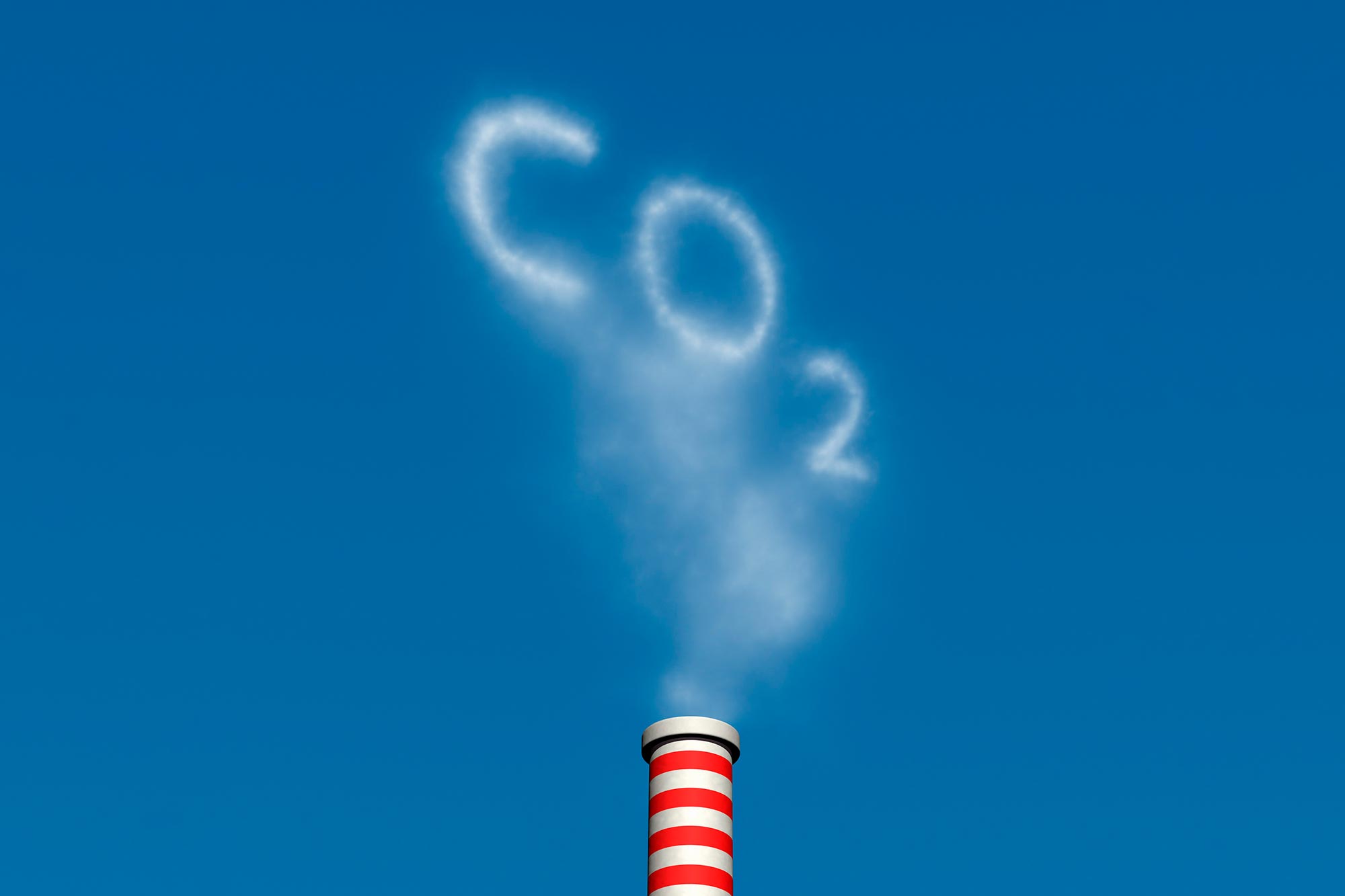
Scientists have developed a highly efficient dual-site catalyst that improves methanol production from carbon dioxide, increasing efficiency by 1.5 times and offering a promising step toward greener fuel and chemical production.
Methanol, a key component in manufacturing everyday products and a promising green energy source, could soon be produced more efficiently and at a faster rate. This advancement comes from a collaboration that includes two researchers from Oregon State University.
Zhenxing Feng and Alvin Chang of OSU’s College of Engineering contributed to characterizing a new electrocatalyst developed by Yale University researchers. Their work helped explain how the catalyst enhances the conversion of carbon dioxide—a major greenhouse gas driving climate change—into methanol.
The study, supported by the National Science Foundation and the Yale Center for Natural Carbon Capture, was published in Nature Nanotechnology.
The researchers’ dual-site catalyst is the result of combining two different catalytic sites at adjacent locations, separated by about 2 nanometers, on carbon nanotubes and represents a significant improvement over previous single-site catalysts.
The new design increases the methanol production rate and results in a higher Faradaic efficiency of 50%, meaning less of the electricity used to catalyze the reaction is wasted. The previous single-site version operated at less than 30%.
Methanol: A Key Chemical and Sustainable Fuel Source
“Methanol is a flexible chemical feedstock that is used for hundreds of common products including plastics, chemicals, and solvents,” said Chang, a doctoral student at OSU. “It’s also a promising green fuel that can be produced from harmful carbon emissions using renewable electrical energy via a process called electrochemical CO2 reduction, simultaneously helping with environmental challenges and energy demands.”
Methanol, also known as wood alcohol, is a comparatively clean-burning compound that can be used in fuel cells, as an alternative to gasoline in internal combustion engines, and as fuel for ships and electricity generation.
In addition to carbon dioxide, which is released into the atmosphere primarily through the burning of fossil fuels, methanol can be produced from sources such as agricultural and municipal waste – meaning it has potential for helping to reduce greenhouse gas emissions and supporting a transition to more eco-friendly energy sources, the researchers note.
The Science Behind the New Catalyst
A catalyst is anything that speeds the rate of a chemical reaction without being consumed by the reaction, and an electrocatalyst is a material that hastens an electrochemical reaction by lowering its activation energy.
Cobalt phthalocyanine molecules supported on carbon nanotubes are one of the very few molecules that can catalyze the electrochemical reduction of carbon dioxide into methanol, said Feng, an associate professor at OSU. A drawback of the previous generation of this catalyst, which contains cobalt tetraaminophthalocyanine molecules as the only active sites, is its relatively low selectivity for methanol.
The electrochemical carbon dioxide reduction reaction happens in two parts, Chang said. Carbon dioxide is first converted to carbon monoxide, which is then converted to methanol.
“The single-site catalyst is limited by a tradeoff,” he said. “At the optimal potential for catalyzing the carbon monoxide to methanol step, it is not efficient in turning carbon dioxide to carbon monoxide.”
The research team introduced nickel tetramethoxyphtyalocyanine into the system and found it can help catalyze the carbon dioxide to carbon monoxide step, resulting in improved methanol production.
“The hybrid catalyst was found to exhibit unprecedented high catalytic efficiencies, nearly 1.5 times higher than observed before,” Feng said. “Advanced vibrational and X-ray spectroscopy revealed that the improvement is because of a carbon monoxide transfer from a nickel site to a cobalt site on the same carbon nanotube.”
Reference: “Molecular-scale CO spillover on a dual-site electrocatalyst enhances methanol production from CO2 reduction” by Jing Li, Quansong Zhu, Alvin Chang, Seonjeong Cheon, Yuanzuo Gao, Bo Shang, Huan Li, Conor L. Rooney, Longtao Ren, Zhan Jiang, Yongye Liang, Zhenxing Feng, Shize Yang, L. Robert Baker and Hailiang Wang, 18 February 2025, Nature Nanotechnology.
DOI: 10.1038/s41565-025-01866-8
The study was funded by the U.S. National Science Foundation and the Yale Center for Natural Carbon Capture.
Hailiang Wang of Yale University led the study, which also included researchers from The Ohio State University and the Southern University of Science and Technology in Shenzhen, China.
Never miss a breakthrough: Join the SciTechDaily newsletter.
Follow us on Google and Google News.
29 Comments
Folks, this is just UNBURNING. Putting the energy back into the chemical bonds it had originally.
Far better not to burn the stuff in the first place.
It’s drivel to think this can address climate change unless we have far more energy than we can use so we can spare some overflow for such “reparations”. Maybe when fusion power gets practical. But for now it’s NONSENSE.
The authors were negligent in not mentioning that there are other industrial uses for methanol that don’t involve oxidation (burning).
VRE is relatively cheap in lot of places hoping fusion would get even cheaper than that is a bit wishful. Some aspects of our current economy, (very long durations energy storage) are utterly dominated in their cost by the cost of storage, for those purposes only storing the energy is some liquid at room temp/pressure thing such as methanol may well be the cheapest solution. If so then great, UNBURNING, even it loses more than half its energy in the round trip can be the cheapest option.
BE AWARE we may be talkiing about the need to store energy across multiple years, dip into that storage once and then not again for multiple years.
AND Yes for NOW (until say 2040) that is nonsense as there will be many cheaper ways to reduce emissions before we tackle the last hardest few. BUT as making methanol was cost effective solution to some very specific problems (small <1% of energy), even before this breakthrough, then this breakthrough improves that further.
So silly.
Why turn the CO2 gas into anything at all? Why not sequester it so it doesn’t have a chance of being emitted into the atmosphere again?
What this plant is going to do is create methanol, the use of which produces carbon dioxide gas. And if we’re serious about keeping carbon dioxide gas out of the atmosphere in large quantities, why convert to an energy source that releases carbon dioxide gas into the atmosphere? If you think you’re going to sequester THAT, just sequester it before it’s even an issue!
Better yet, don’t use any energy sources that involve carbon and oxygen! Ever!
I feel like I’m taking crazy pills!
“Better yet, don’t use any energy sources that involve carbon and oxygen! Ever!”
Taken literally, that means don’t ever use humans.
Perhaps I’m missing something, but it seems to me that a system that converts carbon dioxide – from the atmosphere or from industrial sources – into methanol has two principal benefits. First, the methanol created by the process removes the need for burning an equivalent amount of petroleum. Rather than new carbon dioxide being released into the atmosphere, carbon dioxide is, in effect, being recycled. Second, the methanol serves as a storage medium for energy from intermittent sources, such as solar and wind – one that could well be superior to batteries. Whether this method works on industrial scale has yet to be seen; but I find it encouraging. Anyway, that’s my $0.02 worth.
The problem is the cost. CO2 has ZERO useful energy, so it all has to be pumped in as electricity, which we desperately need for other things. And the “incredible” efficiency is only around 50%, so half the electricity is wasted. And methanol is very useful, but if we burn it, we’ll typically get <50% conversion to useful energy. So, we could charge an EV and use the power with near 100% efficiency, or we could upgrade CO2 and then burn methanol for a net 25% efficiency or less.
Also, as usual these cheerleaders report something interesting that happened in a test tube as if it was a practical real-world process. There are any number of limitations, inefficiencies, and even fatal flaws between where these academic eggheads are and reality.
Well, as pharmaceuticals and a whole range of hydrocarbons essential to your current lifestyle are required. Then a certain amount of Carbon that we used to get out of fossil fuels is going to have to be obtained somewhere else. Not while the vast majority of that carbon in future world will not just get combusted but sued other ways, close to every single carbon atom used in biodegrable stuff is going back into the atmosphere. If the pant makes methanol out of Carbon that was not too long before in the atmosphere then the fact that it is going back into the atmosphere is just fine. That is true exactly kike humans breathing out Co2 also does not cause or worsen climate change, as the co2 breathed out came from food that recently got that carbon out of the air.
It is true however we will likely have to pay to draw down some Co2 from the air, but it also true that you do not have solution how to run a world that clothes and feeds you but has no use for carbon in its processes at all. What is required is using it sensibly so that it does not make the problem worse like burning FF did..
Personally, I don’t feel that 50% reaches the bar of “incredible.” It means that twice as much energy is required than for a process with 100% efficiency. I would call 100% incredible.
It is incredible when there were even at the old 30% level a range of uses for methanol where expending 3/2 (150%) times as mnuch energy to get the methanol, was already a worthwhile thing to do.
(worthwhile means real zero emissions, cheapest available way to do X, that our economy needs.)
So yes I am happy we have perhaps found a way to use 33% less energy to do thing we needed to do.
“In addition to carbon dioxide, which is released into the atmosphere primarily through the burning of fossil fuels…”
According to what I’ve read in numerous places, CO2 from human sources constitutes between 1% and 4% of all CO2 emissions. The rest come from natural sources such as animal respiration, plant life, microbial life and, especially, the oceans.
You heard fraud, not truth, unfortunately. Our atmosphere was stable at ~280 ppm CO2. Since we began burning significant amounts of coal, that figure has grown to 425 ppm, and it is still rising.
During this period, the oceans have actually been a net ABSORBER of CO2. If not for that, atmospheric CO2 would be even higher. The increase in ocean CO2 has caused it to become more acidic, which is bad for various forms of sea life. We are now not far below the acidity level where shellfish will no longer be able to produce shells.
Animal respiration does emit a lot of CO2, but all the food they ate arose from plants absorbing CO2 when they grow.
Plant life is a net absorber of CO2. It converts the carbon to biomass and emits a portion of the oxygen as the O2 that we breathe.
The rapid and unprecedented rise in CO2 concentration in the air is unquestionably due to human activity, mainly the burning of fossil fuels.
“The rapid and unprecedented rise in CO2 concentration in the air is unquestionably due to human activity, mainly the burning of fossil fuels.”
OK.. now what? Eight billion people need to be fed. What is the alternative method of transportation that will not add CO2?
“You heard fraud, not truth, unfortunately. ”
“The increase in ocean CO2 has caused it to become more acidic, …”
“The rapid and unprecedented rise in CO2 concentration in the air is unquestionably due to human activity, mainly the burning of fossil fuels.”
I challenge you to defend those claims, not just make the assertions. Considering the statements that you have made, I think that you need to expand your reading sources.
See the tables for the Carbon Cycle at https://wattsupwiththat.com/2021/06/07/carbon-cycle/ for support of the claim that the Anthropogenic CO2 is only about 4% of the total annual flux.
Logically and grammatically, one cannot have “more” of something if it doesn’t exist. The oceans are defined as being alkaline (AKA basic), NOT acidic! The pH may be lowering, but it is still above the dividing line of pH 7.
Coincidentally, the increase in CO2 in the oceans is about half of the total annual emissions of anthropogenic CO2. However, the oceans can’t distinguish anthro’ from natural sources. (Look up the definition of “spurious correlation.”) Thus, the CO2 that goes into the oceans is in proportion (Ignoring isotopic fractionation.) to the relative abundance of CO2 from the different sources. When one resolves the temporal changes more finely than annual, it is evident from the seasonal changes that the atmospheric flux is dominated by biological activity. And the warm El Nino years show that the rate of increase (slope) and annual peak, are related to global temperature, NOT the relatively constant anthro’ emissions. Also, the seasonal CO2 changes show that the Southern Hemisphere (dominated by oceans) has a smaller range than the Northern Hemisphere. That is, outgassing from warming oceans, greater biological activity of bacteria decomposing organic detritus, increased respiration from the roots of Boreal trees in the Winter, and a ‘greening’ of the Earth (Increasing photosynthetic plankton and terrestrial plants.) all contribute to providing increased CO2. A warming Earth can be expected to show an increase in CO2, even in the absence of an anthro’ contribution.
“According to what I’ve read in numerous places . . .”
Please cite three of those places if you would be so kind.
For anyone wanting to play along at home, but cut to the chase, I have a literature review methodology for you. it is method to get you out of the echo chambers.
First we go to possibly in your view biased source one way or the other, but one that cites lots of sources. EG SkepticalScience.com. It has 100’s of such memes (a comprehensive list) as the ” 1% and 4% of all CO2 emissions. ” one. It also has explanation pitched at various levels of prior knowledge, You can read those and if required ask questions about them. Try to be inquisitive, and relatively respectful to people who answer and clearly have spent longer reading about such topics than you. (politeness usually goes down better when trying to learn.)
Lastly once or understand what much more than 90% of scientists think the world works like. They also have links to all the major sources of contrary claims. Get the buzz words from those claims and use search engine of you choice, or follow actual links and go see what the others (deniers) claim. If you find some other sites claims seem to make sense to you, come back to skeptical science and ask about them, or ask about them here, or some other place where people who know things hang out or visit. Over time you will get all kinds of smarter and better informed. You may even find it make you feel good saves you money, LOTS of money, or at least that is what such knowledge and inquisitiveness did for me.
It is really not hard to find out that say a professor like Plimmer, who had alternate views about Co2 really had no explanation that >>fitted all the data<<. AND far more tellingly what he had was claims based on limited data and zero detectable effort to explain all the data. His claim (one of them) was all the extra CO2 came from under sea volcanoes in places we cant easily look (deep ocean). What he never tried to ever explain was why the undersea CO2 levels were not much higher as they would be if what he claimed had actually happened. Indeed looking for that would be the first way to test his theory, but he never did.
That was the pattern with every denial of the science source I ever checked out, not single one ever appeared to be doing science and (and the hard yards of) trying to find out the truth.
Science is not about consensus. At best, it can help establish paradigms, which have a bad habit of being overturned.
If you insist on having explanations that explain ALL of the observations, please tell me how the currently accepted paradigm (anthro’ cause) explains how and why the atmospheric CO2 concentration rises more quickly and peaks higher in El Nino years than other years, [ See Fig. 3 at https://wattsupwiththat.com/2021/06/11/contribution-of-anthropogenic-co2-emissions-to-changes-in-atmospheric-concentrations/ ] and why during the COVID shut downs, which reached as high as 14-18% in April alone, the graphs of monthly MLO CO2 concentration ramp-ups are indistinguishable in shape from the previous or following year. [ https://wattsupwiththat.com/2022/03/22/anthropogenic-co2-and-the-expected-results-from-eliminating-it/ ]
“What he never tried to ever explain was why the undersea CO2 levels were NOT much higher as they would be if what he claimed had actually happened.”
Do you have a citation to support your assertion? Actually, it is well known that deep, abyssal water has a lower pH than surface waters typically have because the water is very cold and under tremendous pressure, both of which increase CO2 solubility. That low pH is usually attributed to bacterial decomposition of the planktonic ‘rain.’ However, I’m unaware that anyone with the means have gone looking for submarine volcanic CO2 in the Ring of Fire. The oceans are not completely mapped, let alone sampled for anomalous CO2.
https://www.sciencenews.org/article/satellite-data-unknown-oceans-sea-mountains
https://scitechdaily.com/energy-unleashed-by-volcanic-eruptions-deep-in-our-oceans-could-power-all-of-the-united-states/
The link I provided above has citations related to your request. Where are your citations countering the claim? I’ll be happy if you come up with two.
Donald won’t allow this or anything else in America if it cuts into the profits of his billionaire oil buddies. And any other countries who adopt solutions like this would be labeled “cheaters” by Donald and risk war with the United States…
Do you have any facts to support your political opinion?
I’m waiting, Alex.
I have a rule, me not knowing stuff does not make the people who do know stuff such as the authors of the article wrong.
As such not knowing what *very* specific situations burning the methanol again means even its round trip energy losses, really are not problem, as the problem it solved was so hard and expensive to do some other way. That conversion efficiency not being as high as some arbitrary threshold chosen by what i want is irrelevant.
Also while direct burning of methanol does rather immediately rerelease CO2 that was earlier extract from the atmosphere, every other use of carbon anywhere, and we have rather lot of those with no real substitute, either produces forever chemicals (and we ought to stop doing that) or the anything made out of the carbon eventually decomposes as it is biodegradable.
Sure sequestering the carbon, that we got out of the atmosphere would be great, and we will ikely IMO have to pay to do that, but we also have some things that are quite hard to do with just batteries, PHS, as our only forms of storing energy.
I think these people have been drinking too much methanol because they’re already blind to oil propaganda.
Can you cite an example of “oil propaganda” that would read by the public commonly? I can’t remember ever seeing such a thing. I certainly couldn’t support such a claim. Can your?
“We are now not far below the acidity level where shellfish will no longer be able to produce shells.”
Ridiculous.
Take as an example the chalk formations of the White Cliffs of Dover formed from calcium carbonate that was deposited by remains of coccoliths left in a shallow sea when CO2 levels were were 5-10 times higher that current levels.
If fact all over the world are limestone mountains and embedded fossilized shellfish formed when CO2 was at levels > 4000ppm including giant 7 foot clams.
The oceans absolutely are absorbers of CO2 which forms calcium carbonate, which has been deposited in limestone formations all over the world, in fact that’s where a major portion of the previous levels of atmospheric CO2 ended up. If there were some sort of process that prevented shell formation when CO2 levels were too high then there is no way we would have such a rich fossil record of shellfish when there is no doubt CO2 levels were massively high when many of them were formed.
Furthermore, the major problem, with larvae and juvenile calcifiers, is coastal areas where up-welling from the abyssal plains delivers cold, ancient (~1,000-year-old) water enriched in carbonic acid resulting from bacterial decomposition of the ‘planktonic rain’ that settles out. That water has been isolated from the atmosphere for at least several hundred years and does not reflect an anthropogenic influence.
It is also responsible for extremely productive fisheries as the nutrient rich water supports abundant sea life, as in the Humboldt Current. Those growing shellfish in places and under conditions that are not natural should understand that they are interlopers in a natural system and should expect to have transient losses in their economic enterprise. However, trying to make fossil fuel use (which they could not survive without) a scapegoat is not warranted.
I’ve heard stories like this before: 8 or so years ago, there were articles reporting that a group of scientists were able to create a process that would turn (convert?) the hydrocarbons in the atmosphere into kerosene. I was pleased to hear that, but if never went into detail about how the process actually took place. The only thing it mentioned was that the process could be achieved under normal conditions (no extreme heat or cold). I also remember thinking to myself ‘If the main product they’re trying to produce is kerosene, then remember what the byproduct of kerosene is gasoline.’
Was it a stock offering prospectus from P. T. Barnum LLC?