
Close Menu
    Facebook X (Twitter) Instagram
    SciTechDaily
    • Biology
    • Chemistry
    • Earth
    • Health
    • Physics
    • Science
    • Space
    • Technology
    Facebook X (Twitter) Pinterest YouTube RSS
    SciTechDaily
    Home»Space»Gamma Ray Bursts Hold Clues to Chemical Composition of the Early Universe
    Space

    Gamma Ray Bursts Hold Clues to Chemical Composition of the Early Universe

    By SciTechDailyMay 17, 2012No Comments2 Mins Read
    Facebook Twitter Pinterest Telegram LinkedIn WhatsApp Email Reddit
    Share
    Facebook Twitter LinkedIn Pinterest Telegram Email Reddit
    gamma-ray-burst-cosmic-history
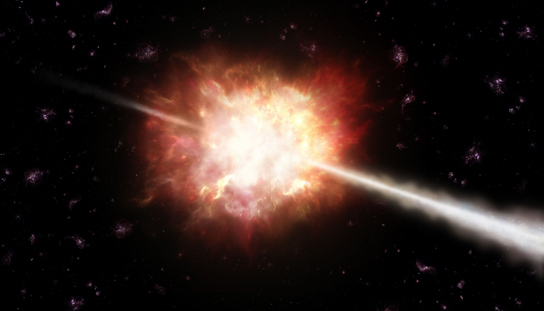
    Artist’s impression of gamma-ray burst.

    Gamma ray bursts (GRBs) have been routinely observed by orbiting observatories, such as NASA’s Fermi and Swift spacecraft, and astronomers are planning on using them as cosmic flashbulbs to probe the details of the early Universe. The researchers published their findings in the journal Nature today.

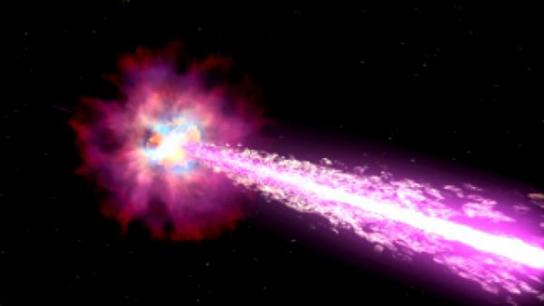
    GRBs are seen almost daily, and are thought to signal the collapse of a star’s core into a black hole, which triggers a cataclysmic explosion. The light from such an explosion can shine all across the observable Universe, through time as well because some of these explosions happened early in the 13-billion-year history of the Universe. Last week, at a Fermi/Swift conference in Munich, Germany, astronomers discussed how they could use GRBs to chart the chemical evolution of the cosmos.
    gamma-ray-burst-cosmic-history-two-directions

    Volker Bromm, an astronomer at the University of Texas at Austin, says that GRBs might carry information about the composition of the first stars that were birthed in the Universe, only a couple of hundred million years after the Big Bang.

    Faint galaxies, quasars, and other extremely distant objects emit GRBs. GRBs are brighter than distant galaxies, making them easier to find. A spectrograph can split them up into their constituent wavelengths to reveal chemical absorption lines.
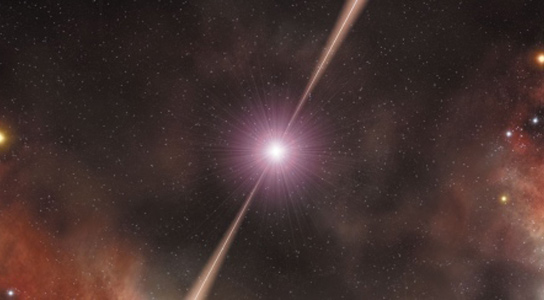
    gamma-ray-burst-cosmic-history-pulsar

    GRBs are unpredictable and brief, lasting only a couple of seconds at the highest energies. They are followed by lingering afterglows that can be measured at longer wavelengths, but they dissipate quickly. Space-based observatories must work in tandem with Earth-based telescopes to spot them.

    GRBs have been firing since the formation of the first stars, which were probably massive, bright, and short-lived. GRBs can be analyzed from other galaxies in different epochs, and these might provide clues of the composition of the early Universe.

    Reference: “Messages from the early Universe” by Eric Hand, 16 May 2012, Nature.
    DOI: 10.1038/485290a

    Never miss a breakthrough: Join the SciTechDaily newsletter.
    Follow us on Google and Google News.

    Astrophysics Cosmology Gamma Ray Spectrograph Universe
    Share. Facebook Twitter Pinterest LinkedIn Email Reddit

    Related Articles

    A Subtle Twist in the Universe’s Oldest Light May Be Larger Than We Thought

    Is the Universe Infinite? The Surprising Truth About Cosmic Geometry

    Five-Time Supernova Discovery May Solve a Century-Old Cosmic Mystery

    The Universe “Will End in a Big Crunch,” Physicists Warns

    New Physics Model Challenges the Big Bang Story We Thought We Knew

    Astrophysicists Zero In on Source of Strange Gamma-Ray Signals

    Astronomers Identify a Signature of Dark Matter Annihilation

    Calculations Show the Ideal Time to Study the Cosmos

    The Bolshoi Simulation: Boxing the Universe

    Leave A Reply Cancel Reply

    • Facebook
    • Twitter
    • Pinterest
    • YouTube

    Don't Miss a Discovery

    Subscribe for the Latest in Science & Tech!

    Trending News

    Millions Take These IBS Drugs, But a New Study Finds Serious Risks

    Scientists Unlock Hidden Secrets of 2,300-Year-Old Mummies Using Cutting-Edge CT Scanner

    Bread Might Be Making You Gain Weight Even Without Eating More Calories

    Scientists Discover Massive Magma Reservoir Beneath Tuscany

    Europe’s Most Active Volcano Just Got Stranger – Here’s Why Scientists Are Rethinking It

    Alzheimer’s Symptoms May Start Outside the Brain, Study Finds

    Millions Take This Popular Supplement – Scientists Discover a Concerning Link to Heart Failure

    The Universe Is Expanding Too Fast and Scientists Can’t Explain Why

    Follow SciTechDaily
    • Facebook
    • Twitter
    • YouTube
    • Pinterest
    • Newsletter
    • RSS
    SciTech News
    • Biology News
    • Chemistry News
    • Earth News
    • Health News
    • Physics News
    • Science News
    • Space News
    • Technology News
    Recent Posts
    • Simple Blood Test May Predict Alzheimer’s Years Before Brain Scans Show Signs
    • Scientists Say Adding This Unusual Seafood to Your Diet Could Reverse Signs of Aging
    • U.S. Waste Holds $5.7 Billion Worth of Crop Nutrients
    • Scientists Say a Hidden Structure May Exist Inside Earth’s Core
    • Doctors Surprised by the Power of a Simple Drug Against Colon Cancer
    Copyright © 1998 - 2026 SciTechDaily. All Rights Reserved.
    • Science News
    • About
    • Contact
    • Editorial Board
    • Privacy Policy
    • Terms of Use

    Type above and press Enter to search. Press Esc to cancel.