
Researchers from the Innovative Genomics Institute at the University of California, Berkeley (UCB) have successfully increased gene expression in a food crop by altering its upstream regulatory DNA. Unlike previous studies that utilized CRISPR/Cas9 gene-editing to eliminate or reduce gene expression, this new research represents the first unbiased gene-editing approach to enhance gene expression and boost downstream photosynthetic activity.
“Tools like CRISPR/Cas9 are accelerating our ability to fine-tune gene expression in crops, rather than just knocking out genes or turning them ‘off’. Past research has shown that this tool can be used to decrease expression of genes involved in important trade-offs, such as those between plant architecture and fruit size,” said Dhruv Patel-Tupper, lead author on the study and former postdoctoral researcher in the Niyogi Lab at UCB. “This is the first study, to our knowledge, where we asked if we can use the same approach to increase the expression of a gene and improve downstream activity in an unbiased way.”
Published in Science Advances, the study is part of the Realizing Increased Photosynthetic Efficiency (RIPE) project, an international effort led by the University of Illinois that focuses on increasing global food production through improved photosynthetic efficiency in food crops.
Leveraging Natural Plant Genes
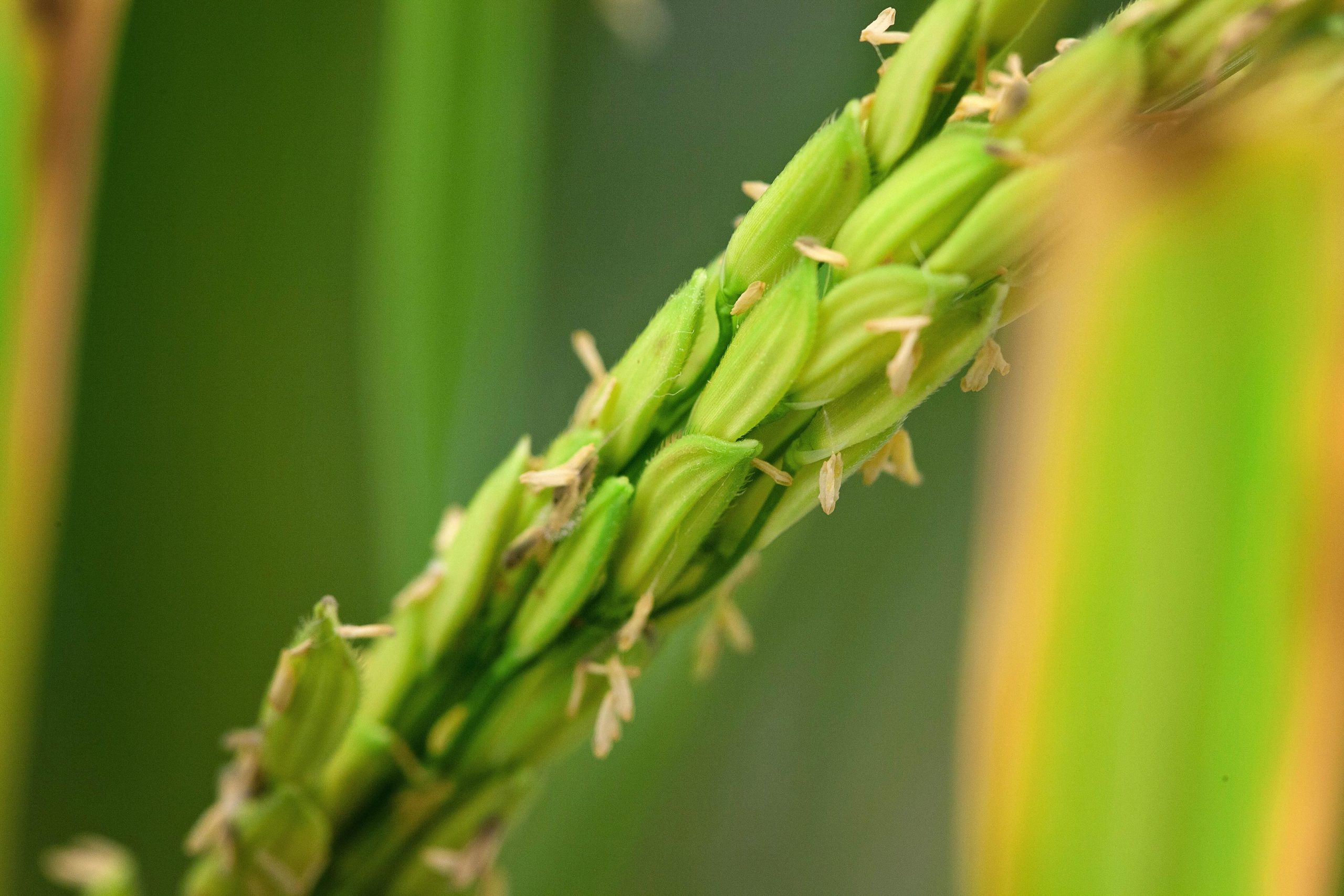
In contrast to synthetic biology strategies that use genes from other organisms to improve photosynthesis, the genes involved in the photoprotection process are naturally found in all plants. Inspired by a 2018 Nature Communications paper that increased water-use efficiency in crops through the overexpression of one of these genes, PsbS, in plants, the Niyogi lab, and its leader Kris Niyogi, wanted to figure out how to change the expression of a plants’ native genes without adding foreign DNA. Given that rice is a staple food and has only one copy of each of the three key photoprotection genes, it was chosen as the ideal candidate for this study.
The researchers used CRISPR/Cas9 to change the DNA upstream of the target gene, which controls how much of the gene is expressed and when. They aimed to discover how such changes could enhance downstream activity.
Surprising Results from Gene Expression Studies
The results of their experiments exceeded expectations. “The changes in the DNA that increased gene expression were much bigger than we expected and bigger than we’ve really seen reported in other similar stories,” said Patel-Tupper, an AAAS Science and Technology Policy Fellow at the USDA.
“We were a little bit surprised, but I think it goes to show how much plasticity plants and crops have. They’re used to these big changes in their DNA from millions of years of evolution and thousands of years of domestication. As plant biologists, we can leverage that ‘wiggle room’ to make large changes in just a handful of years to help plants grow more efficiently or adapt to climate change,” he added.
Impact and Efficiency of Gene Modifications
The researchers learned that inversions, or “flipping” of the regulatory DNA, resulted in increased gene expression of PsbS. Unique to this project, after the largest inversion was made to the DNA, the team members conducted an RNA sequencing experiment to compare how the activity of all genes in the rice genome changed with and without their modifications. What they found was a very small number of differentially expressed genes, much smaller than similar transcriptome studies, suggesting their approach did not compromise the activity of other essential processes.
Patel-Tupper added that while the team showed that this method is possible, it’s still relatively rare. Around 1% of the plants they generated had the desired phenotype.
Conclusion and Future Implications
Patel-Tupper explained the research’s impact: “We showed a proof-of-concept here, that we can use CRISPR/Cas9 to generate variants in key crop genes and get the same leaps as we would in traditional plant breeding approaches, but on a very focused trait that we want to engineer and at a much faster timescale,” he said. “It’s definitely more difficult than using a transgenic plant approach, but by changing something that is already there, we may be able to preempt regulatory issues that can slow how quickly we get tools like this into the hands of farmers.”
Reference: “Multiplexed CRISPR-Cas9 mutagenesis of rice PSBS1 noncoding sequences for transgene-free overexpression” by Dhruv Patel-Tupper, Armen Kelikian, Anna Leipertz, Nina Maryn, Michelle Tjahjadi, Nicholas G. Karavolias, Myeong-Je Cho and Krishna K. Niyogi, 7 June 2024, Science Advances.
DOI: 10.1126/sciadv.adm7452
The Realizing Increased Photosynthetic Efficiency (RIPE) project receives support from the Bill & Melinda Gates Foundation, Foundation for Food & Agriculture Research, and the U.K. Foreign, Commonwealth & Development Office.
Never miss a breakthrough: Join the SciTechDaily newsletter.
Follow us on Google and Google News.
1 Comment
Things like these are putting us further and further apart from nature, for the sake of satisfying human greed. One day it’s gonna backfire in the form of crops mysteriously dying off because they will have lost all the robustness which evolution gave them.