
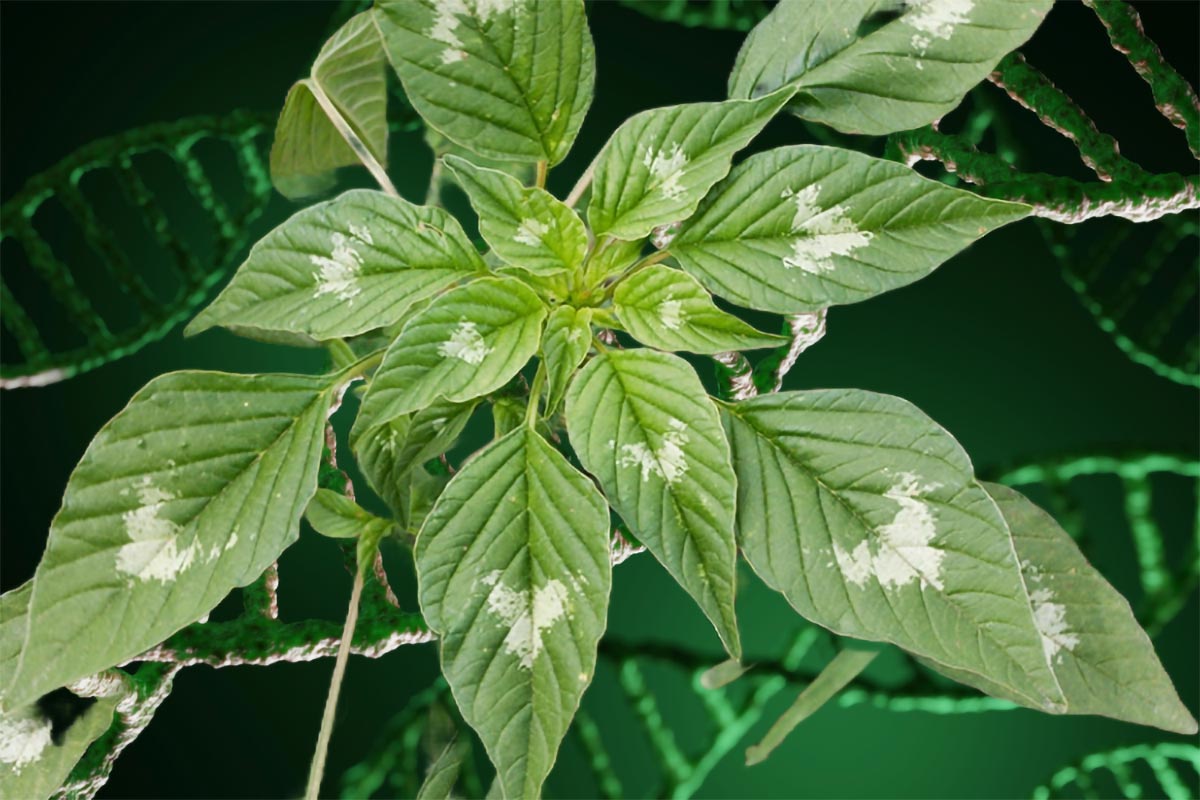
Researchers have sequenced the genomes of Palmer amaranth and other pigweed species, uncovering key mechanisms behind herbicide resistance and paving the way for new control strategies through genetic and genomic research.
Palmer amaranth and other weeds make farming more challenging and less profitable, and existing herbicides are becoming less effective. To develop better solutions, scientists first need a deep understanding of these weeds.
A new study from the University of Illinois Urbana-Champaign and partner institutions provides complete chromosome-level genomes for Palmer amaranth, smooth pigweed, and redroot pigweed. This breakthrough significantly enhances researchers’ knowledge of these weeds’ biology, including how they resist and detoxify common herbicides.
“Having these reference genomes greatly speeds our ability to investigate weeds with multiple herbicide resistance and gets us closer to novel control strategies,” said study co-author Pat Tranel, professor in the Department of Crop Sciences, part of the College of Agricultural, Consumer and Environmental Sciences at Illinois.
Along with making the genomes available, the study digs into important gene families, such as cytochrome P450s. Because these weeds have hundreds of similar P450 genes, it has been difficult to understand which ones play an important role in non-target-site resistance by detoxifying herbicides before they can cause damage. Tranel says non-target-site resistance has long been seen as a black box, but the new genomes are starting to reveal what’s inside.
“Now that we have a catalog of the P450 genes, we can systematically figure out which ones confer resistance to which herbicides,” he said. “That way we can determine which herbicides are detoxified by the same non-target-site resistance mechanism and avoid tank-mixing those products.”
The Evolution of Glyphosate Resistance
The study focused extra attention on Palmer amaranth, arguably the most troublesome of the three species. To start, the research team characterized Palmer’s glyphosate resistance gene, which occurs in a large circular segment of DNA that exists outside of any chromosome. Although glyphosate resistance had been linked to this odd structure previously, the study provided new insights into how it originated.
“The evolutionary story is that this gene got inserted into a circle at one time and then that circle expanded across the globe. That one evolutionary event is responsible for all the resistance we’re finding in Palmer across nearly every continent,” said study co-author Jake Montgomery, now a postdoctoral researcher at the University of Chicago after earning graduate degrees at Illinois and Colorado State University. “Our study supports this conclusion, by using the reference genome and new sequence from Palmer amaranth populations from North and South America to show the nearly complete conservation of the sequence of the circle.”
Next, the researchers honed in on genes related to sex determination in Palmer, a line of inquiry Tranel’s group has been working on for some time. His goal is to develop modified male plants containing a gene drive, a segment of DNA coding for maleness, which would be passed on to its offspring, and on through all future generations. Ultimately, all plants in a given population would become male, reproduction would cease, and populations would crash.
“In the current study, we identified two genes that appear to control maleness on chromosome 3 in Palmer,” said lead study author Damilola Alex Raiyemo, who completed his doctoral work with Tranel. “We still need to validate these genes, but this is an important step forward.”
A Landmark Study for the International Weed Genomics Consortium
Notably, the study also represents the first genomes published by the International Weed Genomics Consortium, an organization comprised of academic institutions and industry partners that generates reference genomes of weed species to facilitate research. The IWGC makes those reference genomes freely available, removing barriers and speeding up the pace of discovery about important weeds.
“Before the IWGC, researchers would apply to grant agencies with ideas about mapping important traits, like new types of herbicide resistance. To do that, you first need a reference genome,” said study co-author Todd Gaines, professor at Colorado State University and executive committee member at IWGC. “But there aren’t that many weed genomicists and few who can do that kind of work within the timeframe of a typical grant cycle. So those grants would go nowhere. With these resources, researchers can jump on their ideas almost immediately.”
As an example, Tranel’s group recently used the reference genome of another troublesome amaranth — waterhemp — to identify regions associated with resistance to the herbicides 2,4-D and dicamba.
“Waterhemp is an economically impactful agronomic weed in the Midwest that has evolved resistance to herbicides from seven sites of action,” said that study’s lead author, Isabel Werle, doctoral student in crop sciences at Illinois. “We were able to identify eight genomic regions associated with resistance to 2,4-D and dicamba, different products with the same mode of action. Surprisingly, we found very little overlap among the eight regions controlling resistance to the two products, suggesting waterhemp is using multiple strategies to avoid damage.”
As more scientists access these genomic resources, Tranel and his colleagues believe the pace of discovery — and actionable solutions in the hands of farmers — can only increase.
References:
“Chromosome-level assemblies of Amaranthus palmeri, Amaranthus retroflexus, and Amaranthus hybridus allow for genomic comparisons and identification of a sex-determining region” by Damilola A. Raiyemo, Jacob S. Montgomery, Luan Cutti, Fatemeh Abdollahi, Victor Llaca, Kevin Fengler, Alexander J. Lopez, Sarah Morran, Christopher A. Saski, David R. Nelson, Eric L. Patterson, Todd A. Gaines and Patrick J. Tranel, 24 February 2025, The Plant Journal.
DOI: 10.1111/tpj.70027
“Different nontarget-site mechanisms underlie resistance to dicamba and 2,4-D in an Amaranthus tuberculatus population” by Isabel Schlegel Werle, Lucas Kopecky Bobadilla, Damilola A Raiyemo, Alexander J Lopez, Filipi Mesquita Machado and Patrick J Tranel, 18 February 2025, Pest Management Science.
DOI: 10.1002/ps.8712
The genome paper was supported by the International Weed Genomics Consortium with funding from the Foundation for Food & Agriculture Research, Bayer AG, Corteva Agriscience, Syngenta Ltd, BASF SE, and CropLife International (Global Herbicide Resistance Action Committee). Funding was also provided by the USDA National Institute of Food and Agriculture.
The waterhemp paper was partially supported by the USDA National Institute of Food and Agriculture.
Never miss a breakthrough: Join the SciTechDaily newsletter.
Follow us on Google and Google News.