
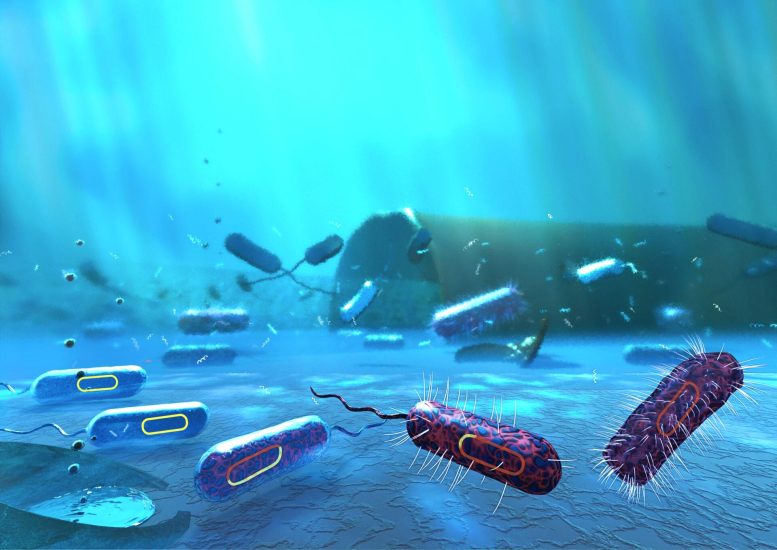
A complex interplay of factors influences the spread of superbug genes during wastewater treatment and reuse.
The combination of chemical and physical stressors that bacteria face during wastewater treatment can impact the transfer of genes between them. But while certain combinations of stressors significantly increase the gene-transfer rate, other combinations reduce it, KAUST researchers have discovered. The finding could inform best practice design and management of wastewater treatment for reuse.
Globally, many regions are considering treated wastewater as a potentially invaluable freshwater source. “As part of the Saudi Vision 2030, water reuse and treatment rates need to be increased,” says Bothayna Al-Gashgari, a Ph.D. student in Peiying Hong’s group, who led the research. “Facilitating safe treatment and reuse is crucial,” she says.
Natural Uptake of eDNA by Bacteria
Bacteria can naturally take up extracellular DNA (eDNA) from their surroundings and integrate the functional genes it contains into their genome. Treated wastewater can contain bacteria and eDNA at relatively high concentration. It can also expose bacteria to stressors known to enhance eDNA uptake and integration, including UV light, disinfection chemical byproducts and pharmaceuticals.
“Several studies have highlighted the potential impact of individual stressors in chlorinated wastewater on bacterial horizontal gene transfer,” Al-Gashgari says. But in a real wastewater environment, multiple stressors co-exist. “Our aim was to understand the effects of these factors in combination,” she says.
Unexpected Results of Stressor Combinations
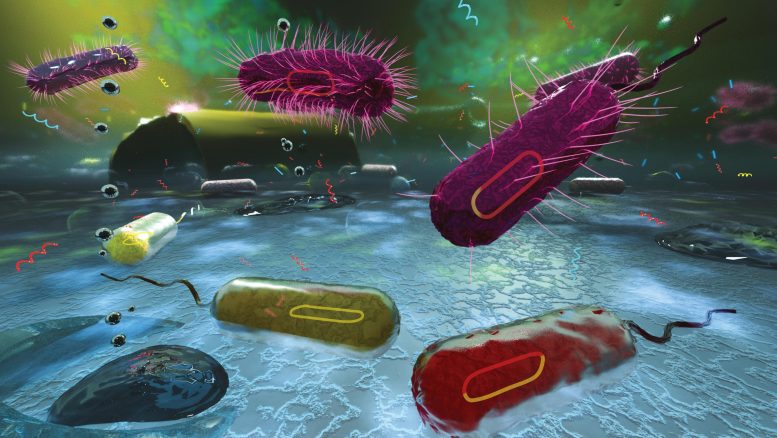
The researchers hypothesized that multiple stressors would have an additive effect on the gene-transfer rate. Surprisingly, a far more complex picture emerged, Hong says.
Depending on their modes of action, some combinations produced a synergistic large increase in gene-transfer rate, some had a neutral effect, while others decreased it.
“For example, when a stressor that can increase bacterial cell wall permeability, such as the pharmaceutical carbamazepine, was combined sequentially with a stressor that causes DNA damage, like solar irradiation, the two stressors had a synergistic effect,” Al-Gashgari says. “We also established that if one stressor interacts detrimentally and directly with the eDNA — such as chloroform — it can impede integration of DNA into the bacterial genome and result in an antagonistic effect.”
This complexity makes the combinatorial effect of multiple stressors difficult to predict, complicating the ability to assess whether unintentional consequences can arise in the downstream reuse environment, says Hong. However, the findings show clear conclusions on wastewater treatment, she says.
Recommendations for Wastewater Treatment
The key goal should be to keep the bacteria and eDNA in wastewater at such low concentrations that gene transfer is minimized.
“We argue that, rather than sand filtration, wastewater treatment facilities should retrofit microfiltration membranes because they can remove both bacteria and extracellular DNA to levels that would not facilitate natural transformation,” Hong says. “Installing and operating membrane microfiltration would be more expensive than sand filtration, but we urge utilities to take this precautionary approach.”
Reference: “Impact of chemicals and physical stressors on horizontal gene transfer via natural transformation” by Bothayna Al-Gashgari, David Mantilla-Calderon, Tiannyu Wang, Maria de los Angeles Gomez, Fras Baasher, Daniele Daffonchio, Taous-Meriem Laleg-Kirati and Pei-Ying Hong, 13 July 2023, Nature Water.
DOI: 10.1038/s44221-023-00110-8
Never miss a breakthrough: Join the SciTechDaily newsletter.
Follow us on Google and Google News.
1 Comment
Amcor Sorbe from AmCorCo Corporation, USA is an USDA CERTIFIED BIOPREFERRED ABSORBENT PRODUCT and an EPA BIOBASED ALTERNATIVE ABSORBENT PRODUCT that eliminates dangerous combustible fumes, that can be used on WASTEWATER cleansing and released back into the water or agriculture. Environmentally safe.
Meeting and exceeding Americas EO 13101.