

Close Menu
    Facebook X (Twitter) Instagram
    SciTechDaily
    • Biology
    • Chemistry
    • Earth
    • Health
    • Physics
    • Science
    • Space
    • Technology
    Facebook X (Twitter) Pinterest YouTube RSS
    SciTechDaily
    Home»Biology»Genetic Welding: Unleashing Evolution’s Future or Playing With Ethical Fire?
    Biology

    Genetic Welding: Unleashing Evolution’s Future or Playing With Ethical Fire?

    By Cell PressMarch 28, 2023No Comments4 Mins Read
    Facebook Twitter Pinterest Telegram LinkedIn WhatsApp Email Reddit
    Share
    Facebook Twitter LinkedIn Pinterest Telegram Email Reddit
    DNA Genetic Editing Concept
    In a new opinion paper published in Trends in Genetics, evolutionary geneticist Asher Cutter highlights the ethical and scientific considerations surrounding “genetic welding,” the use of CRISPR-Cas9 technology to alter the evolutionary course of organisms by inserting easily-spread genes. Cutter emphasizes the need to examine the potential long-term consequences of genetic welding on natural populations spanning hundreds or thousands of generations before implementing it in practice.

    CRISPR-driven genetic welding alters populations rapidly but raises ethical and long-term concerns.

    With CRISPR-Cas9 technology, humans can now rapidly change the evolutionary course of animals or plants by inserting genes that can easily spread through entire populations. Evolutionary geneticist Asher Cutter proposes that we call this evolutionary meddling “genetic welding.” In an opinion paper published today (March 28) in the journal Trends in Genetics, he argues that we must scientifically and ethically scrutinize the potential consequences of genetic welding before we put it into practice.

    “The capability to do genetic welding has only taken off in the last few years, and much of the thinking about it has focused on what can happen in the near term,” says Cutter of the University of Toronto. “Ethically, before humans apply this to natural populations, we need to start thinking about what the longer-term consequences might be on a time scale of hundreds or thousands of generations.”

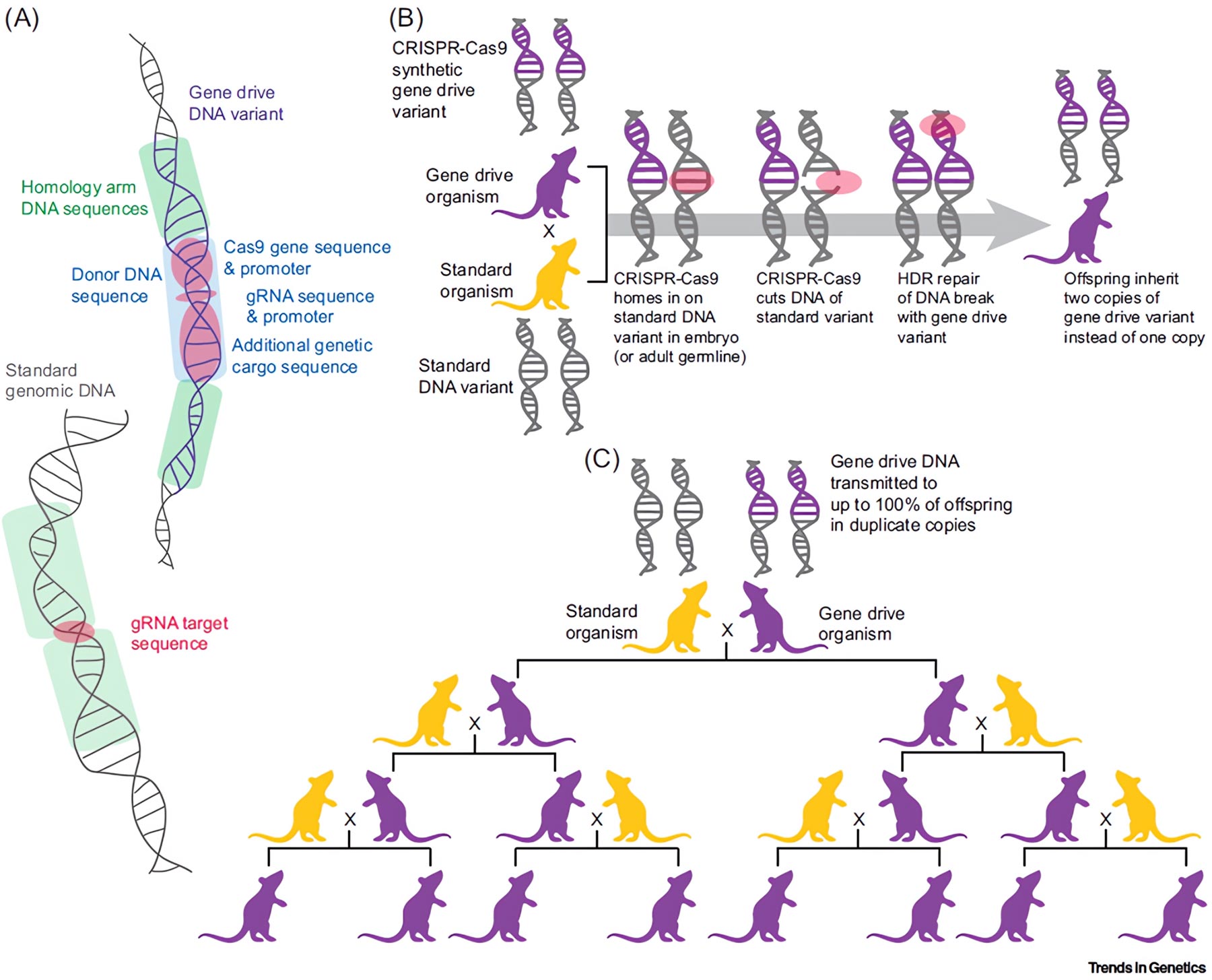
    In classical Mendelian genetics, we think about genes having a 50:50 chance of getting passed from parent to offspring, but this isn’t always the case. In a natural phenomenon known as “genetic drive,” some genes are able to bias their own transmission so that they are much more likely to be inherited.
    Gene Drive Transmission Is Non-Mendelian
    This is a figure explaining that gene drive transmission is non-Mendelian. Credit: Cutter, 2023

    Genetic welding is the human-mediated version of this: introducing genes that have an unfair advantage when it comes to heritability into natural populations. Because these genes spread easily and rapidly through populations, they result in much faster evolutionary change than the usual slow plod that we see from natural and artificial selection. Also, in contrast to natural selection, genetic drives and genetic welding can perpetuate genes that don’t necessarily benefit the organisms that carry them, making them an attractive potential method to control problematic/invasive/disease-bearing species.

    Applications and Ethical Dilemmas of Genetic Welding

    Genetic welding in this way has been proposed as a tool for controlling disease-bearing mosquito populations and invasive species. It could also be used to genetically engineer endangered species to be resistant to infectious pathogens that threaten them with extinction. “It raises the question of how much should humans intervene into processes that are normally beyond our control,” says Cutter. 

    “If ethicists, medical practitioners, and politicians decide that it is acceptable in some cases to edit the germ line of humans, then that would open the possibility that genetic welding could be used as a tool in that regard,” says Cutter. “This would open a much bigger can of worms by virtue of the fact that genetic welding could change the entirety of a population or species, not just a few individuals that elected to have a procedure.”

    Though it might be difficult to experimentally assess the long-term implications of genetic welding, Cutter says that thought experiments, mathematical theory, computer simulations, and conversations with bioethicists could all play important roles, as could experiments in organisms with short lifespans and rapid reproduction.

    Reference: “Synthetic gene drives as an anthropogenic evolutionary force” by Asher D. Cutter, 28 March 2023, Trends in Genetics.
    DOI: 10.1016/j.tig.2023.02.01

    This research was supported by the Natural Sciences and Engineering Research Council of Canada.

    Never miss a breakthrough: Join the SciTechDaily newsletter.
    Follow us on Google and Google News.

    Cell Press CRISPR Evolutionary Biology Genetics
    Share. Facebook Twitter Pinterest LinkedIn Email Reddit

    Related Articles

    CRISPR Gene Editing Now Possible in Cockroaches

    Forget Mammoths – These Scientists Are Working To Resurrect the Extinct Christmas Island Rat Through DNA Editing

    Researchers Engineer a Mini CRISPR Genetic Editing System That Could Be Easier To Deliver Into Cells

    Harvard Study Identifies Genetic ‘Switches’ That Affect Height

    Study Finds “Rare” Genetic Variants Aren’t So Rare

    Evolutionary Changes Surrounding the NOS1 Gene

    Rare Example of Bacterial Gene Transfer Providing Evolutionary Benefit

    Human Y-Chromosome Has Enough Genes to Stay for Millions of Years

    Researchers Complete Genome Sequence of a Denisovan Human Finger Bone

    Leave A Reply Cancel Reply

    • Facebook
    • Twitter
    • Pinterest
    • YouTube

    Don't Miss a Discovery

    Subscribe for the Latest in Science & Tech!

    Trending News

    Scientists Uncover Potential Brain Risks of Popular Fish Oil Supplements

    Scientists Discover a Surprising Way To Make Bread Healthier and More Nutritious

    After 60 Years, Scientists Uncover Unexpected Brain Effects of Popular Diabetes Drug Metformin

    New Research Uncovers Hidden Side Effects of Popular Weight-Loss Drugs

    Scientists Rethink Extreme Warming After Surprising Ocean Discovery

    Landmark Study Links Never Marrying to Significantly Higher Cancer Risk

    Researchers Discover Unknown Beetle Species Just Steps From Their Lab

    Largest-Ever Study Finds Medicinal Cannabis Ineffective for Anxiety, Depression, PTSD

    Follow SciTechDaily
    • Facebook
    • Twitter
    • YouTube
    • Pinterest
    • Newsletter
    • RSS
    SciTech News
    • Biology News
    • Chemistry News
    • Earth News
    • Health News
    • Physics News
    • Science News
    • Space News
    • Technology News
    Recent Posts
    • Not Just Alzheimer’s: Scientists Uncover Clues to a Second, Overlooked Disorder
    • Scientists Uncover Dangerous Connection Between Serotonin and Heart Valve Disease
    • Scientists Discover a “Protector” Protein That Could Help Reverse Hair Loss
    • Powerful Lasers Reveal How Matter Becomes Plasma in Trillionths of a Second
    • A Simpler Path to Super-Resolution: Scientists Reinvent Microscopy
    Copyright © 1998 - 2026 SciTechDaily. All Rights Reserved.
    • Science News
    • About
    • Contact
    • Editorial Board
    • Privacy Policy
    • Terms of Use

    Type above and press Enter to search. Press Esc to cancel.