
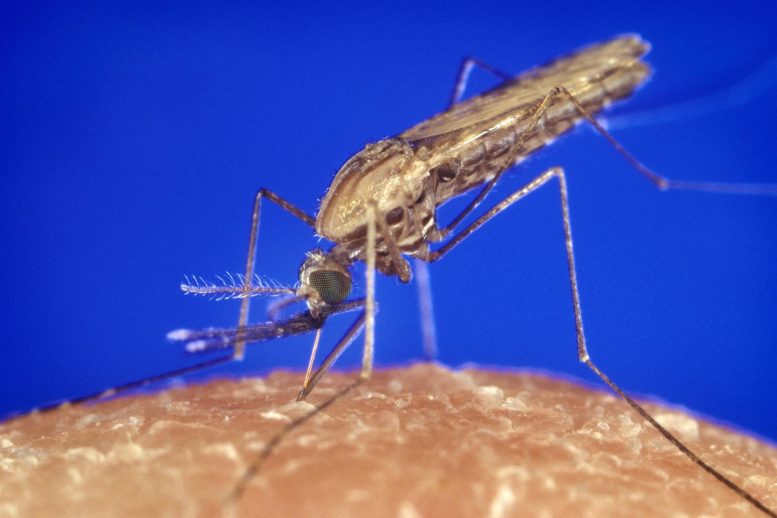
Genetically modifying mosquitoes to express antimalarial genes and pass them on to their offspring is being tested as a new strategy to eliminate malaria.
Altering a mosquito’s gut genes to make them spread antimalarial genes to the next generation of their species shows promise as an approach to curb malaria, suggests a preliminary study published today (April 13, 2021) in eLife.
The study is the latest in a series of steps toward using CRISPR-Cas9 gene-editing technology to make changes in mosquito genes that could reduce their ability to spread malaria. If further studies support this approach, it could provide a new way to reduce illnesses and deaths caused by malaria.
Growing mosquito resistance to pesticides, as well as malaria parasite resistance to antimalarial drugs, has created an urgent need for new ways to fight the disease. Gene drives are being tested as a new approach. They work by creating genetically modified mosquitoes that, when released into the environment, would spread genes that either reduce mosquito populations or make the insects less likely to spread the malaria parasite. But scientists must prove that this approach is safe and effective before releasing genetically modified mosquitoes into the wild.
“Gene drives are promising tools for malaria control,” says first author Astrid Hoermann, Research Associate at Imperial College London, UK. “But we wanted a clear pathway for safely testing such tools in countries where the disease most commonly occurs.”
Engineering Mosquitoes to Pass on Antimalarial Traits
In the study, Hoermann and colleagues genetically modified the malaria-transmitting mosquito Anopheles gambiae. They used the CRISPR-Cas9 technology to insert a gene that encodes an antimalarial protein amidst genes that are turned on after the mosquito eats a blood meal. The team did this in a manner that allowed the whole section of DNA to also function as a gene drive that could be passed on to most of the mosquitoes’ offspring. They initially inserted the gene along with a fluorescent marker to help them track it in three different spots in the DNA, and then later removed the marker, leaving only a minor genetic modification behind.
Next, the team bred the mosquitoes to see if they were able to successfully reproduce and remain healthy. They also tested how well the malaria parasite developed in the mosquitoes’ guts. Their experiments provide preliminary evidence that this approach to genetic modifications could create successful gene drives.
“These genetic modifications are passive, and could be tested in the field and undergo a stringent regulatory process to ensure they are safe and effective in blocking the parasite without raising concerns of accidental spread in the environment,” explains senior author Nikolai Windbichler, Senior Lecturer at the Department of Life Sciences, Imperial College London. “However, once we combine them with other mosquitoes with an active gene drive, they turn into gene drives themselves without the need for any further changes. Our approach thus brings gene drives one step closer to being tested in the field as a malaria elimination strategy.”
Reference: “Converting endogenous genes of the malaria mosquito into simple non-autonomous gene drives for population replacement” by Astrid Hoermann, Sofia Tapanelli, Paolo Capriotti, Giuseppe Del Corsano, Ellen KG Masters, Tibebu Habtewold, George K Christophides and Nikolai Windbichler, 13 April 2021, eLife.
DOI: 10.7554/eLife.58791
Funding: Bill and Melinda Gates Foundation
Never miss a breakthrough: Join the SciTechDaily newsletter.
Follow us on Google and Google News.
2 Comments
Can we genetically modify them to not be @ssholes?
BIO WEAPONS COME TO MIND WHEN I THINK OF MAN CREATING THE MOST DEADLY FLYING INSECT THAT THERE IS. MAN RELEASED 1 BILLION IN FLORIDA AND IN TEXAS IN 2018 IT KILLED PEOPLE MADE PEOPLE SICK AND PEOPLE SUFFER FROM PERMANENT SEIZURES.BIOTECH AND BILL GATES ARE RESPONSIBLE