
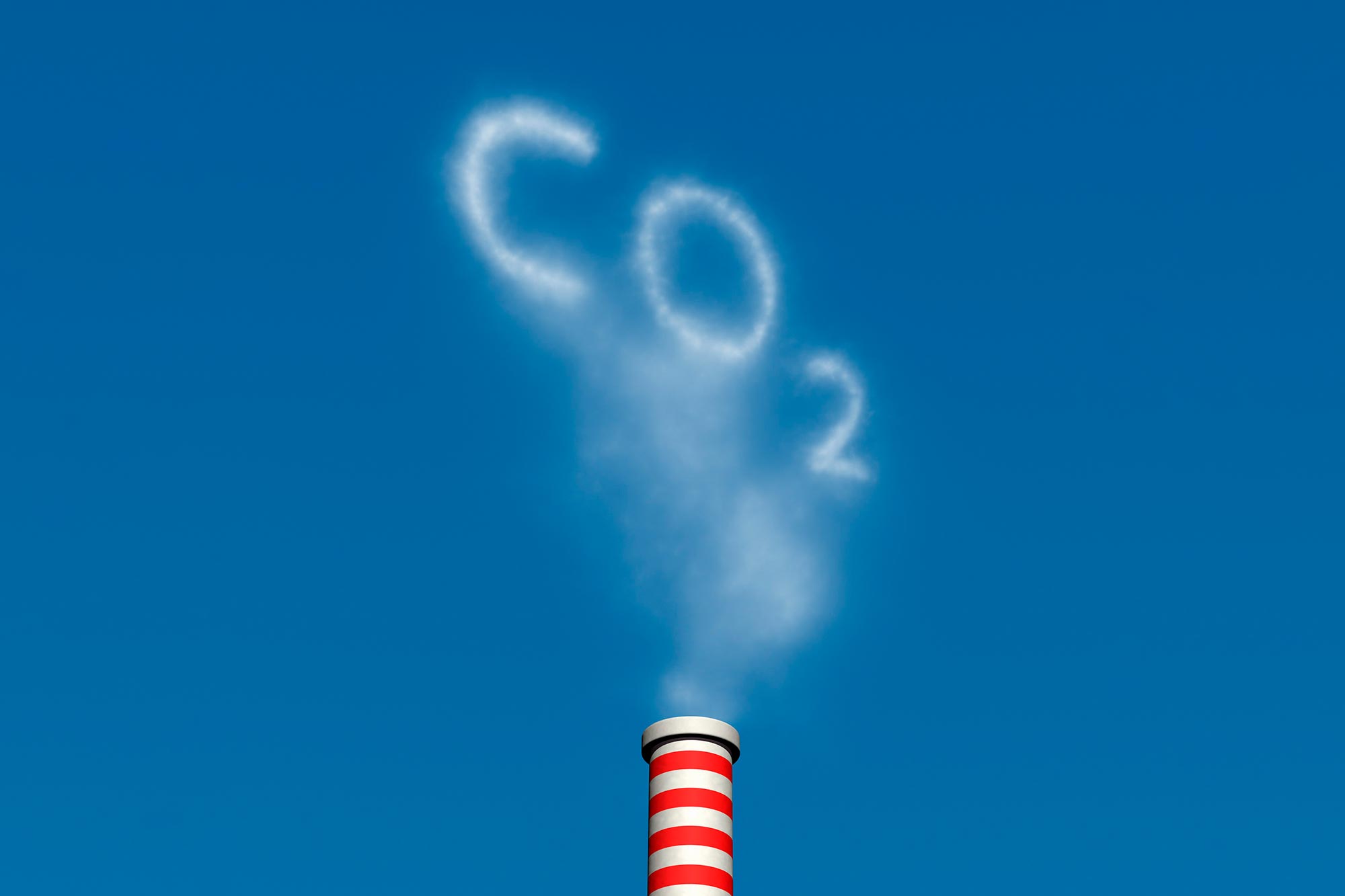
Global carbon emissions hit a new high in 2024, with scientists urging swift action to avoid breaching the 1.5°C warming target.
According to new research by the Global Carbon Project science team, global carbon emissions from fossil fuels have hit a record high in 2024.
The 2024 Global Carbon Budget projects fossil carbon dioxide (CO2) emissions of 37.4 billion tons, up 0.8% from 2023.
Despite the urgent need to cut emissions to slow climate change, the researchers say there is still “no sign” that the world has reached a peak in fossil CO2 emissions.
With projected emissions from land-use change (such as deforestation) of 4.2 billion tons, total CO2 emissions are projected to be 41.6 billion tons in 2024, up from 40.6 billion tons last year.
Over the last 10 years, fossil CO2 emissions have risen while land-use change CO2 emissions have declined on average – leaving overall emissions roughly level over that period.
This year, both fossil and land-use change CO2 emissions are set to rise, with drought conditions exacerbating emissions from deforestation and forest degradation fires during the El Niño climate event of 2023-2024.
With over 40 billion tons released each year at present, the level of CO2 in the atmosphere continues to rise – driving increasingly dangerous global warming.
The research team included the University of Exeter, the University of East Anglia (UEA), CICERO Center for International Climate Research, Ludwig-Maximilian-University Munich, Alfred-Wegener-Institut and 80 other institutions around the world.
Global Leaders Urged to Take Action
“The impacts of climate change are becoming increasingly dramatic, yet we still see no sign that burning of fossil fuels has peaked,” said Professor Pierre Friedlingstein, of Exeter’s Global Systems Institute, who led the study.
“Time is running out to meet the Paris Agreement goals – and world leaders meeting at COP29 must bring about rapid and deep cuts to fossil fuel emissions to give us a chance of staying well below 2°C warming above pre-industrial levels.”
Professor Corinne Le Quéré, Royal Society Research Professor at UEA’s School of Environmental Sciences, said: “Despite another rise in global emissions this year, the latest data shows evidence of widespread climate action, with the growing penetration of renewables and electric cars displacing fossil fuels, and decreasing deforestation emissions in the past decades confirmed for the first time.”
Dr. Glen Peters, of the CICERO Center for International Climate Research in Oslo, said: “There are many signs of positive progress at the country level, and a feeling that a peak in global fossil CO2 emissions is imminent, but the global peak remains elusive.
“Climate action is a collective problem, and while gradual emission reductions are occurring in some countries, increases continue in others.
“Progress in all countries needs to accelerate fast enough to put global emissions on a downward trajectory towards net zero.”
Professor Friedlingstein added: “Until we reach net zero CO2 emissions globally, world temperatures will continue to rise and cause increasingly severe impacts.”
Other key findings from the 2024 Global Carbon Budget include:
- Globally, emissions from different fossil fuels in 2024 are projected to increase: coal (0.2%), oil (0.9%), gas (2.4%). These contribute 41%, 32%, and 21% of global fossil CO2 emissions respectively. Given the uncertainty in the projections, it remains possible that coal emissions could decline in 2024.
- China’s emissions (32% of the global total) are projected to marginally increase by 0.2%, although the projected range includes a possible decrease in emissions.
- US emissions (13% of the global total) are projected to decrease by 0.6%.
- India’s emissions (8% of the global total) are projected to increase by 4.6%.
- European Union emissions (7% of the global total) are projected to decrease by 3.8%.
- Emissions in the rest of the world (38% of the global total) are projected to increase by 1.1%.
- International aviation and shipping (3% of the global total, and counted separately from national/regional totals) are projected to increase by 7.8% in 2024, but remain below their 2019 pre-pandemic level by 3.5%.
- Globally, emissions from land-use change (such as deforestation) have decreased by 20% in the past decade, but are set to rise in 2024.
- Permanent CO2 removal through reforestation and afforestation (new forests) is offsetting about half of the permanent deforestation emissions.
- Current levels of technology-based Carbon Dioxide Removal (excluding nature-based means such as reforestation) only account for about one millionth of the CO2 emitted from fossil fuels.
- Atmospheric CO2 levels are set to reach 422.5 parts per million in 2024, 2.8 parts per million above 2023, and 52% above pre-industrial levels.
- The effects of the temporary El Niño climate event also led to a reduction in carbon absorption by ecosystems on land (known as the land CO2 “sink”) in 2023, which is projected to recover as El Niño ended by the second quarter of 2024.
- Emissions from fires in 2024 have been above the average since the beginning of the satellite record in 2003, particularly due to the extreme 2023 wildfire season in Canada (which persisted in 2024) and intense drought in Brazil.
- The land and ocean CO2 sinks combined continued to take up around half of the total CO2 emissions, despite being negatively impacted by climate change.
How long until we pass 1.5°C of global warming?
This study estimates the remaining “carbon budget” before the 1.5°C target is breached consistently over multiple years, not just for a single year. At the current rate of emissions, the Global Carbon Budget team estimates a 50% chance global warming will exceed 1.5°C consistently in about six years. This estimate is subject to large uncertainties, primarily due to the uncertainty of the additional warming coming from non-CO2 agents (e.g., CH4, N2O, aerosols). However, it’s clear that the remaining carbon budget – and therefore the time left to meet the 1.5°C target and avoid the worst impacts of climate change – has almost run out.
Reference: “Global Carbon Budget 2024” by Pierre Friedlingstein, Michael O’Sullivan, Matthew W. Jones, Robbie M. Andrew, Judith Hauck, Peter Landschützer, Corinne Le Quéré, Hongmei Li, Ingrid T. Luijkx, Are Olsen, Glen P. Peters, Wouter Peters, Julia Pongratz, Clemens Schwingshackl, Stephen Sitch, Josep G. Canadell, Philippe Ciais, Robert B. Jackson, Simone R. Alin, Almut Arneth, Vivek Arora, Nicholas R. Bates, Meike Becker, Nicolas Bellouin, Carla F. Berghoff, Henry C. Bittig, Laurent Bopp, Patricia Cadule, Katie Campbell, Matthew A. Chamberlain, Naveen Chandra, Frédéric Chevallier, Louise P. Chini, Thomas Colligan, Jeanne Decayeux, Laique Djeutchouang, Xinyu Dou, Carolina Duran Rojas, Kazutaka Enyo, Wiley Evans, Amanda Fay, Richard A. Feely, Daniel J. Ford, Adrianna Foster, Thomas Gasser, Marion Gehlen, Thanos Gkritzalis, Giacomo Grassi, Luke Gregor, Nicolas Gruber, Özgür Gürses, Ian Harris, Matthew Hefner, Jens Heinke, George C. Hurtt, Yosuke Iida, Tatiana Ilyina, Andrew R. Jacobson, Atul Jain, Tereza Jarníková, Annika Jersild, Fei Jiang, Zhe Jin, Etsushi Kato, Ralph F. Keeling, Kees Klein Goldewijk, Jürgen Knauer, Jan Ivar Korsbakken, Siv K. Lauvset, Nathalie Lefèvre, Zhu Liu, Junjie Liu, Lei Ma, Shamil Maksyutov, Gregg Marland, Nicolas Mayot, Patrick McGuire, Nicolas Metzl, Natalie M. Monacci, Eric J. Morgan, Shin-Ichiro Nakaoka, Craig Neill, Yosuke Niwa, Tobias Nützel, Lea Olivier, Tsuneo Ono, Paul I. Palmer, Denis Pierrot, Zhangcai Qin, Laure Resplandy, Alizée Roobaert, Thais M. Rosan, Christian Rödenbeck, Jörg Schwinger, T. Luke Smallman, Stephen Smith, Reinel Sospedra-Alfonso, Tobias Steinhoff, Qing Sun, Adrienne J. Sutton, Roland Séférian, Shintaro Takao, Hiroaki Tatebe, Hanqin Tian, Bronte Tilbrook, Olivier Torres, Etienne Tourigny, Hiroyuki Tsujino, Francesco Tubiello, Guido van der Werf, Rik Wanninkhof, Xuhui Wang, Dongxu Yang, Xiaojuan Yang, Zhen Yu, Wenping Yuan, Xu Yue, Sönke Zaehle, Ning Zeng and Jiye Zeng, 13 November 2024, Earth System Science Data.
DOI: 10.5194/essd-2024-519
The Global Carbon Budget report, produced by an international team of more than 120 scientists, provides an annual, peer-reviewed update, building on established methodologies in a fully transparent manner. The 2024 edition (the 19th annual report) will be published in the journal Earth System Science Data on November 13 as a pre-print, and later as a peer-reviewed paper.
The report will be published at COP29 in Baku, Azerbaijan. A UN press conference will be held from 10:30-11am Azerbaijan time on 13 November, in Press Conference 2 (Natavan), Area C, Blue Zone. The official UN launch event for the 2024 Global Carbon Budget will take place on 14 November, from 3-4.30pm Azerbaijan time in Side Event 5 in the Blue Zone.
Never miss a breakthrough: Join the SciTechDaily newsletter.
Follow us on Google and Google News.
12 Comments
hello
Attention communist c*nt climate cult clowns: CARBON IS NOT A POLLUTANT. CARBON IS NOT A POLLUTANT. CARBON IS NOT A POLLUTANT. CARBON IS NOT A POLLUTANT. CARBON IS NOT A POLLUTANT. CARBON IS NOT A POLLUTANT. CARBON IS NOT A POLLUTANT. CARBON IS NOT A POLLUTANT. CARBON IS NOT A POLLUTANT. CARBON IS NOT A POLLUTANT. CARBON IS NOT A POLLUTANT. CARBON IS NOT A POLLUTANT. CARBON IS NOT A POLLUTANT. CARBON IS NOT A POLLUTANT. CARBON IS NOT A POLLUTANT. CARBON IS NOT A POLLUTANT. CARBON IS NOT A POLLUTANT. CARBON IS NOT A POLLUTANT. CARBON IS NOT A POLLUTANT. CARBON IS NOT A POLLUTANT. CARBON IS NOT A POLLUTANT. CARBON IS NOT A POLLUTANT. CARBON IS NOT A POLLUTANT. CARBON IS NOT A POLLUTANT. CARBON.
FOR ONE BILLION YEARS, the ENTIRE PLANET WAS COMPLETELY COVERED WITH VOLCANO AND MAGMA. OBJECTIVELY, WORSE THAN COWS. Yet, somehow we are here..with out greta or al or communism or kyoto or pair.
“…, the level of CO2 in the atmosphere continues to rise – driving increasingly dangerous global warming.”
Considering that COP29 is going on at the moment, I’d be surprised to NOT see some claim like this.
However, a question that I have asked, and not received a satisfactory answer for is, “Why was there no decline in the rate of increase or the peak of CO2 during the 2020 seasonal CO2 ramp-up phase, which took place during the COVID shutdowns, when April alone saw a decrease of anthropogenic CO2 emissions of 14-18%?” It argues that the atmospheric concentration is driven by biogenic forces, which are driven by temperature, not the other way around.
For those of you who are stalwart supporters of the religion of Gaia, and consider humans to be a plague upon the Earth, now is your chance to make a compelling argument to support the hypothesis of CO2 driving the warming. That means providing evidence for cause-and-effect that is incontrovertible, not just repeating things said in article like this, which are largely non sequiturs.
MayI recommend that you write directly to one of the numerous co-authors listed in that report? You would possibly receive a more scientific type of answer than through the reply columns hosted by SciTech Daily. As for me, the lockstep fit during the last 80 years between human population growth, increase in atmospheric CO2 and the very similar increase in burning hydrocarbon fuels for energy seems a pretty good argument. However, you prefer it to be coincidence and not correlation. Prove it is coincidental.
April does not constitute a season; proof that the alleged 14-18% drop in April’s output of CO2 is anthropogenic? It merely coinicides with an event in global human behaviour……….
0
No need to prove coincidence. There may indeed be a relation, but the direction of casualty may not be what’s officially propagandized.
Correlation does not establish cause and effect. The timing of two events are more useful in determining causation when there is correlation. Do an online search for “spurious correlation.”
Because taxes are paid on the sale of fossil fuels, and no government wants to leave money on the table, we have a more accurate and precise measure of fossil fuel CO2 than we do of natural sources of CO2. See Fig. 1 at https://wattsupwiththat.com/2022/03/22/anthropogenic-co2-and-the-expected-results-from-eliminating-it/ for the full results of the COVID shutdowns in the Spring of 2020.
“…; proof that the alleged 14-18% drop in April’s output of CO2 is anthropogenic?”
Note that I specified it was a drop of anthro’ CO2, not all CO2.
And a very successful animal is the camel, albeit deemed ugly, both for transport when “broken in” and also when wild…….Horses? Good looking they may be but they lack the desert-capable four-pad drive and water tank of the camel.
Agreed about authorships.
Incidentally, my Rule of Thumb is that the social contribution of a scientific report is inversely proportional to the number of contributors. I have seen papers with more than 120 contributors. However, they led me to formulating my Rule of Thumb.
Be that as it may. Rules of thumb are unscientific, unless one is approximating a measurement in inches, and no doubt one could estimate statistically within a certain calculated accuracy what might be the probable error of such measurements. I have read papers, written by just one author, that are errononeous. One cannot know everything about the topic about which one is writing, but one can explore possibilities even though such explorations prove later to be incorrect. Hence the words “could/might” as used by academics.
You missed that my remark was at least partly ‘tongue in cheek.’ The point really is that a large number of authors does not guarantee that a paper is of higher quality or greater veracity than a paper with one or two authors. Then, there is the old joke about the camel being an animal designed by a committee.
It’s fun seeing all those Western elitist types bending over backwards trying to “do something”, or, more precisely, pretending to give a fvck.
Climate will be fine. We will be fine. This is just a silly show.