

Cobalt sits at the heart of the clean energy transition, but this study suggests its supply chain is far more fragile than it appears.
Cobalt plays a central role in lithium-ion batteries and electric vehicles, but its global supply chain faces growing systemic risks that extend well beyond isolated disruptions. A new study shows that shocks starting in a single country or at one stage of production can spread across borders and life cycle stages, leading to widespread failures throughout the cobalt supply network.
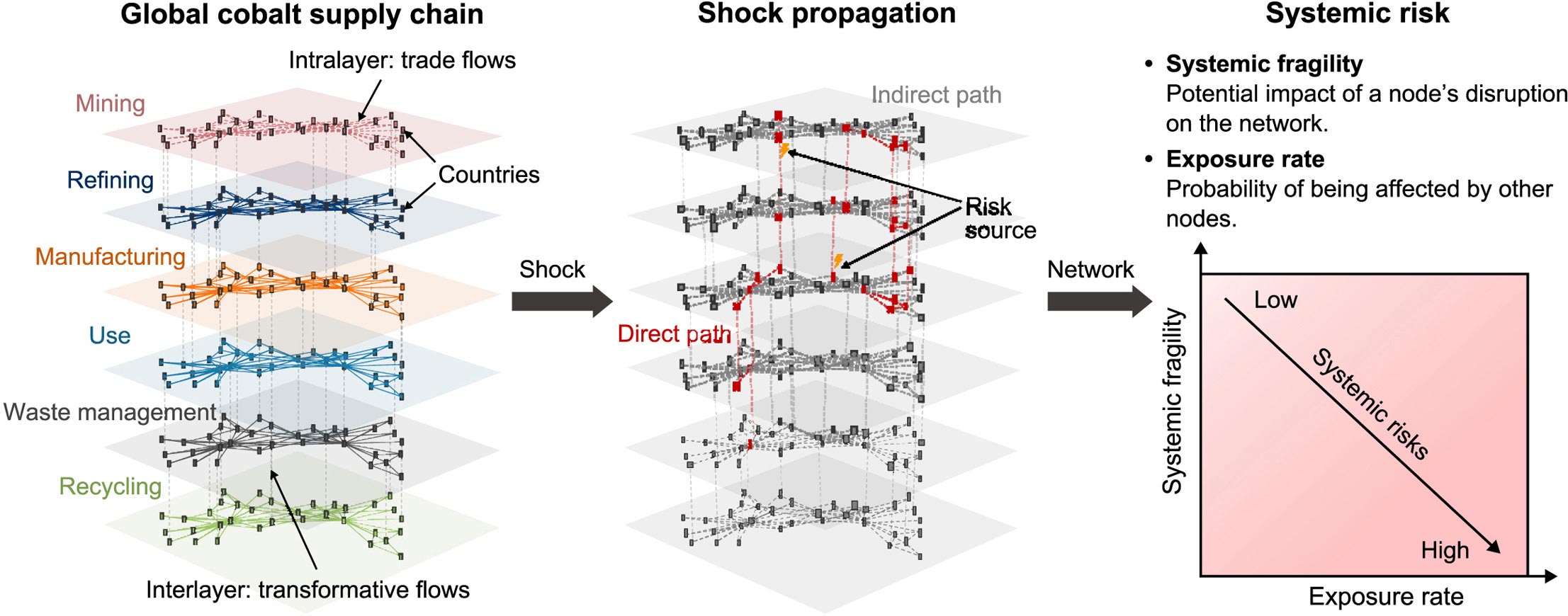
By combining material flow analysis with a multilayer shock propagation model, the researchers found that risks are concentrated in upstream stages but build most intensely at refining and manufacturing bottlenecks.
Shock pathways that move horizontally across countries and vertically across production stages, along with both direct and indirect routes, can extend disruptions, trigger multistage knock-on effects, and lead to sudden nonlinear breakdowns. These findings suggest that traditional country-level risk assessments underestimate the true vulnerability of the cobalt supply system, and that coordinated system-level strategies are needed to improve resilience.
Growing Demand, Growing Complexity
As electric vehicles and energy storage systems expand globally, demand for cobalt has surged. This growth has raised concerns about supply security, geopolitical concentration, and environmental and social impacts.
Conventional approaches to assessing critical minerals often focus on individual countries, materials, or trade flows. This overlooks the tightly linked upstream-downstream relationships that define modern supply chains. Recent events, including export restrictions, trade disputes, and pandemic-related disruptions, have shown that even localized shocks can spread through global production systems.
Current analytical tools still struggle to track how risks move across multiple production stages and economies at the same time. These limitations highlight the need for a more comprehensive, network-based approach to studying cobalt supply risks.
A Global Network Analysis
In a study published in Environmental Science and Ecotechnology, researchers from the Chinese Academy of Sciences, Peking University, and the University of Southern Denmark examined global cobalt flows from 1998 to 2019.
They built a multilayer supply chain network and applied an iterative shock propagation model to analyze how disruptions move across countries and through six life cycle stages, including mining, refining, manufacturing, use, and recycling. The results provide one of the most detailed evaluations of systemic risk in the global cobalt supply chain.
The team mapped a network linking 230 countries across six interconnected production stages, combining trade linked material flow data with a dynamic shock model. This framework allowed them to simulate how supply shortages or demand drops in one part of the system could trigger cascading failures elsewhere.
Their analysis shows that disruptions travel through both direct and indirect pathways, crossing trade links and domestic production chains. While mining disruptions, especially in highly concentrated upstream regions, are common sources of risk, the most severe impacts occur at refining and manufacturing “bridges,” where dense connections amplify failures.
Fragility Hidden Beneath Apparent Stability
The study also found that the resulting “avalanche network” of potential failures is about four times denser than the physical trade network, revealing extensive hidden dependencies. Countries such as China and the United States show high systemic fragility, meaning disruptions in these regions can trigger widespread collapse.
At the same time, some countries with relatively low production but high exposure are especially vulnerable to random disruptions and lack strong response capacity. Overall, global cobalt supply risks have increased over the past two decades, with fluctuations driven by rising concentration and imbalances between supply and demand.
Implications for Policy and the Energy Transition
The researchers describe the cobalt supply chain as having a “robust-yet-fragile” structure. It can absorb small, random disruptions but remains highly sensitive to targeted shocks at critical points. Measures such as national stockpiling or reshoring may reduce risks for individual countries, but they can also shift vulnerabilities elsewhere in the system.
Improving resilience, the authors argue, requires coordinated strategies that account for connections across production stages rather than isolated national actions. Without this broader perspective, efforts to secure critical minerals for the energy transition could unintentionally increase global supply instability.
These findings have important implications for energy policy, critical mineral governance, and industrial planning. By identifying where risks begin, build, and spread, the framework can support early warning systems and strengthen international cooperation. Policymakers can use this approach to develop shared stockpiling strategies, expand refining and manufacturing capacity, and better assess the broader impacts of trade restrictions or decoupling efforts.
The approach could also be applied to other materials essential for batteries and clean energy technologies. The study ultimately suggests that a stable low-carbon transition will depend not only on resource availability, but also on managing the complex global networks that connect them.
Reference: “Systemic risks and cascading dynamics in the global cobalt supply chain” by Xin Ouyang, Litao Liu, Qiance Liu, Wu Chen, Chao Wang, Xun Pang, Canfei He and Gang Liu, 30 December 2025, Environmental Science and Ecotechnology.
DOI: 10.1016/j.ese.2025.100654
This work was financially supported by the National Natural Science Foundation of China (72334001, 42530502, and 52270191) and the Humanities and Social Sciences Fund of the Ministry of Education of China (23JZD018).
Never miss a breakthrough: Join the SciTechDaily newsletter.
Follow us on Google and Google News.