
Close Menu
    Facebook X (Twitter) Instagram
    SciTechDaily
    • Biology
    • Chemistry
    • Earth
    • Health
    • Physics
    • Science
    • Space
    • Technology
    Facebook X (Twitter) Pinterest YouTube RSS
    SciTechDaily
    Home»Earth»Gold Mining in Russia’s Central Aldan Ore District Seen From Space
    Earth

    Gold Mining in Russia’s Central Aldan Ore District Seen From Space

    By Kathryn Hansen, NASA Earth ObservatoryJanuary 30, 2021No Comments3 Mins Read
    Facebook Twitter Pinterest Telegram LinkedIn WhatsApp Email Reddit
    Share
    Facebook Twitter LinkedIn Pinterest Telegram Email Reddit
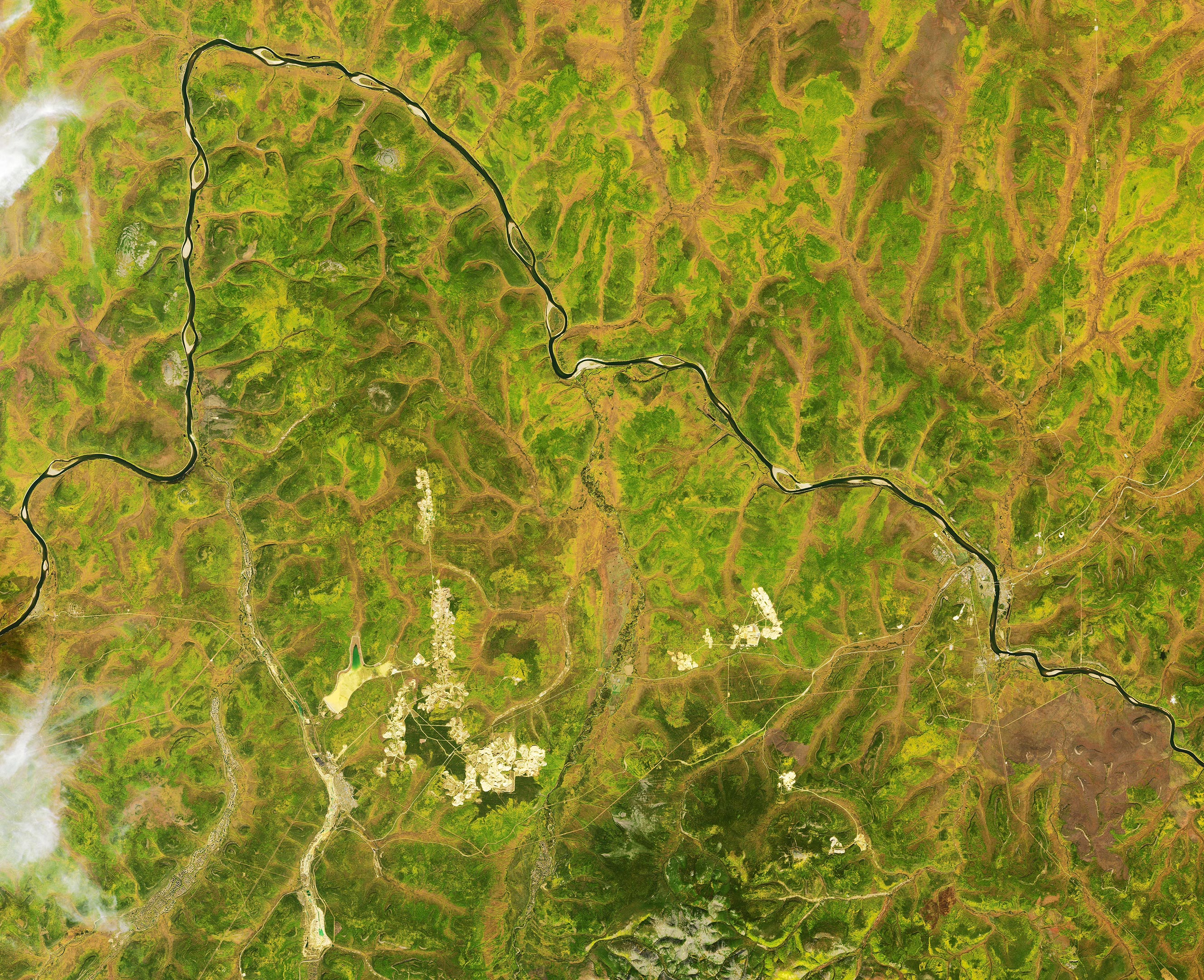
    Russia's Central Aldan Ore District Annotated
    September 11, 2019. (Click image for wider, high-resolution view.)

    In places where concentrations of the precious metal have been discovered, mining operations are large enough to be seen from space.

    Gold has been found on every continent except Antarctica, but the lustrous yellow metal is not exactly ubiquitous. The element (Au on the periodic table) is actually quite rare, accounting for just one out of every billion atoms in Earth’s crust. But in places such as the Central Aldan ore district in the Russian Far East—where concentrations of the precious metal have been discovered—mining operations are large enough to be seen from space.

    On September 11, 2019, the Operational Land Imager (OLI) on Landsat 8 acquired this natural-color image showing part of the ore district in the Republic of Sakha (Yakutia). The image is centered about 25 kilometers (15 miles) northwest of the gold-mining town of Aldan, and about 450 kilometers southwest of the regional capital city, Yakutsk.

    Central Aldan is one of Russia’s largest gold ore districts, with the mineral occurring in numerous deposits, or “lodes,” in the fractured rock. One of the largest lodes lies in the Kuranakh deposit, a shallow, ribbon-like orebody (up to 50 meters thick and 25 kilometers long) sandwiched between Cambrian limestone below and Jurassic sandstone above. A mining site developed to to extract this gold is visible in the detailed image below.
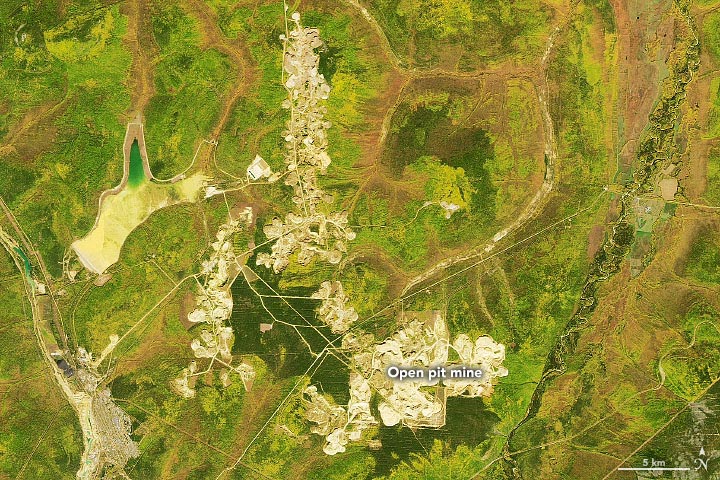
    Russia's Central Aldan Ore District Open Pit Mine
    September 11, 2019

    The Kuranakh gold deposit was discovered in 1947, and a moderate amount of gold was extracted by 1955. Ten years later, large-scale open-pit mining began and continues today. Open-cut, drilling, and blasting techniques are now used to access the ore, which is processed at an onsite mill. In 2019, the Kuranakh mine produced 224,700 ounces of refined gold.
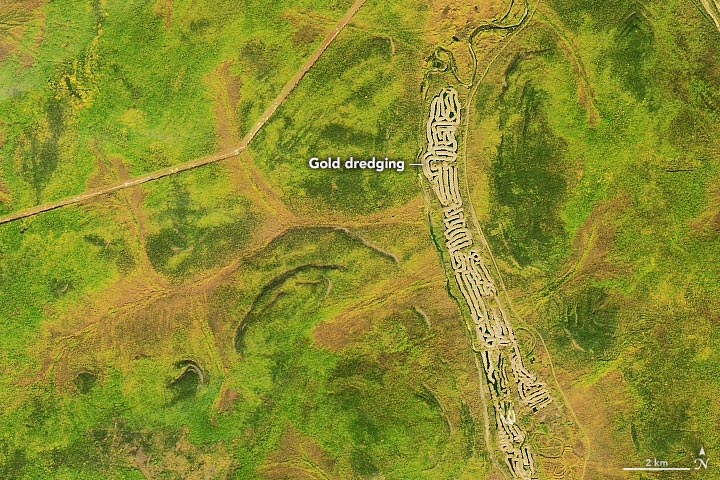
    Russia's Central Aldan Ore District Gold Dredging
    September 11, 2019

    Not all of the region’s gold shows up as lode deposits. In areas where a lode has been eroded, pieces of gold can become concentrated by rivers and streams into placer deposits. The second image, centered west of the town of Nizhny Kuranakh, shows the excavation site of buried placer along a tributary of the Aldan River.

    To excavate the placer, bucket-lined dredges scoop up material in the front and dump the tailings behind in curved piles. The accumulation of arc-shaped piles forms the long, maze like-pattern, which is visible in the image above. From April to December in the 2019 mining season, three dredges extracted 18,600 ounces (530 kilograms) of gold from the Bolshoy Kuranakh placer deposit.

    NASA Earth Observatory images by Joshua Stevens, using Landsat data from the U.S. Geological Survey.

    Never miss a breakthrough: Join the SciTechDaily newsletter.
    Follow us on Google and Google News.

    Geography Geology Gold NASA NASA Earth Observatory
    Share. Facebook Twitter Pinterest LinkedIn Email Reddit

    Related Articles

    Utah’s Hidden Time Capsule: The Dark Canyon Complex

    Traces of an Ancient Watery World in Capitol Reef Photographed From Space Station

    Island Obliterated: Dramatic Changes at Hunga Tonga-Hunga Ha’apai

    Otherworldly Earth: This NASA Photo Isn’t Really Mars, It’s the Libyan Desert

    Movie Mars on Earth: Wadi Rum as a Stand-In for the Red Planet

    Ol Doinyo Lengai: The Symmetric “Mountain of God” in Tanzania Is Part of the East African Rift System

    From Russia With Questions: Distinctive Striping Pattern in Siberia Puzzles Researchers

    Gold Rush in the Peruvian Amazon Leads to Deforestation

    Sea of Galilee Seen From Space – Source of Religious Inspiration and Intrigue

    Leave A Reply Cancel Reply

    • Facebook
    • Twitter
    • Pinterest
    • YouTube

    Don't Miss a Discovery

    Subscribe for the Latest in Science & Tech!

    Trending News

    The Universe Is Expanding Too Fast and Scientists Can’t Explain Why

    “Like Liquid Metal”: Scientists Create Strange Shape-Shifting Material

    Early Warning Signals of Esophageal Cancer May Be Hiding in Plain Sight

    Common Blood Pressure Drug Shows Surprising Power Against Deadly Antibiotic-Resistant Superbug

    Scientists Uncover Dangerous Connection Between Serotonin and Heart Valve Disease

    Scientists Discover a “Protector” Protein That Could Help Reverse Hair Loss

    Bone-Strengthening Discovery Could Reverse Osteoporosis

    Scientists Uncover Hidden Trigger Behind Stem Cell Aging

    Follow SciTechDaily
    • Facebook
    • Twitter
    • YouTube
    • Pinterest
    • Newsletter
    • RSS
    SciTech News
    • Biology News
    • Chemistry News
    • Earth News
    • Health News
    • Physics News
    • Science News
    • Space News
    • Technology News
    Recent Posts
    • Scientists Crack Alfalfa’s Chromosome Mystery After Decades of Debate
    • Ancient Ant-Plant Alliance Collapses As Predatory Wasps Move In
    • Scientists Discover Tiny New Spider That Hunts Prey 6x Its Size
    • Natural Component From Licorice Shows Promise for Treating Inflammatory Bowel Disease
    • New Research Finds Shocking Link Between Chili Peppers and Cancer
    Copyright © 1998 - 2026 SciTechDaily. All Rights Reserved.
    • Science News
    • About
    • Contact
    • Editorial Board
    • Privacy Policy
    • Terms of Use

    Type above and press Enter to search. Press Esc to cancel.