
Using gold flakes, salt water, and light, scientists have made the universe’s invisible binding forces visible in color. The discovery opens new possibilities for studying how matter organizes itself at the smallest scales.
When dust clings to a surface or a lizard walks across a ceiling, the effect comes from what scientists often call “nature’s invisible glue.” Researchers at Chalmers University of Technology in Sweden have now developed a fast and straightforward way to investigate these hidden forces that hold the smallest building blocks of matter together. By combining gold, salt water, and light, they created a platform where those forces become visible as shifting colors.
Gold Flakes, Salt Water, and Light
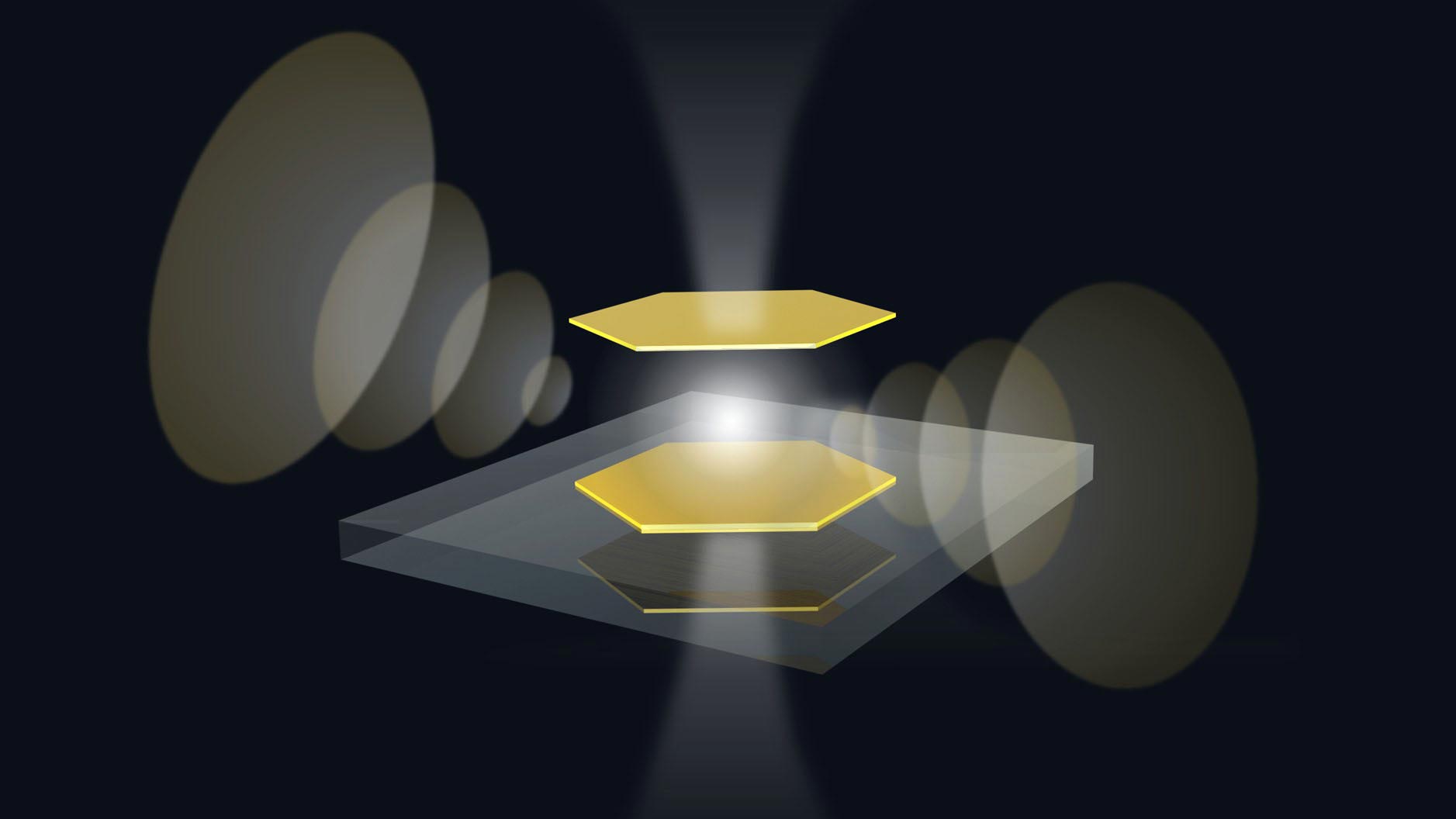
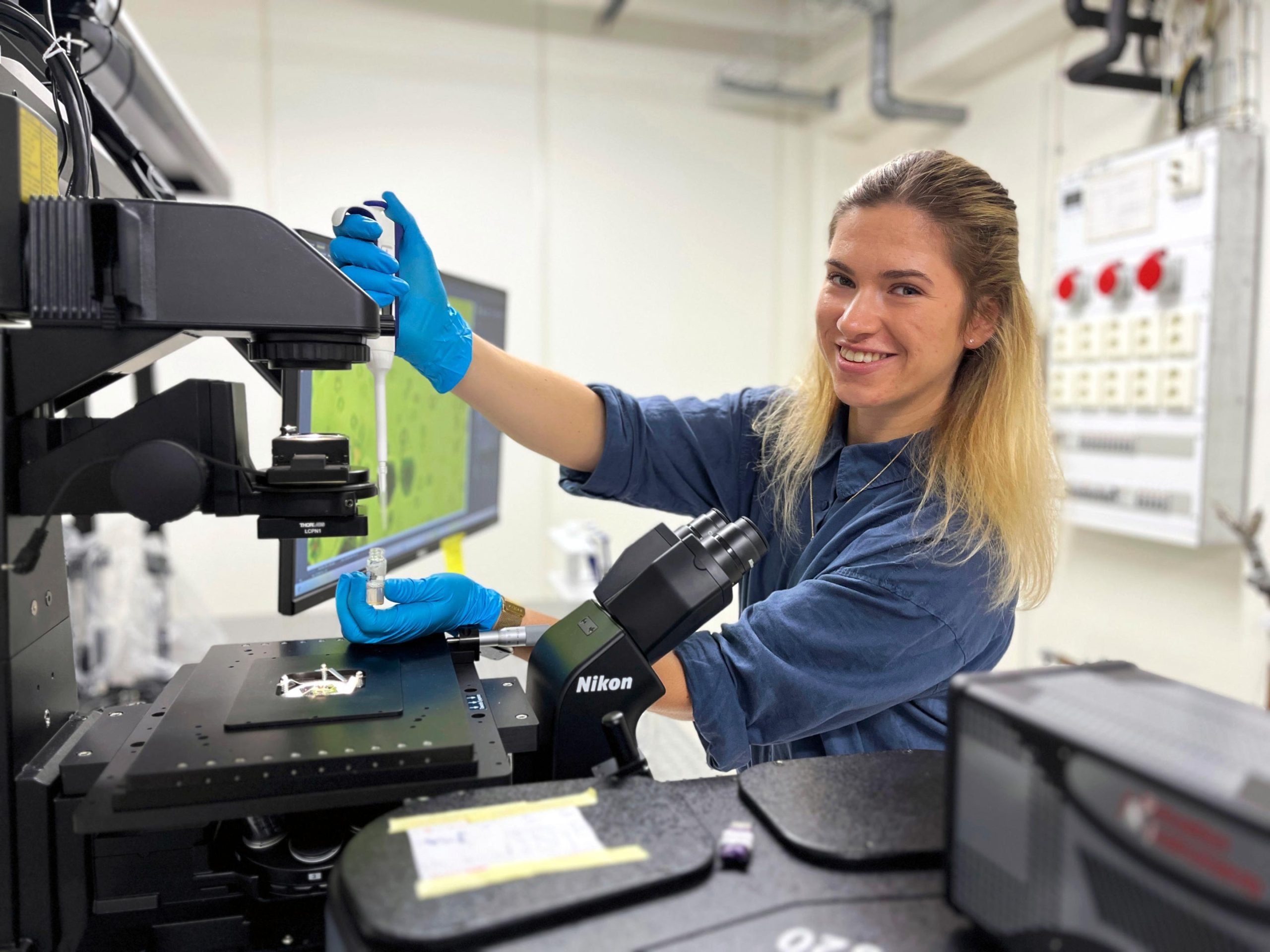
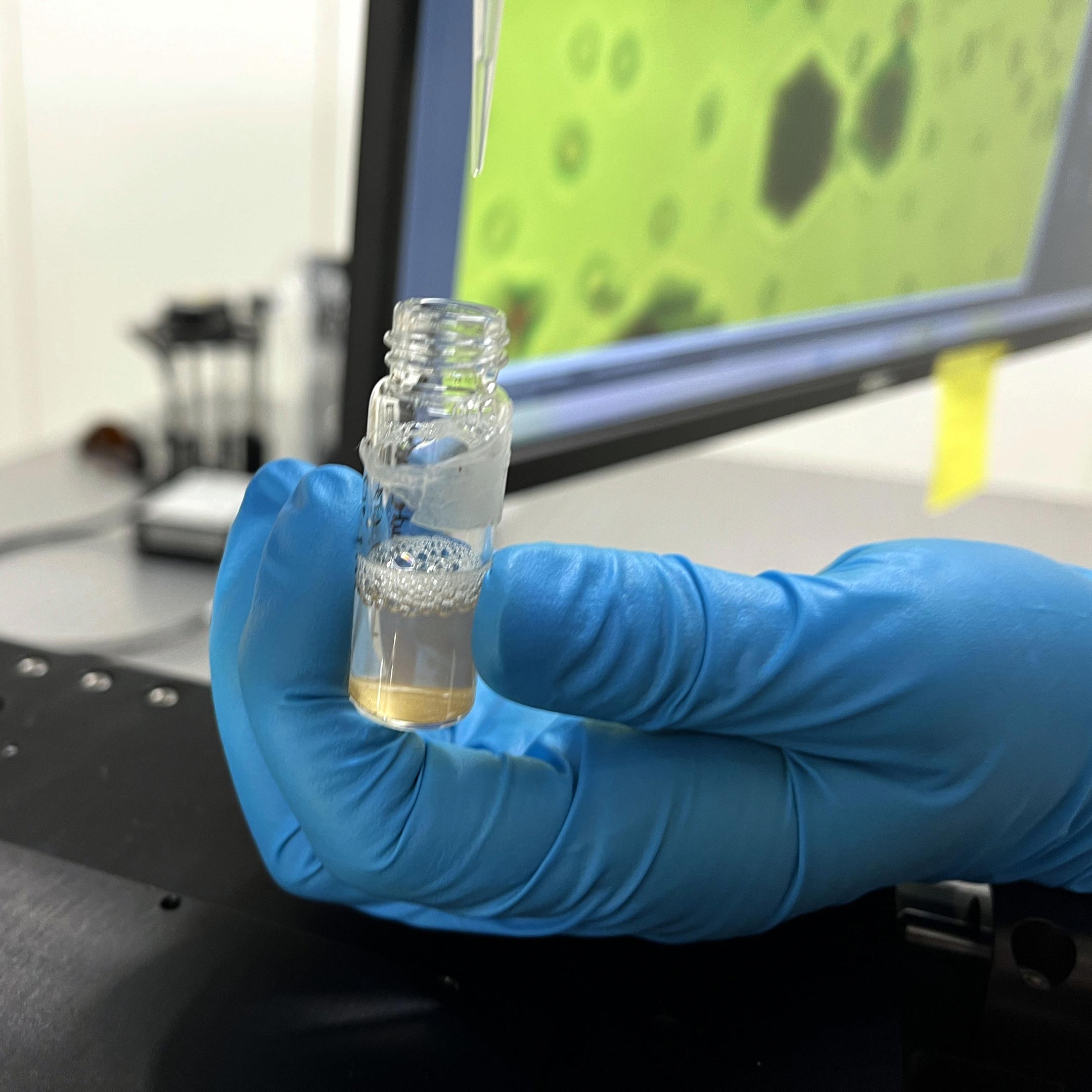
Inside the lab, doctoral student Michaela Hošková holds up a small glass container filled with millions of micrometer-sized gold flakes suspended in a salt solution. Using a pipette, she places a droplet of the mixture onto a gold-coated glass plate positioned under an optical microscope. The flakes are immediately drawn toward the surface but stop just short of fully attaching, leaving nanometer-sized gaps between the flakes and the gold substrate.
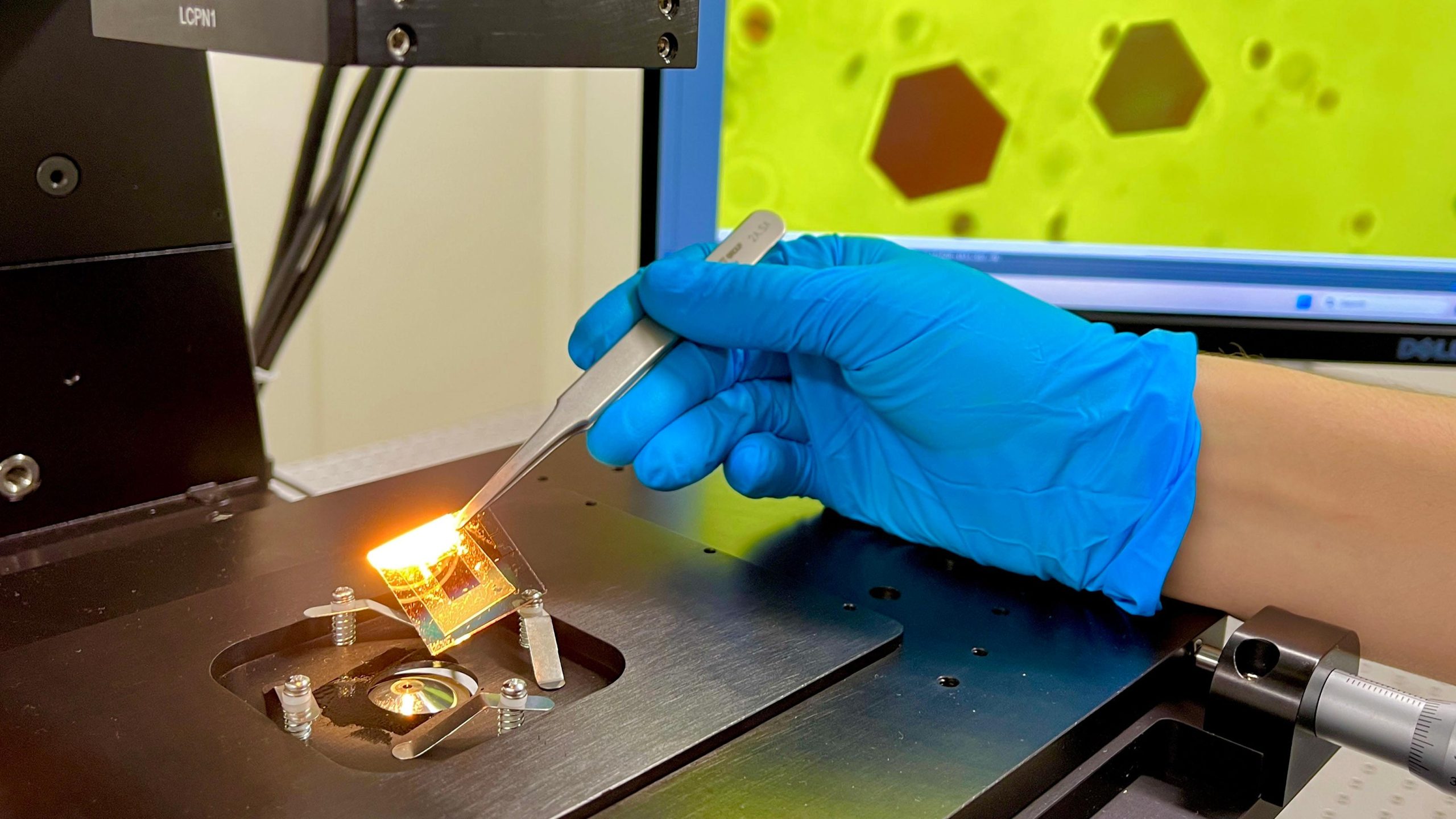
These tiny liquid-filled gaps act like miniature light chambers. Light reflects back and forth inside them, producing visible colors. When the setup is illuminated with a halogen lamp and the reflected light is analyzed with a spectrometer, the different wavelengths become clear. On the connected monitor, flakes shimmer and shift in colors such as red and green against a golden yellow background.
Studying “Nature’s Glue” With Trapped Light
“What we are seeing is how fundamental forces in nature interact with each other. Through these tiny cavities, we can now measure and study the forces we call ‘nature’s glue’ – what binds objects together at the smallest scales. We don’t need to intervene in what is happening, we just observe the natural movements of the flakes,” says Michaela Hošková, a doctoral student at the Department of Physics at Chalmers University of Technology and first author of the scientific article in the journal PNAS in which the platform is presented.
By examining the light captured in the cavities, the team can analyze the balance between two competing forces – one that pulls the flakes together and one that keeps them apart. The attractive force, known as the Casimir effect, causes the gold flakes to move toward each other and toward the surface. The opposing electrostatic force develops in the salt solution and prevents the flakes from fully sticking. When these forces reach equilibrium, a process called self-assembly occurs, forming the cavities that make the measurements possible.
“Forces at the nanoscale affect how different materials or structures are assembled, but we still do not fully understand all the principles that govern this complex self-assembly. If we fully understood them, we could learn to control self-assembly at the nanoscale. At the same time, we can gain insights into how the same principles govern nature on much larger scales, even how galaxies form,” says Michaela Hošková.
On the monitor, which is connected to the lab equipment, it is possible to see many gold flakes moving and changing to colors like red and green against the golden yellow background. The colors reveal the forces at play. Credit: Chalmers University of Technology | Mia Halleröd Palmgren
Gold Flakes as Floating Sensors
The new platform builds on several years of research in Professor Timur Shegai’s group at the Department of Physics. Four years ago, the team showed that a pair of gold flakes could form a self assembled resonator. They have now expanded that discovery into a broader method for investigating fundamental forces.
In this system, the gold flakes function as tiny floating sensors. According to the researchers, the approach could be valuable across physics, chemistry, and materials science.
“The method allows us to study the charge of individual particles and the forces acting between them. Other methods for studying these forces often require sophisticated instruments which cannot provide information down to the particle level,” says research leader Timur Shegai.
Applications From Medicine to Materials
The platform may also help scientists better understand how particles behave in liquids, including whether they remain stable or tend to clump together. That knowledge could improve how medicines move through the body, support the design of more effective biosensors, and contribute to better water filtration systems. It is also relevant for everyday products such as cosmetics, where preventing unwanted clumping is essential.
“The fact that the platform allows us to study fundamental forces and material properties shows its potential as a truly promising research platform,” says Timur Shegai.
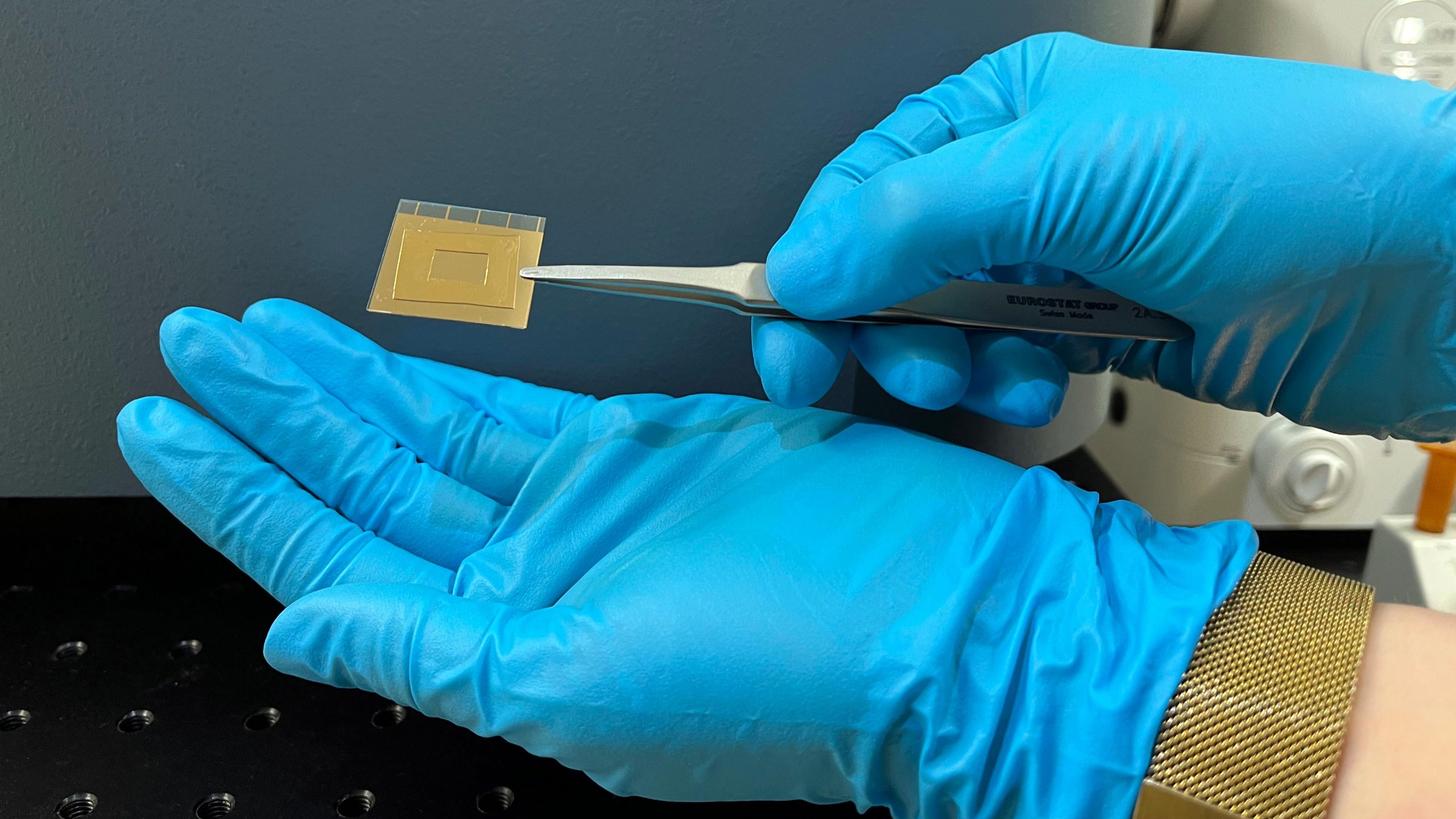
In the laboratory, Hošková opens a small box containing a finished version of the device. Using tweezers, she places it into the microscope. Two thin glass plates enclose everything needed to examine nature’s invisible glue.
“What I find most exciting is that the measurement itself is so beautiful and easy. The method is simple and fast, based only on the movement of gold flakes and the interaction between light and matter,” says Michaela Hošková, zooming in on a gold flake whose colors immediately reveal the forces at work.

How the Platform Works
Gold flakes about 10 micrometers in size are placed in a salt solution, meaning water that contains free ions. When a droplet is added to a gold-coated glass surface, the flakes are drawn toward it, and nanometer-sized cavities (100-200 nanometers) form. This self assembly results from the balance between two forces: the Casimir force, a measurable quantum effect that pulls objects together, and the electrostatic force that arises between charged surfaces in a salt solution.
A halogen lamp shines light into the cavities, where it becomes trapped and reflected. An optical microscope and spectrometer then separate the light into its component wavelengths so the colors can be identified. By adjusting the salt concentration and observing how the flakes shift relative to the surface, researchers can measure the underlying forces. To prevent evaporation, the droplet containing the gold flakes is sealed and covered with a second glass plate.
The platform was developed at Chalmers’ Nanofabrication Laboratory, Myfab Chalmers, and at the Chalmers Materials Analysis Laboratory (CMAL).
Reference: “Casimir self-assembly: A platform for measuring nanoscale surface interactions in liquids” by Michaela Hošková, Oleg V. Kotov, Betül Küçüköz, Catherine J. Murphy and Timur O. Shegai, 1 August 2025, Proceedings of the National Academy of Sciences.
DOI: 10.1073/pnas.2505144122
The scientific article “Casimir self-assembly: A platform for measuring nanoscale surface interactions in liquids” has been published in PNAS (Proceedings of the National Academy of Sciences). It was written by Michaela Hošková, Oleg V. Kotov, Betül Küçüköz and Timur Shegai at the Department of Physics, Chalmers University of Technology, Sweden, and Catherine J. Murphy at the Department of Chemistry, University of Illinois, USA.
The research was funded by the Swedish Research Council, the Knut and Alice Wallenberg Foundation, the Vinnova Centre 2D-Tech and Chalmers University of Technology’s Nano Area of Advance.
Never miss a breakthrough: Join the SciTechDaily newsletter.
Follow us on Google and Google News.
2 Comments
Golden Experiment Reveals the Invisible Forces Holding the Universe Together.
VERY GOOD.
Please ask researchers to think deeply:
1. If space exhibits ideal fluid physical characteristics, can it become the Invisible Forces Holding the Universe Togethe?
2. Are the objects in space derived from phase transitions or dynamic evolution of space itself, or from God?
Physics needs more people and publications who truly care about physics, rather than so-called peer-reviewed publications (including the Proceedings of the National Academy of Sciences, Physical Review Letters, Science, Nature, Science Bulletin, etc.) that are severely poisoned and polluted by pseudoscience and pseudo academia.
Matter, energy, and space-time are all manifestations of structure, not independently existing substances. Vortices are fundamental not because they are carriers of some more basic substance, but because they are the fundamental units of structure. The core proposition of Topological Vortex Theory (TVT) eloquently expresses this position: “Topology precedes matter, structure precedes existence.”
This philosophical turn echoes discussions in 20th-century philosophy of science regarding “structural realism”—when scientific theory undergoes revolutionary change, continuity is often carried not by entities but by mathematical structures. From classical mechanics to quantum field theory, from relativity to string theory, entities are continually overturned, but mathematical structures (such as symmetry, invariants, topological properties) persist in some manner. TVT pushes this insight to its extreme: if structure is truly fundamental, then the “vortex” as the archetype of topological structure has the potential to become the first principle for reconstructing physics.
Are these science?
Example 1
Two sets of cobalt-60 are manually rotated in opposite directions, and even without detection, people around the world know that they will not be symmetrical because these two objects are not mirror images of each other at all. However, a group of so-called physicists and so-called academic publications do not believe it. They conducted experiments and the results were indeed asymmetric, but they still firmly believed that these two objects were mirror images of each other, and the asymmetry was due to a violation of the previous natural laws (CP violation). In the history of science, there can never be a dirtier and uglier operation and explanation than this.
—— Excerpted from https://scitechdaily.com/what-happens-when-light-gains-extra-dimensions/#comment-947619.
Example 2
Please see how the so-called “mystery of θ – τ” is explained: θ and τ are completely identical in all measurable physical properties such as mass, lifetime, charge, spin, etc. However, experimental observations have shown that the θ meson decays into two π mesons, while the τ meson decays into three π mesons, making it difficult for physicists to explain why they are so similar. Physicist Martin Block proposed a highly challenging idea: θ and τ are the same particle, but in weak interactions, parity is not conserved. An easy to understand explanation is the following analogy:: There are two boxes of apples with identical weight, color, and taste. However, when one box is opened, there are two apples, while when the other box is opened, there are three apples. This confuses the old farmer who buys apples. He circled around the orchard and came up with a highly challenging idea: these two boxes of apples are not from the same tree, so they are the same.
—— Excerpted from https://scitechdaily.com/what-happens-when-light-gains-extra-dimensions/#comment-947686.
Everyone who has a reverence for natural laws and regulations deserves respect.