

Ultra clean, air-free measurements reveal a new property of graphene.
Graphene is often called a “miracle material” because it is both mechanically extremely strong and highly conductive, making it ideal for many technological applications. Physicists at the University of Vienna, led by Jani Kotakoski, have now made a breakthrough: by rippling graphene like an accordion, they significantly increased its stretchability for the first time.
This innovation opens the door to new possibilities where flexibility is essential, such as in wearable electronics. In collaboration with the Vienna University of Technology, the team uncovered the precise mechanism behind this effect, and their findings were published in Physical Review Letters.
The unique properties of 2D materials
Graphene was first experimentally confirmed in 2004, marking the discovery of an entirely new class of materials known as two-dimensional (2D) solids. These materials are just a single layer of atoms thick, which gives them unusual and valuable properties. Graphene, for instance, is known for its exceptional electrical conductivity but is also extremely stiff. This stiffness comes from its honeycomb-like atomic structure.
While it might seem logical that removing atoms and their bonds would make the material softer, previous studies have produced conflicting results—some showing a slight decrease in stiffness, others a significant increase.
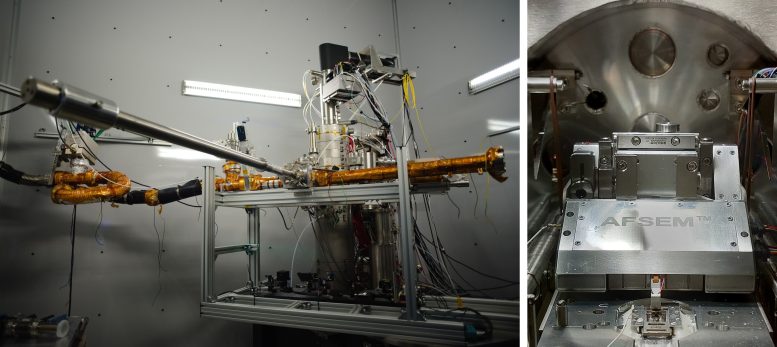
These contradictions have now been clarified through new measurements conducted by researchers of the group led by Jani Kotakoski at the University of Vienna. The experiments were carried out with state-of-the-art devices all sharing the same ultra-clean airless environment. This allows transporting samples between the different devices without ever being exposed to ambient air.
“This unique system we have developed in the University of Vienna allows us to examine 2D materials without interference,” explains Jani Kotakoski. Wael Joudi, first author of the study adds: “For the first time, this kind of experiment has been carried out with the graphene fully isolated from ambient air and the foreign particles it contains. Without this separation, these particles would quickly settle on the surface, affecting the experiment procedure and measurements.”

Discovery of the accordion effect
In fact, the focus on meticulous cleanliness of the material surface led to the discovery of the so-called accordion effect with regard to the stiffness of graphene: already the removal of two neighboring atoms leads to discernible bulging of the initially flat material.

Several bulges together result in a corrugation of the material: “You can imagine it like an accordion. When pulled apart, the waved material now gets flattened, which requires much less force than stretching the flat material and therefore it becomes more stretchable,” explains Wael Joudi. Simulations carried out by the theoretical physicists Rika Saskia Windisch and Florian Libisch from the Vienna University of Technology confirm both the formation of waves and the resulting stretchability.
The experiments also showed that foreign particles on the material surface not only suppress this effect, but lead to the opposite result. Specifically, their influence makes the material appear stiffer, which also explains contradictions of the past. “This shows the importance of the measurement environment when dealing with 2D materials. The results open up a way to regulate the stiffness of graphene and thus pave the way for potential applications,” concludes Wael Joudi.
Reference: “Corrugation-Dominated Mechanical Softening of Defect-Engineered Graphene” by Wael Joudi, Rika Saskia Windisch, Alberto Trentino, Diana Propst, Jacob Madsen, Toma Susi, Clemens Mangler, Kimmo Mustonen, Florian Libisch and Jani Kotakoski, 25 April 2025, Physical Review Letters.
DOI: 10.1103/PhysRevLett.134.166102
The research was funded in whole or in part by the Austrian Science Fund (FWF).
Never miss a breakthrough: Join the SciTechDaily newsletter.
Follow us on Google and Google News.
1 Comment
Foreign particles on the material surface not only suppress this effect, but lead to the opposite result. This shows the importance of the measurement environment when dealing with 2D materials. The team uncovered the precise mechanism behind this effect, and their findings were published in Physical Review Letters.
VERY GOOD!
Ask the researchers:
How can you be certain that the material you observe and study is 2D?
Scientific research guided by correct theories can enable researchers to think more. There is no difference between insisting on CP violation’s Physical Review Letters and being an omnipotent god unconstrained by natural laws.