
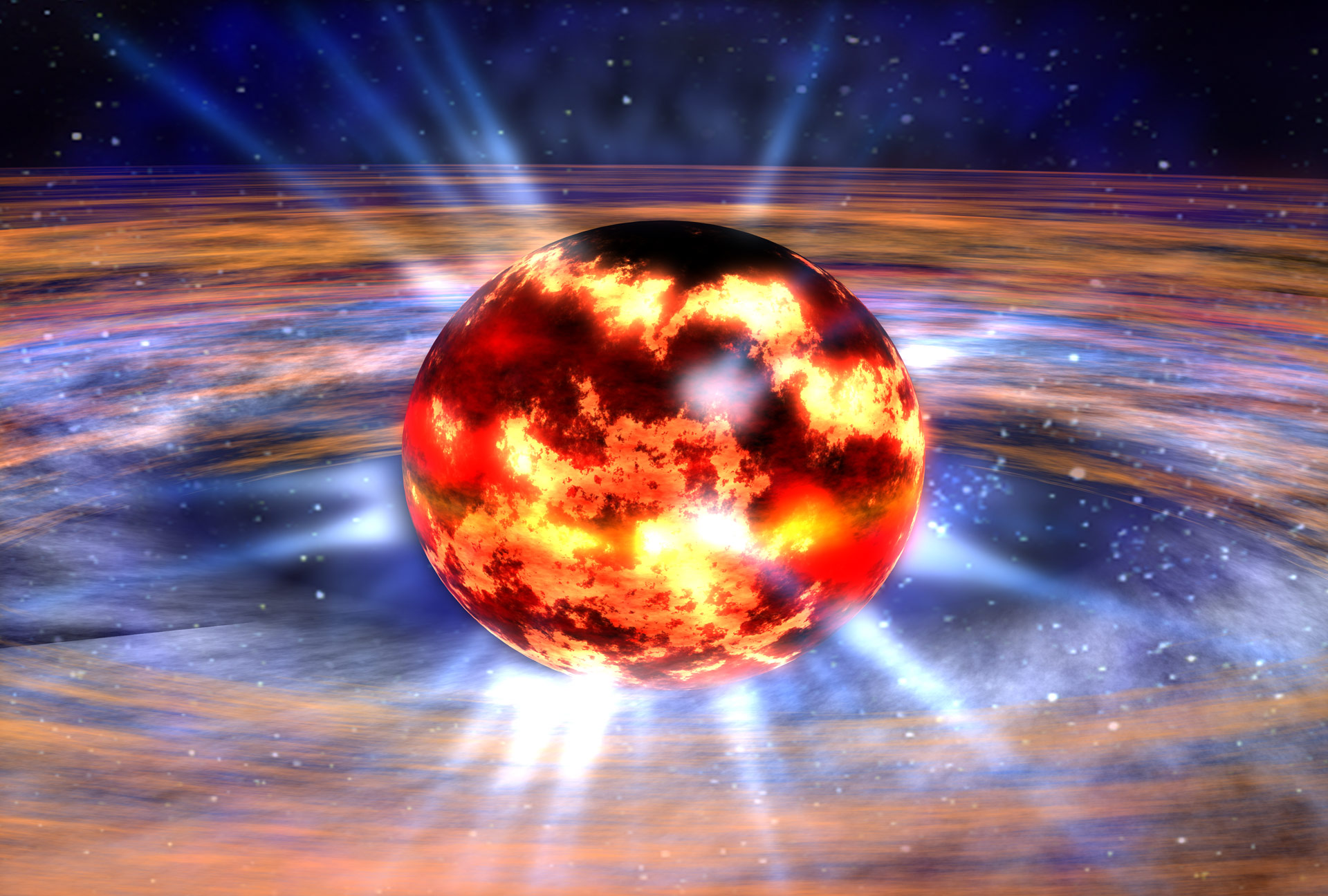
A newly published study details how scientists developed a new way to use gravitational waves to measure the expansion rate of the universe.
In a paper published in the journal Physical Review X, the international research team outline how they have developed highly advanced computer simulations to use special types of neutron stars to learn more about the fabric of the Universe.
Lead author Dr. Christopher Messenger, of the University of Glasgow’s School of Physics and Astronomy, said: “In Einstein’s theory of gravity, acceleration of mass leads to the emission of energy in the form of gravitational radiation – ripples in the very fabric of space-time that travel at the speed of light.
“Gravitational radiation has not yet been directly detected by scientists, as the ripples are extremely weak by the time they reach Earth. However, highly sensitive detectors such as American Laser Interferometer Gravitational Wave Observatory (LIGO) and the French-Italian-Dutch Virgo project may well soon find the first direct evidence of gravitational waves’ existence.
“Among the most likely sources of waves expected to be detected by LIGO and Virgo are astrophysical binaries consisting of neutron stars – the tiny, extremely dense remainders of suns which have collapsed after reaching supernova.
“These neutron stars lose energy to gravitational radiation over hundreds of millions of years, causing them to spiral in and merge to create a hyper-massive neutron star. We expect that LIGO and Virgo will allow us to detect the spacetime ripples from the last 15 minutes of this inspiral process.”
Physicist Bernard Schutz discovered in 1986 that such merging binaries could be used to accurately measure distances to galaxies billions of light years away.
To measure the expansion rate of the Universe and its dark matter and dark energy content, however, it is necessary to measure not just the distance but also the cosmological redshift of the source, namely how quickly distant galaxies are receding from us. Redshift is the name given to the phenomenon whereby electromagnetic radiation is increased in wavelength with distance. A commonly-known example of redshift is the apparent change in the pitch of an emergency siren as police cars or ambulances move closer and further away from an observer.
Until recently it was believed that gravitational wave observations alone would not determine the cosmological redshifts of their sources.
Dr. Messenger added: “What we’ve shown for the first time is that, in the special case where the binary consists of neutron stars, it will be possible to measure both the distance and cosmological redshift using just gravitational waves.
“We’ve used numerical simulations which take months to run on state-of-the-art computing facilities to accurately model the dynamics of such systems and to compute the emitted gravitational radiation. These highly accurate simulations have allowed us to identify characteristic frequencies in the gravitational wave signal from the hyper-massive neutron star.”
The researchers say that they have shown how measurement of the characteristic frequencies before and after merger, together with prior knowledge of their true values from numerical simulations, makes it possible to extract the redshift directly from gravitational wave observations. For the first time they have demonstrated that there is a cosmological application for the post-merger signal and that redshift measurements can be made from binary neutron star merger signals.
Dr. Messenger said: “What we have shown is that it will be possible in theory to measure redshifts of cosmological sources. To accomplish this in practice we will need more sophisticated simulations of the merger dynamics of neutron stars. For example, we don’t know yet the internal structure of neutron stars and this has to be understood in detail in order for us to infer redshifts from gravitational wave observations.”
Researchers from the Max Planck Institute for Gravitational Physics and Goethe University in Germany, the California Institute of Technology in the USA, and Cardiff University in Wales also contributed to the paper.
Reference: “Source Redshifts from Gravitational-Wave Observations of Binary Neutron Star Mergers” by C. Messenger, Kentaro Takami, Sarah Gossan, Luciano Rezzolla and B. S. Sathyaprakash, 8 October 2014, Physical Review X.
DOI: 10.1103/PhysRevX.4.041004
arXiv: 1312.1862
Never miss a breakthrough: Join the SciTechDaily newsletter.
Follow us on Google and Google News.