
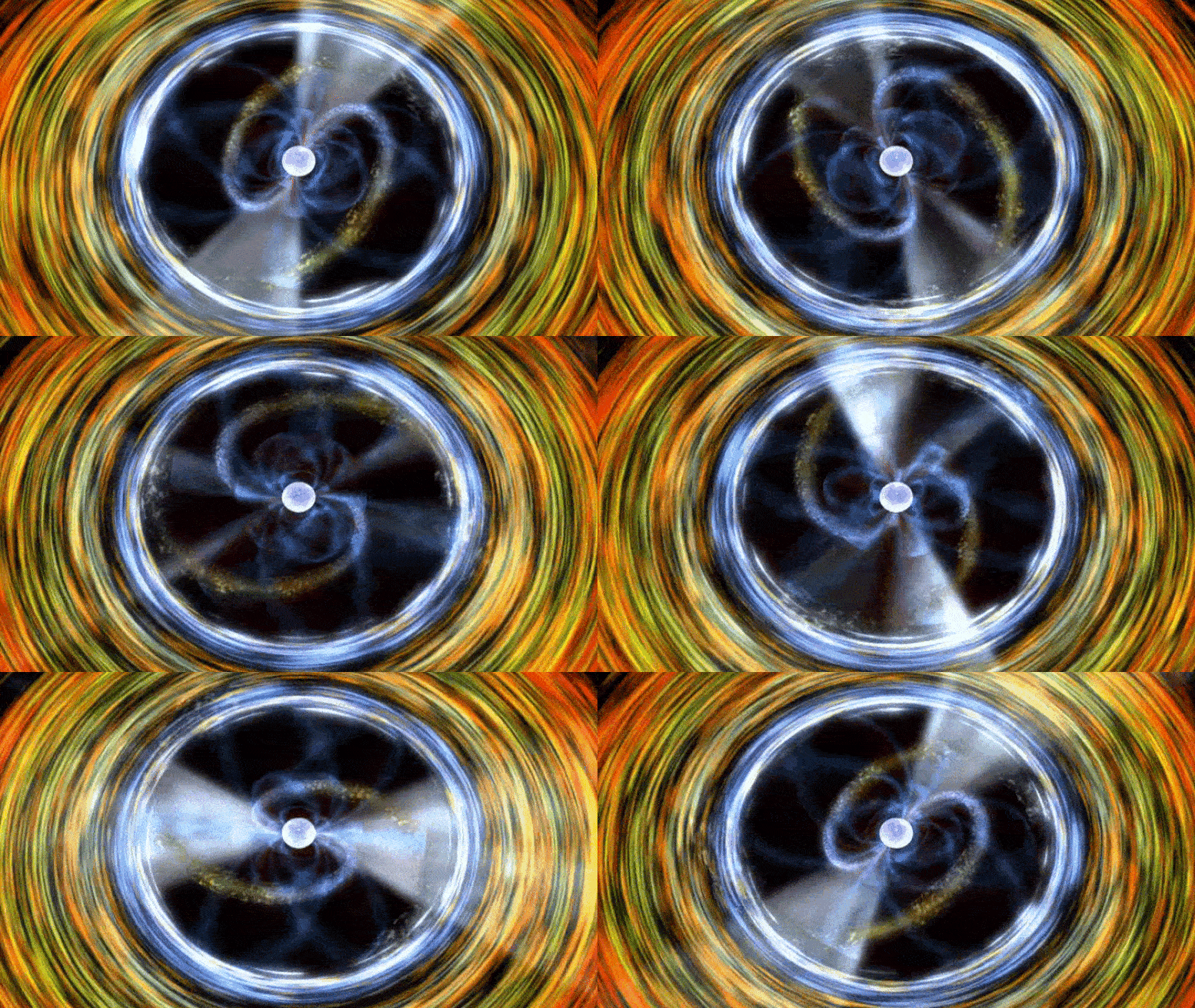
A group of astronomers has discovered 8 millisecond pulsars located within dense clusters of stars, known as “globular clusters,” using South Africa’s MeerKAT radio telescope.
Millisecond pulsars are neutron stars, the most compact star known, that spin up to 700 times per second. This is the first pulsar discovery using the MeerKAT antennas and it comes from the synergic work of two international collaborations, TRAPUM and MeerTIME, with the findings detailed in a Monthly Notices of the Royal Astronomical Society paper that was recently published.
Millisecond pulsars are extremely compact stars mainly made up of neutrons, and are amongst the most extreme objects in the universe: they pack hundreds of thousands of times the mass of the Earth in a sphere with a diameter of about 24 km (15 mi); and spin at a rate of hundreds of rotations per second. They emit a beam of radio waves that are detected by the observer at every rotation, like a lighthouse. The formation of these objects is highly enhanced in the star-rich environments at the centers of globular clusters.
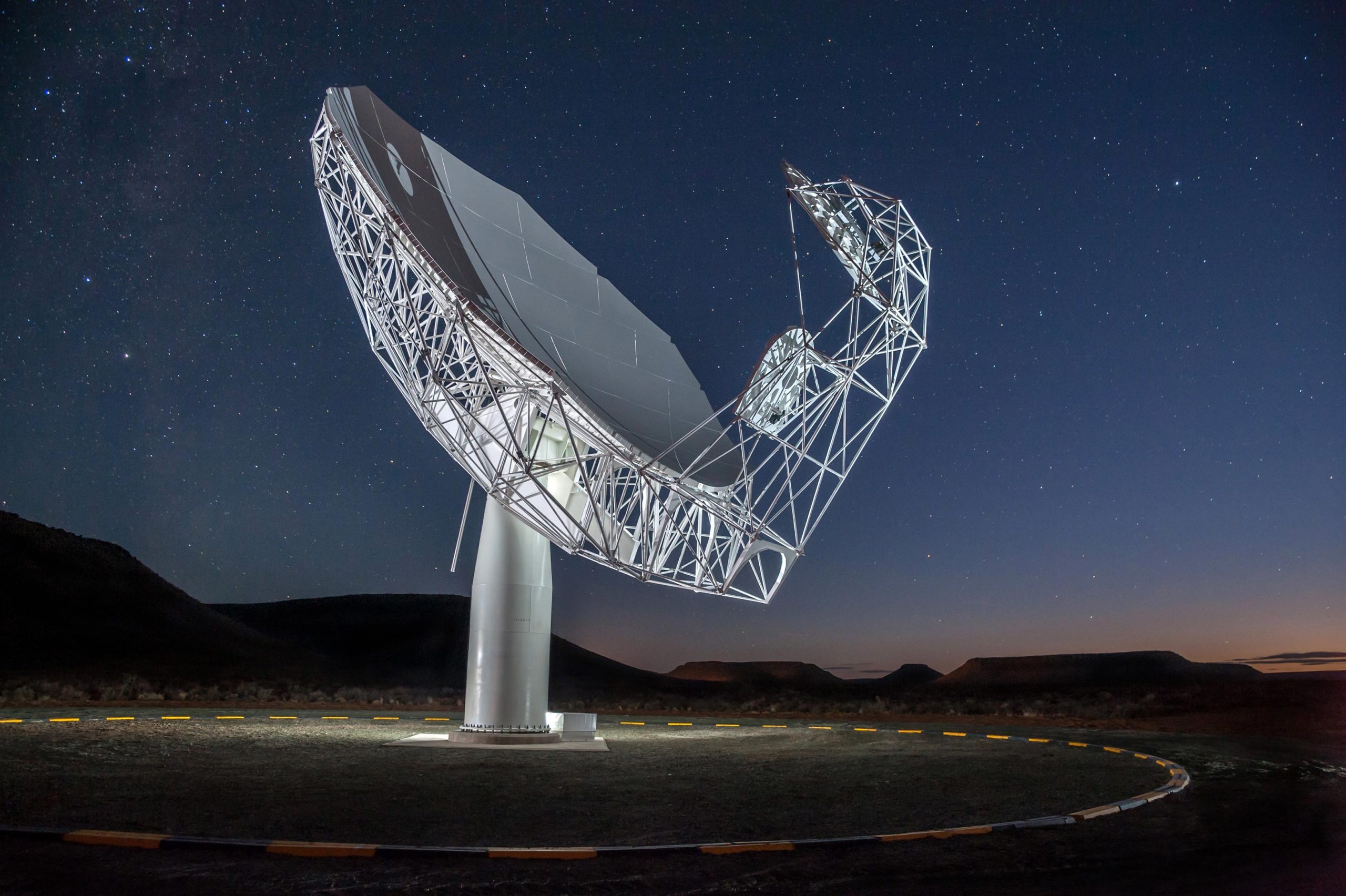
“It is really exciting to see the potential for finding a large number of new millisecond pulsars in Globular Clusters using the excellent MeerKAT telescope,” says Professor Ben Stappers, from The University of Manchester and co-PI of the TRAPUM project. “It is also a preview of what will be possible with the Square Kilometer Array telescope for which MeerKAT is one of the precursors.”
Unusual Binary System: PSR J1823-3021G
Lead author, Alessandro Ridolfi, a post-doctoral research fellow at INAF and MPIfR said: “We directed the MeerKAT antennas toward 9 globular clusters, and we discovered new pulsars in 6 of them!” Five of these new pulsars orbit around another star, and one of these, named PSR J1823-3021G, is particularly interesting: “Because of its highly elliptical orbit, and massive companion, this system is likely the result of an exchange of partners: following a ‘close encounter’: the original partner was expelled and replaced by a new companion star”, continues Ridolfi.
“It is really exciting to see the potential for finding a large number of new millisecond pulsars in Globular Clusters using the excellent MeerKAT telescope. It is also a preview of what will be possible with the Square Kilometer Array telescope for which MeerKAT is one of the precursors.”
Benjamin Stappers, Professor of Astrophysics at The University of Manchester
Tasha Gautam, a doctoral researcher at the MPIfR in Bonn and co-author of the paper, explains: “This particular pulsar could have a high mass, more than 2 times the mass of the Sun, or it could be the first confirmed system formed by a millisecond pulsar and a neutron star. If confirmed by current additional observations, this would make this millisecond pulsar a formidable laboratory for studying fundamental physics.”
A Glimpse of What’s to Come
The 8 new pulsars are just the tip of the iceberg: the observations that led to their discovery used only about 40 of the MeerKAT 64 antennas and focused only on the central regions of the globular clusters.
The TRAPUM collaboration (the TRAnsients and PUlsars with MeerKAT) is one of several Large Survey Proposals (LSP) approved to use the MeerKAT telescope. It is co-led by Professor Stappers from The University of Manchester and Professor Kramer (MPIfR/UoM). TRAPUM will search the sky for pulsars and transients using the extremely high sensitivity of MeerKAT. One of the places they will search are Globular Clusters. This result was obtained in collaboration with MeerTIME, another MeerKAT LSP, and used their infrastructure for capturing the data.
This work also served as a testbed for the TRAPUM collaboration to better plan the fully-fledged globular cluster pulsar survey, which is currently underway and which makes use of all the current 64 dishes (thus further gaining in sensitivity). The survey will broaden the search to many more globular clusters, and will also survey their outer regions.
Reference: “Eight new millisecond pulsars from the first MeerKAT globular cluster census” by A Ridolfi, T Gautam, P C C Freire, S M Ransom, S J Buchner, A Possenti, V Venkatraman Krishnan, M Bailes, M Kramer, B W Stappers, F Abbate, E D Barr, M Burgay, F Camilo, A Corongiu, A Jameson, P V Padmanabh, L Vleeschower, D J Champion, W Chen, M Geyer, A Karastergiou, R Karuppusamy, A Parthasarathy, D J Reardon, M Serylak, R M Shannon and R Spiewak, 18 March 2021, Monthly Notices of the Royal Astronomical Society.
DOI: 10.1093/mnras/stab790
Operated by SARAO, MeerKAT is the largest radio telescope in the Southern Hemisphere and one of two SKA Observatory precursor instruments in South Africa. Located in the Karoo desert, the radio telescope will soon be expanded with an additional 20 dishes, bringing the total number of antennas up to 84 and becoming “MeerKAT+”. This will later be gradually integrated into the first phase of the SKAO project, whose construction will soon begin and will continue until 2027. The first scientific observations of MeerKAT+ could begin as early as 2023, during the testing phases of the telescope.
TRAPUM is one of the Large Survey Proposals running on MeerKAT and is an international collaboration, led by The University of Manchester and the MPIfR, and includes institutions such as INAF, the National Radio Astronomy Observatory (NRAO) and the South African Radio Astronomy Observatory (SARAO).
MeerTIME is also a Large Survey Proposal running on MeerKAT, led by the Swinburne University of Technology, and integrating several Australian institutions as well as INAF, University of Manchester, MPIfR, NRAO and SARAO.
Never miss a breakthrough: Join the SciTechDaily newsletter.
Follow us on Google and Google News.