
Close Menu
    Facebook X (Twitter) Instagram
    SciTechDaily
    • Biology
    • Chemistry
    • Earth
    • Health
    • Physics
    • Science
    • Space
    • Technology
    Facebook X (Twitter) Pinterest YouTube RSS
    SciTechDaily
    Home»Space»Scientists Challenge Pulsar ‘Glitch’ Theory
    Space

    Scientists Challenge Pulsar ‘Glitch’ Theory

    By University of SouthamptonDecember 27, 20121 Comment3 Mins Read
    Facebook Twitter Pinterest Telegram LinkedIn WhatsApp Email Reddit
    Share
    Facebook Twitter LinkedIn Pinterest Telegram Email Reddit
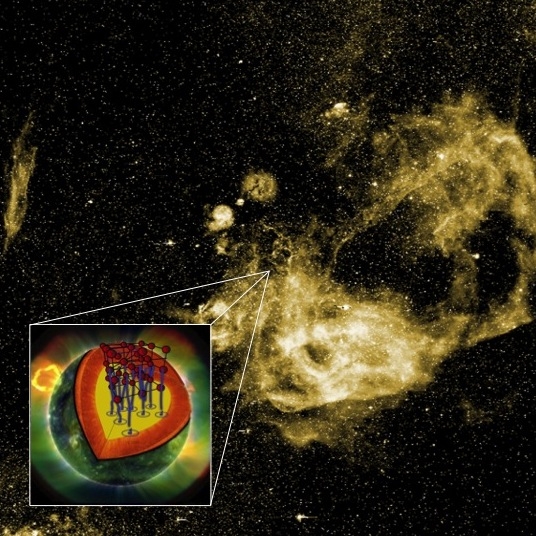
    The Vela supernova remnant at optical wavelengths
    The background shows the Vela supernova remnant at optical wavelengths with location of the Vela pulsar indicated. Inset: Artist’s impression of the pulsar’s interior, and the interaction between superfluid vortices and the nuclei that make up the star’s crust. Credit: CTIO/AURA/NSF

    Using a mathematical model, in conjunction with data from radio telescopes and recent results from nuclear physics theory, researchers at the University of Southampton challenge a 40-year-old theory explaining the ‘glitching’ of pulsars in their newly published study.

    Researchers from the University of Southampton have called into question a 40-year-old theory explaining the periodic speeding up or ‘glitching’ of pulsars.

    A pulsar is a highly magnetized rotating neutron star formed from the remains of a supernova. It emits a rotating beam of electromagnetic radiation, which can be detected by powerful telescopes when it sweeps past the Earth, rather like observing the beam of a lighthouse from a ship at sea.

    Pulsars rotate at extremely stable speeds, but occasionally they speed up in brief events described as ‘glitches’ or ‘spin-ups’. The prevailing theory is that these events arise as a rapidly spinning superfluid within the star transfers rotational energy to the star’s crust, the component that is tracked by observations. However, Southampton academics have used a mathematical model to disprove this.

    Professor Nils Andersson explains: “Imagine the pulsar as a bowl of soup, with the bowl spinning at one speed and the soup spinning faster. Friction between the surface of the bowl and its contents, the soup, will cause the bowl to speed up. The more soup there is, the faster the bowl will be made to rotate.

    “This analogy describes the concept behind the accepted theory of why pulsars suddenly increase speed or ‘spin-up’. However, our research shows that these pulsar glitches are too large to be explained in this way. The amount of superfluid, or ‘soup’, available in the crust of a pulsar is too small to cause the kind of friction needed to create this effect.”

    Professor Andersson and Dr. Wynn Ho from the University of Southampton used their calculations, in conjunction with data from radio telescopes and recent results from nuclear physics theory, to challenge current thinking on this subject.

    The Southampton researchers have written a paper detailing their theory, produced in collaboration with Kostas Glampedakis at the Universidad de Murcia, Spain and Cristobal Espinoza at the University of Manchester. It is published in Physical Review Letters.

    Reference: “Crustal Entrainment and Pulsar Glitches” by N. Chamel, 2 January 2013, Physical Review Letters.
    DOI: 10.1103/PhysRevLett.110.011101

    Never miss a breakthrough: Join the SciTechDaily newsletter.
    Follow us on Google and Google News.

    Astronomy Astrophysics Popular Pulsars Supernova University of Southampton
    Share. Facebook Twitter Pinterest LinkedIn Email Reddit

    Related Articles

    Cosmic Kaboom: Astronomers Reveal the Largest Explosion Ever Witnessed

    How Do the Most Massive Stars Explode? Bubbles With Titanium Trigger Titanic Explosions

    Mysterious Giant Radio Pulses From Pulsars Are Hundreds of Times More Energetic Than Previously Believed

    Weird X-ray Surges Detected in Crab Pulsar’s Radio Bursts by NASA’s NICER

    Reclusive Neutron Star May Have Been Found in Famous Supernova SN 1987A

    Intriguing Remains of a Rare Stellar Explosion Discovered in Milky Way Center

    Gravitational Wave Search Finds Tantalizing New Clue: Unexplained Fluctuations in Space-Time

    Milky Way’s Dark Side Revealed by Measurements of Pulsar Acceleration

    Galactic “Mystery Source” of Gamma Rays Identified: Record-Setting “Black Widow” Pulsar

    1 Comment

    1. Madanagopal.V.C. on December 28, 2012 8:11 am

      When super galaxies are travelling in the universe at a fantastic speed, propelled by Dark Matter found, 96% , along with Dark Energy ,in the Universe, to result in the expansion of the Universe , why can’t these Pulsars also subject to Dark Matter Forces on their transit in the cosmos? Thus the periodic glitches of Pulsars can be possible by this method just like Gravitational lensing of distant galaxies by Dark Matter. After all rotating electro-magnetic radiation is simply an extension of light in the spectrum, isn’t it? Thank You.

      Reply
    Leave A Reply Cancel Reply

    • Facebook
    • Twitter
    • Pinterest
    • YouTube

    Don't Miss a Discovery

    Subscribe for the Latest in Science & Tech!

    Trending News

    Researchers Have Found a Dietary Compound That Increases Longevity

    Scientists Baffled by Bizarre “Living Fossil” From 275 Million Years Ago

    Your IQ at 23 Could Predict Your Wealth at 27, Study Finds

    320 Light-Years Away, a Planet Confirms a Fundamental Cosmic Assumption

    The Crown Jewel of Dentistry? Breakthrough Tech Could Transform Tooth Repair

    Python Blood Could Hold the Secret to Weight Loss Without Side Effects

    Naturally Occurring Bacteria Completely Eradicate Tumors in Mice With a Single Dose

    New “Nanozyme Hypothesis” Could Rewrite the Story of Life’s Origins

    Follow SciTechDaily
    • Facebook
    • Twitter
    • YouTube
    • Pinterest
    • Newsletter
    • RSS
    SciTech News
    • Biology News
    • Chemistry News
    • Earth News
    • Health News
    • Physics News
    • Science News
    • Space News
    • Technology News
    Recent Posts
    • How Quantum Mechanics Went From Baffling Theory to Revolutionizing Modern Technology
    • Scientists May Have Found the Key to Jupiter and Saturn’s Moon Mystery
    • Scientists Uncover Hidden Clues to the Origin of the Genetic Code
    • Scientists Discover Unexpected Role of Alzheimer’s Protein in Cell Division
    • Scientists Uncover Brain Changes That Link Pain to Depression
    Copyright © 1998 - 2026 SciTechDaily. All Rights Reserved.
    • Science News
    • About
    • Contact
    • Editorial Board
    • Privacy Policy
    • Terms of Use

    Type above and press Enter to search. Press Esc to cancel.