
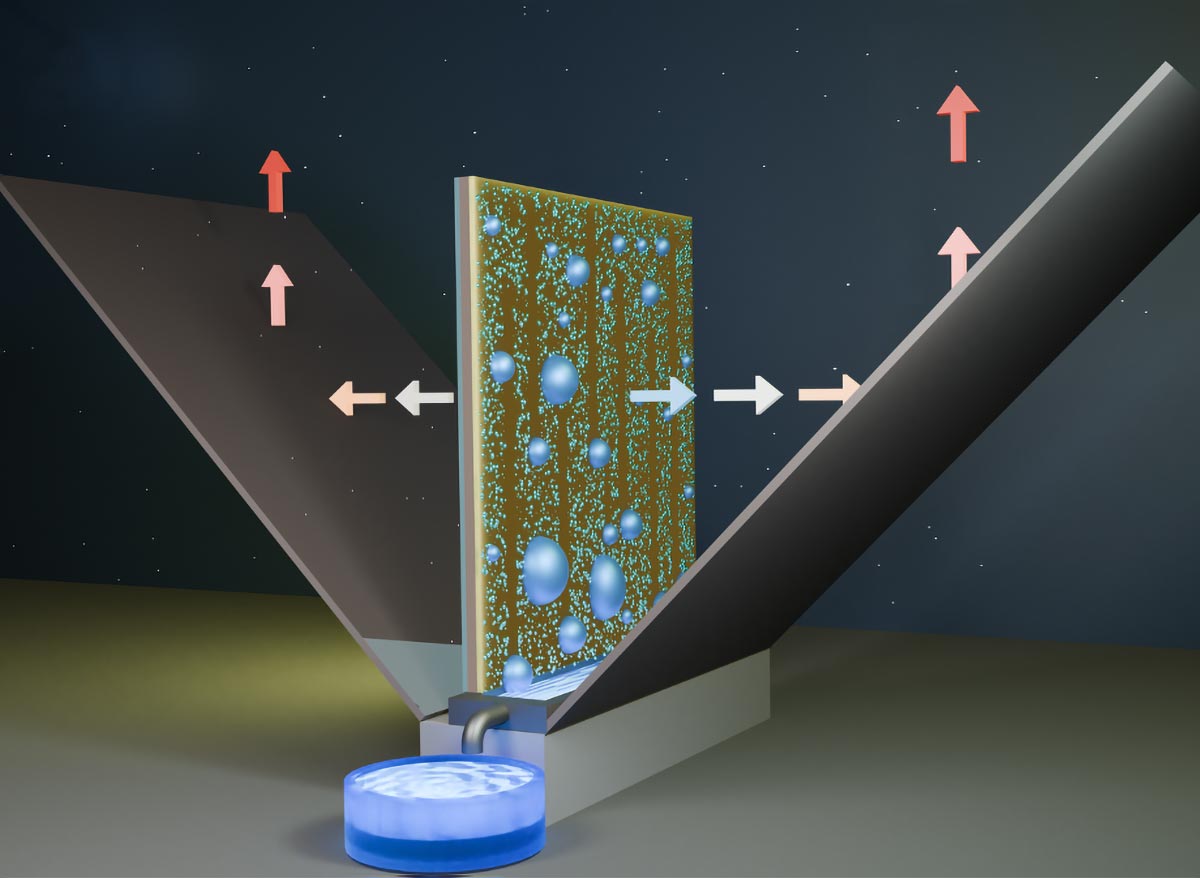
Researchers in Saudi Arabia have created a new device that collects atmospheric water to cool solar cells without using electricity. This sustainable technology also promises reduced operational costs and can double water collection rates in arid regions.
Saudi Arabia’s significant investment in solar cell technology, coupled with its plentiful sunlight, has effectively positioned it to become a major exporter of renewable energy. Solar power now constitutes over 80% of the Kingdom’s renewable energy output. However, there’s an inherent paradox: these solar cells risk overheating due to their intense operation. To combat this, cooling systems are essential, though many of these systems still rely on electricity.
Innovative Cooling Solution
An international research team led by KAUST Professor Qiaoqiang Gan has designed a potential solution. Their device needs no electricity, as it extracts water from the air using nothing more than gravity and relies on cheap, readily available materials. Along with keeping the solar cells and other semiconductor technologies cool, the water can be repurposed for irrigation, washing, cooling buildings on which the solar cells are placed, and other applications.
Atmospheric Water Harvesting Advances
Scientists estimate that the atmosphere contains six times more water than all the fresh water in the rivers combined. “This water can be collected by atmospheric water harvesting technologies,” says Gan. While these technologies work reasonably well, in arid environments like that of Saudi Arabia they require electricity to harvest practical amounts of water. This demand risks deterring the adoption of solar cells in rural regions of the Kingdom, where electricity infrastructure is costly.
Enhancing Efficiency With a New Coating
One reason for the low efficiency is that the water adheres to the surface of the harvesting device. Professor Dan Daniel and Shakeel Ahmad, a postdoc in Gan’s group, found that by adding a lubricant coating that is a mix of a commercial polymer and silicon oil, they could collect more water by relying on only gravity.
“A common challenge in atmospheric water harvesting systems is that water droplets tend to remain pinned to the surface [of the device], necessitating active condensate collection. Our coating effectively eliminated pinning, enabling true passive water collection driven by water,” says Ahmad. “Since this system operates entirely on passive radiative cooling, it doesn’t consume any electricity.”
The solution is based on previous technology made by Gan, which he describes as “vertical double-sided architecture.” That system was originally designed to reflect thermal heat back to the sky to keep the solar cells cool but not to capture the water produced.
Economic and Environmental Benefits
The new device was tested six times over the span of a year in natural conditions in the town of Thuwal, about 100 km north of Jeddah, and could almost double the rate of water collection compared with alternative atmospheric water harvesting technologies.
Along with the efficiency of the water collection, Daniel is equally excited about the economic benefits of adopting.
“The system doesn’t consume any electricity, leading to energy savings. Moreover, it doesn’t rely on any mechanical parts like compressors or fans, reducing the maintenance over traditional systems, leading to further savings,” he said.
Reference: “Lubricated Surface in a Vertical Double-Sided Architecture for Radiative Cooling and Atmospheric Water Harvesting” by Shakeel Ahmad, Abdul Rahim Siddiqui, Kaijie Yang, Ming Zhou, Hafiz Muhammad Ali, Rifan Hardian, Gyorgy Szekely, Dan Daniel, Shu Yang and Qiaoqiang Gan, 06 September 2024, Advanced Materials.
DOI: 10.1002/adma.202404037
Along with Gan and Daniel, KAUST Associate Professor Gyorgy Szekely contributed to the study, which was published in Advance Materials. This project is one of the many ongoing at the new KAUST Center of Excellence for Renewable Energy and Sustainable Technologies.
Never miss a breakthrough: Join the SciTechDaily newsletter.
Follow us on Google and Google News.