
Close Menu
    Facebook X (Twitter) Instagram
    SciTechDaily
    • Biology
    • Chemistry
    • Earth
    • Health
    • Physics
    • Science
    • Space
    • Technology
    Facebook X (Twitter) Pinterest YouTube RSS
    SciTechDaily
    Home»Technology»Self-Harvesting Energy To Power Rechargeable Devices, Sensors
    Technology

    Self-Harvesting Energy To Power Rechargeable Devices, Sensors

    By American Institute of PhysicsAugust 4, 2021No Comments3 Mins Read
    Facebook Twitter Pinterest Telegram LinkedIn WhatsApp Email Reddit
    Share
    Facebook Twitter LinkedIn Pinterest Telegram Email Reddit
    Indoor Photovoltaics for Battery-Powered Sensors
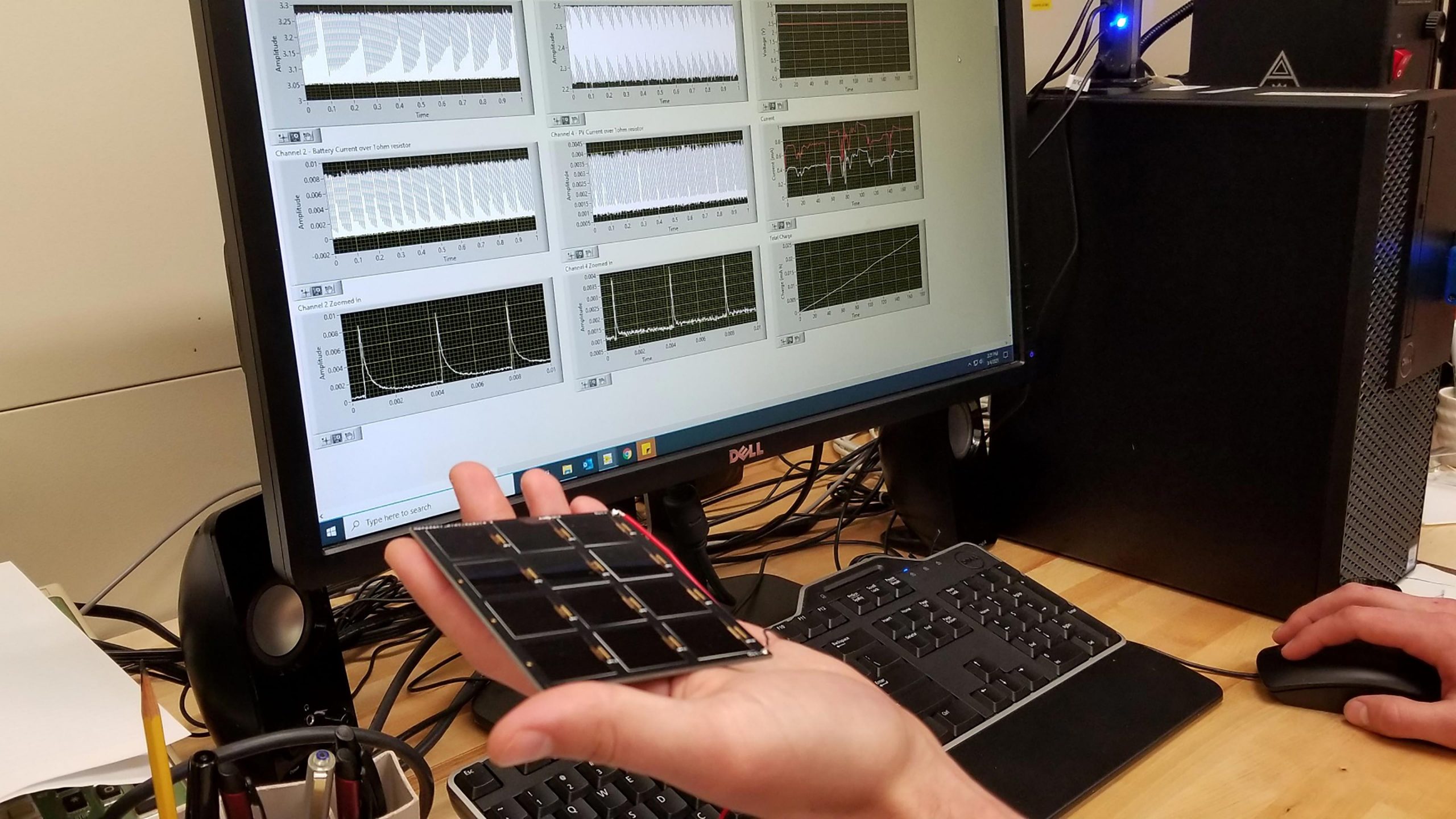
    Indoor photovoltaics for battery-powered sensors. Credit: Shore and Hamadani

    Self-harvesting energy from indoor environments proves effective for charging batteries.

    As more of our devices require recharging of their batteries, researchers are looking to ambient lighting as a potential source of generating small amounts of power for indoor devices.

    During the AIP Publishing Horizons — Energy Storage and Conversion virtual conference, which will be held August 4-6, 2021, Andrew Shore and Behrang Hamadani, from the National Institute of Standards and Technology, will present their findings on the capabilities of indoor solar cells in generating power under an LED. Their presentation, “Indoor photovoltaics for battery-powered sensors,” will be available during the three-day conference.

    The researchers used one lighting source, a white LED with a color coordinate temperature of 3,000 K and an illuminance of 1,000 lux, akin to normal brightness for indoor lights, to test three different modules — a gallium indium phosphide (GaInP) semiconductor, a gallium arsenide (GaAs) semiconductor, and a silicon (Si) semiconductor. The light source peaked in intensity on the shorter wavelengths of light.

    “Under these light settings, the GaInP mini module performed with the highest power conversion efficiency, followed by the GaAs mini module, with the Si mini module as the lowest performer,” Shore said. “The GaInP and GaAs modules have a better spectral match with this visible-spectrum LED light source.”

    Viability of Indoor Charging for Sensors and Batteries

    Since there is usually plenty of indoor ambient light from different sources, a ceiling light in an office environment would be enough to charge any of the mini modules that were tested, making them all viable as power sources for indoor batteries and sensors. Shore said the GaInP would require the least amount of light and still maintain high efficiency, but not all indoor light sources are LEDs.

    “Different light sources have different spectra,” he said. “For instance, an incandescent light source has a large portion of its irradiance in the near infrared region. Fluorescent lights have several spikes in intensity at different places in the visible spectrum. LED lights generally have one short, prominent peak around 450 nanometers and another more gradual peak around 600 nm. Each of these light sources will affect the power conversion efficiency of the photovoltaic technology.”

    Shore said the next step will be testing the mini modules under real-world conditions, like a person turning a light on and off at regular intervals. They hope to operate more than one sensor being powered by a module during that testing.

    Never miss a breakthrough: Join the SciTechDaily newsletter.
    Follow us on Google and Google News.

    American Institute of Physics Battery Technology Energy Photovoltaics Semiconductors
    Share. Facebook Twitter Pinterest LinkedIn Email Reddit

    Related Articles

    Gravity-Powered Innovation Transforms Renewable Energy: Solar Panels That Cool and Water Themselves

    Revolutionary One-Atom-Thick Ribbons Set To Transform Batteries and Solar Cells

    Photosynthesis Power: A Reliable and Renewable Biological Photovoltaic Cell

    Predicting Semiconductor Solar Cell Performance From Terahertz and Microwave Spectroscopy

    Measuring Photovoltaic Performance Indoors – Under Artificial Ambient Light

    Batteries Mimic Multilayer Geometry of Mammal Bones for Structural Stability

    Improving Lithium-Ion Battery Performance, Cell Lifetime for Renewable Energy Applications

    Using Carbon Filler to Improve High-Energy Lithium-Ion Batteries

    New Battery Can Self-Charge Without Losing Energy

    Leave A Reply Cancel Reply

    • Facebook
    • Twitter
    • Pinterest
    • YouTube

    Don't Miss a Discovery

    Subscribe for the Latest in Science & Tech!

    Trending News

    Largest-Ever Study Finds Medicinal Cannabis Ineffective for Anxiety, Depression, PTSD

    250-Million-Year-Old Egg Solves One of Evolution’s Biggest Mysteries

    Living With Roommates Might Be Changing Your Gut Microbiome Without You Knowing

    Century-Old Cleaning Chemical Linked to 500% Increased Risk of Parkinson’s Disease

    What if Your Memories Never Happened? Physicists Take a New Look at the Boltzmann Brain Paradox

    One of the Universe’s Largest Stars May Be Getting Ready To Explode

    Scientists Discover Enzyme That Could Supercharge Ozempic-Like Weight Loss Drugs

    Popular Sweetener Linked to DNA Damage – “It’s Something You Should Not Be Eating”

    Follow SciTechDaily
    • Facebook
    • Twitter
    • YouTube
    • Pinterest
    • Newsletter
    • RSS
    SciTech News
    • Biology News
    • Chemistry News
    • Earth News
    • Health News
    • Physics News
    • Science News
    • Space News
    • Technology News
    Recent Posts
    • Want Less Stress? Landmark Study Points to a Simple Habit
    • Scientists Reveal Eating Fruits and Vegetables May Increase Your Risk of Lung Cancer
    • AI Reveals Explosive Growth of Floating Algae Across the World’s Oceans
    • 5.5 Million Bees Discovered Living Beneath a New York Cemetery
    • Scientists Reverse Brain Aging With Simple Nasal Spray
    Copyright © 1998 - 2026 SciTechDaily. All Rights Reserved.
    • Science News
    • About
    • Contact
    • Editorial Board
    • Privacy Policy
    • Terms of Use

    Type above and press Enter to search. Press Esc to cancel.