
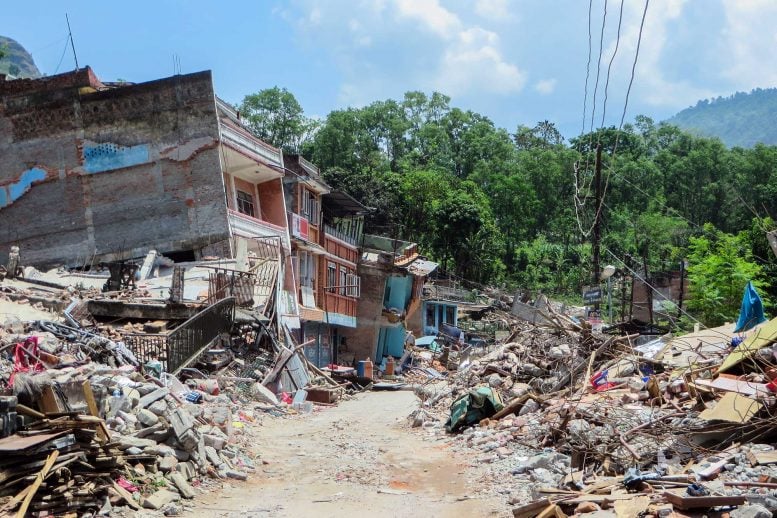
University of California, Riverside research sheds new light on earthquake that killed 9,000 people.
A new understanding of a fault that caused a deadly 7.8 magnitude earthquake can help scientists better understand where and when the next big one will hit.
For decades, scientists have debated the structure of the Main Himalayan Thrust — the fault responsible for a 2015 earthquake that killed nearly 9,000 people, injured 22,000, and destroyed 600,000 homes in Gorkha, Nepal. This fault is a direct result of the ongoing collision between two tectonic plates — the Indian and Eurasian – that gives rise to the Himalayas.
Led by UC Riverside, a team of researchers has determined a new geometric model for the fault that will allow officials to better prepare for future shakers. The team’s work is detailed in a paper published yesterday (November 11, 2019) in Nature Geoscience.
“This is the most high-resolution model of this fault structure to date,” said Abhijit Ghosh, a UCR associate professor of geophysics. “With this knowledge we can better explain why the quake happened the way it happened, and better estimate the stress points along the fault that may act as birthplaces for future large damaging earthquakes.”
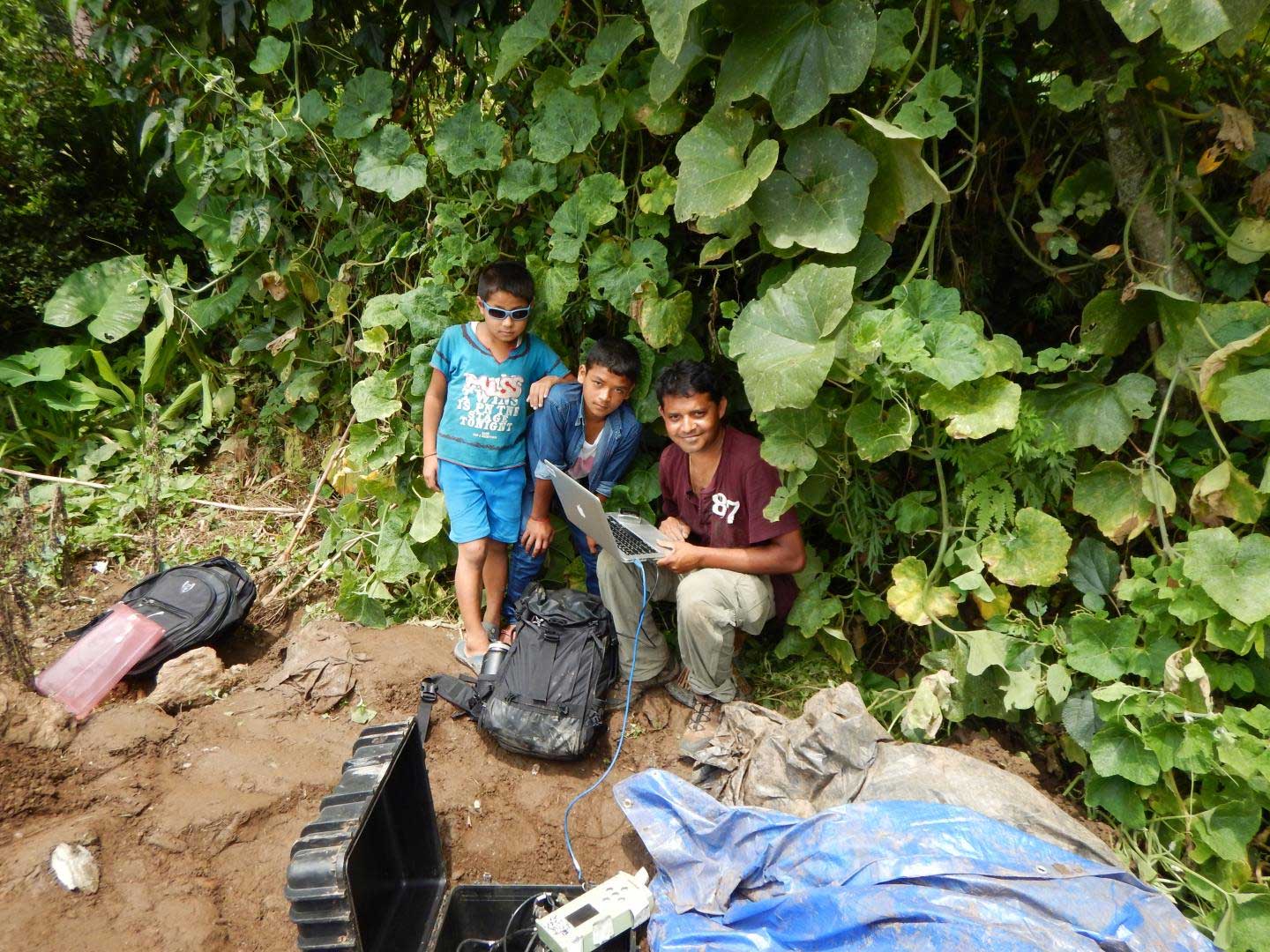
Following the quake, Ghosh and his collaborators rushed to Nepal to operate a network of 45 seismometers in the ground. Their journey was complicated by the difficulty of traveling in that high-altitude, rocky region as well as the timing of the quake during monsoon season.
Despite the difficulties, the team pushed through because the existing network of aftershock-measuring devices, known as seismic stations, was very limited. Without data on the aftershocks, such as their locations and magnitude, it would not have been possible to develop a more detailed understanding of the fault.
“The geometry of the fault also matters,” Ghosh said. “It’s critical to look at smaller earthquakes and aftershocks to determine where the stress points are in a fault. Fault geometry plays a major role in earthquake generation.”
It is also critical to learn the shape of a fault, as well as earthquake “style,” meaning the ways in which a block of rock moves relative to other rocks during an earthquake.
The team found that the Himalayan Thrust, which runs more than 1,000 kilometers (620 miles) from Pakistan to Myanmar, is built in a shape known as a duplex in the area where the magnitude 7.8 earthquake occurred in 2015.
“It consists of two horizontal planes connected by a complex structure bounded by many not-quite-horizontal faults,” Ghosh explained.
This study was funded by the National Science Foundation. The first author of the paper is Matt Mendoza, a Ph.D. student in the Ghosh Earthquake Seismology lab at UCR. Partners included the Government of Nepal’s Department of Mining and Geology, as well as researchers from Stanford University, the University of Texas, El Paso, and the University of Oregon.
The team concluded the fault is still accumulating stress, and that the 2015 event may have increased the likelihood of another big earthquake nearby. This last point may be of interest to Californians.
Accumulated stress from the Nepalese earthquake may be adding stress to parts of the underlying fault that haven’t ruptured yet, and the same may be true of faults in Southern California.
In particular, Ghosh is interested in the aftermath of a magnitude 7.1 earthquake that hit Ridgecrest, California, on July 5, 2019. The 150-mile-long (240-kilometer-long) Garlock fault lies perpendicular to the one that caused the Ridgecrest quake and could produce an even larger and more damaging earthquake.
Those residing anywhere near major fault lines should always have an emergency plan and supplies on hand because earthquakes are inevitable.
“The moral of this story is if you live anywhere near a fault, get your earthquake kit ready,” Ghosh said. “That is always the moral of the story.”
Reference: “Duplex in the Main Himalayan Thrust illuminated by aftershocks of the 2015 Mw 7.8 Gorkha earthquake” by M. M. Mendoza, A. Ghosh, M. S. Karplus, S. L. Klemperer, S. N. Sapkota, L. B. Adhikari and A. Velasco, 11 November 2019, Nature Geoscience.
DOI: 10.1038/s41561-019-0474-8
Never miss a breakthrough: Join the SciTechDaily newsletter.
Follow us on Google and Google News.