
Close Menu
    Facebook X (Twitter) Instagram
    SciTechDaily
    • Biology
    • Chemistry
    • Earth
    • Health
    • Physics
    • Science
    • Space
    • Technology
    Facebook X (Twitter) Pinterest YouTube RSS
    SciTechDaily
    Home»Space»Gravity’s Cosmic Spotlight: Unveiling a Monstrous 30-Billion-Solar-Mass Black Hole Through Light-Bending Phenomenon
    Space

    Gravity’s Cosmic Spotlight: Unveiling a Monstrous 30-Billion-Solar-Mass Black Hole Through Light-Bending Phenomenon

    By Durham UniversityMarch 30, 20232 Comments4 Mins Read
    Facebook Twitter Pinterest Telegram LinkedIn WhatsApp Email Reddit
    Share
    Facebook Twitter LinkedIn Pinterest Telegram Email Reddit
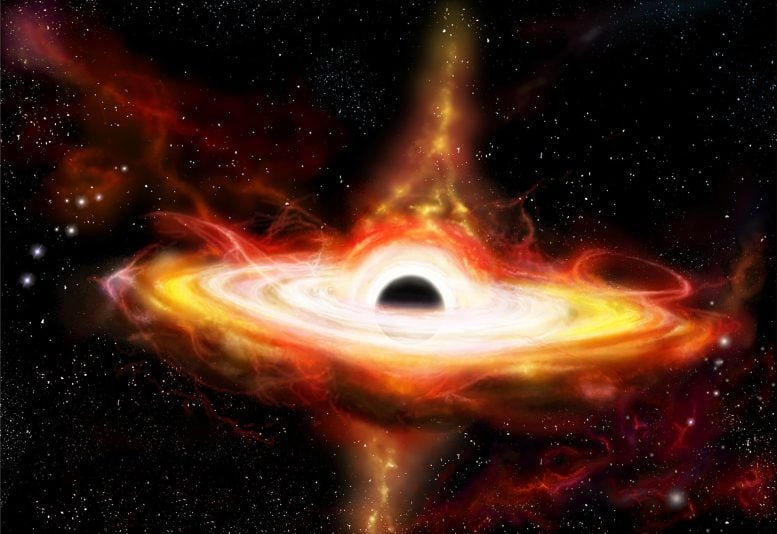
    Quasar Supermassive Black Hole Illustration
    Astronomers led by Durham University have discovered one of the largest black holes ever found, with a mass over 30 billion times that of the Sun, by utilizing gravitational lensing and supercomputer simulations on the DiRAC HPC facility. This groundbreaking technique, which simulates light traveling through the universe, allowed the researchers to accurately predict the light’s path as seen in real Hubble Space Telescope images. The discovery has been published in the Monthly Notices of the Royal Astronomical Society.

    Taking advantage of a phenomenon called gravitational lensing, a team of astronomers has discovered one of the biggest black holes ever found.

    Light-Bending Gravity

    The team, led by Durham University, UK, used gravitational lensing – where a foreground galaxy bends the light from a more distant object and magnifies it – and supercomputer simulations on the DiRAC HPC facility, enabled the team to closely examine how light is bent by a black hole inside a galaxy hundreds of millions of light-years from Earth.

    The team simulated light traveling through the Universe hundreds of thousands of times, with each simulation including a different mass black hole, changing light’s journey to Earth.
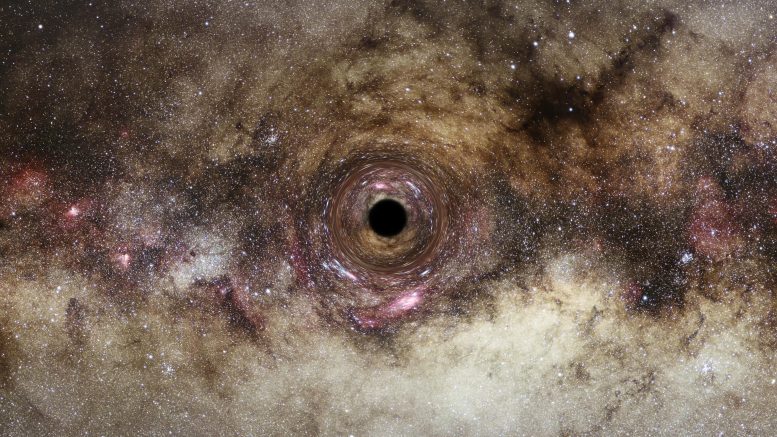
    Artist’s Impression of Black Hole Intense Gravitational Field
    An artist’s impression of a black hole, where the black hole’s intense gravitational field distorts the space around it. This warps images of background light, lined up almost directly behind it, into distinct circular rings. This gravitational “lensing” effect offers an observation method to infer the presence of black holes and measure their mass, based on how significant the light bending is. The Hubble Space Telescope targets distant galaxies whose light passes very close to the centers of intervening fore-ground galaxies, which are expected to host supermassive black holes over a billion times the mass of the sun. Credit: ESA/Hubble, Digitized Sky Survey, Nick Risinger (skysurvey.org), N. Bartmann

    30 Billion Times the Mass of Our Sun

    When the researchers included an ultramassive black hole in one of their simulations, the path taken by the light from the faraway galaxy to reach Earth matched the path seen in real images captured by the Hubble Space Telescope.

    What the team had found was an ultramassive black hole, an object over 30 billion times the mass of our Sun, in the foreground galaxy – a scale rarely seen by astronomers.

    This is the first black hole found using gravitational lensing and the findings were published today (March 29) in the journal Monthly Notices of the Royal Astronomical Society.


    A video showing how Astronomers used gravitational lensing to discover a black hole 30 billion times the mass of the sun in a galaxy 2 billion light years away. Credit: Durham University

    Looking Back in Cosmic Time

    Most of the biggest black holes that we know about are in an active state, where matter pulled in close to the black hole heats up and releases energy in the form of light, X-rays, and other radiation.

    Gravitational lensing makes it possible to study inactive black holes, something not currently possible in distant galaxies. This approach could let astronomers discover far more inactive and ultramassive black holes than previously thought and investigate how they grew so large.

    The story of this particular discovery started back in 2004 when fellow Durham University astronomer, Professor Alastair Edge, noticed a giant arc of a gravitational lens when reviewing images of a galaxy survey.

    Fast forward 19 years and with the help of some extremely high-resolution images from NASA’s Hubble telescope and the DiRAC COSMA8 supercomputer facilities at Durham University, Dr. Nightingale and his team were able to revisit this and explore it further.

    Exploring the Mysteries of Black Holes

    The team hopes that this is the first step in enabling a deeper exploration of the mysteries of black holes, and that future large-scale telescopes will help astronomers study even more distant black holes to learn more about their size and scale.

    Reference: “Abell 1201: detection of an ultramassive black hole in a strong gravitational lens” by J W Nightingale, Russell J Smith, Qiuhan He, Conor M O’Riordan, Jacob A Kegerreis, Aristeidis Amvrosiadis, Alastair C Edge, Amy Etherington, Richard G Hayes, Ash Kelly, John R Lucey and Richard J Massey, 29 March 2023, Monthly Notices of the Royal Astronomical Society.
    DOI: 10.1093/mnras/stad587

    The research was supported by the UK Space Agency, the Royal Society, the Science and Technology Facilities Council (STFC), part of UK Research and Innovation (UKRI), and the European Research Council.

    This work used both the DiRAC Data Intensive Service (CSD3) and the DiRAC Memory Intensive Service (COSMA8), hosted by University of Cambridge and Durham University on behalf of the DiRAC High-Performance Computing facility.

    Never miss a breakthrough: Join the SciTechDaily newsletter.
    Follow us on Google and Google News.

    Astronomy Astrophysics Black Hole Durham University Gravitational Lensing Popular
    Share. Facebook Twitter Pinterest LinkedIn Email Reddit

    Related Articles

    Astronomers Use “X-Ray Magnifying Glass” To Enhance View of Distant Black Holes

    First Confirmed Heartbeat of a Supermassive Black Hole Is Still Beating

    NASA’s NuSTAR Identifies Its First Ten Supermassive Black Holes

    New Method for Measuring Black Hole Spin Could Provide a Greater Understanding of Galaxy Growth

    NASA Satellite Discovers a New Black Hole in the Milky Way

    Cloud of Hydrogen and Helium Plunging Toward the Galactic Center

    Data Reveals Swift J1644+57’s QPO Cycle

    Intermediate-Mass Black Hole Candidates Discovered at the Center of the Milky Way

    Scientists Convene to Take a Picture of the Supermassive Black Hole at the Center of the Milky Way

    2 Comments

    1. Bob on March 30, 2023 4:39 am

      Thank you for providing correct data rather than making false statements like another large science news website that reported on the same subject.

      Reply
    2. Albert on April 5, 2023 2:50 pm

      I read this on a crazy theory site. The largest black hole should be the one that inverted to create this universe. After it’s white hole period is over on this side, it’ll go back the other direction and we’ll one day disappear and the “other” Universe will re-create in an endless loop. This is why you get deja-vu. You literally live the same life over and over to infinity when the same universe inevitably reforms again and again and again though it take many billions of years.

      Reply
    Leave A Reply Cancel Reply

    • Facebook
    • Twitter
    • Pinterest
    • YouTube

    Don't Miss a Discovery

    Subscribe for the Latest in Science & Tech!

    Trending News

    The Universe Is Expanding Too Fast and Scientists Can’t Explain Why

    “Like Liquid Metal”: Scientists Create Strange Shape-Shifting Material

    Early Warning Signals of Esophageal Cancer May Be Hiding in Plain Sight

    Common Blood Pressure Drug Shows Surprising Power Against Deadly Antibiotic-Resistant Superbug

    Scientists Uncover Dangerous Connection Between Serotonin and Heart Valve Disease

    Scientists Discover a “Protector” Protein That Could Help Reverse Hair Loss

    Bone-Strengthening Discovery Could Reverse Osteoporosis

    Scientists Uncover Hidden Trigger Behind Stem Cell Aging

    Follow SciTechDaily
    • Facebook
    • Twitter
    • YouTube
    • Pinterest
    • Newsletter
    • RSS
    SciTech News
    • Biology News
    • Chemistry News
    • Earth News
    • Health News
    • Physics News
    • Science News
    • Space News
    • Technology News
    Recent Posts
    • Scientists Overcome Major Quantum Bottleneck, Potentially Transforming Teleportation and Computing
    • Quantum Physics’ Strangest Problem May Hold the Key to Time Itself
    • Scientists Create “Liquid Gears” That Spin Without Touching
    • The Simple Habit That Could Help Prevent Cancer
    • Forgotten Medicinal Plant Shows Promise in Fighting Dangerous Superbugs
    Copyright © 1998 - 2026 SciTechDaily. All Rights Reserved.
    • Science News
    • About
    • Contact
    • Editorial Board
    • Privacy Policy
    • Terms of Use

    Type above and press Enter to search. Press Esc to cancel.