
Close Menu
    Facebook X (Twitter) Instagram
    SciTechDaily
    • Biology
    • Chemistry
    • Earth
    • Health
    • Physics
    • Science
    • Space
    • Technology
    Facebook X (Twitter) Pinterest YouTube RSS
    SciTechDaily
    Home»Earth»Greece Fire: Large Swaths of Greece Consumed by Wildfire
    Earth

    Greece Fire: Large Swaths of Greece Consumed by Wildfire

    By Michael Carlowicz, NASA Earth ObservatoryAugust 15, 2021No Comments3 Mins Read
    Facebook Twitter Pinterest Telegram LinkedIn WhatsApp Email Reddit
    Share
    Facebook Twitter LinkedIn Pinterest Telegram Email Reddit
    Greece Fire Natural Color August 2021 Annotated
    August 10, 2021
    Greece Fire False Color August 2021 Annotated
    August 10, 2021

    In the first two weeks of August 2021, Greece has endured a series of wildland fires that have charred a large swath of the island of Evia and several areas of the Peloponnese region. The fires followed closely after one of the worst heatwaves in the country since the 1980s, which dried up scarce moisture and left forests primed to burn. Greek Prime Minister Kyriakos Mitsotakis told several news agencies that the fire outbreak has been a “disaster of unprecedented proportions.”

    According to data from the European Forest Fire Information System (EFFIS), more than 110,000 hectares (424 square miles) have burned in Greece this year, more than five times the yearly average from 2008 to 2020 (21,000 hectares). EFFIS counted 58 fires (30 hectares or larger) in the country in 2021, already above the yearly average total of 46.

    The Operational Land Imager (OLI) on Landsat 8 acquired natural- and false-color views (above) of the north end of Evia on August 10, 2021. The false-color image combines shortwave infrared, near infrared, and red light (OLI bands 6-5-4). In this view, burned vegetation appears dark brown, and greens and yellows indicate a combination of unburned trees and scrub.

    On August 8, the Visible Infrared Imaging Radiometer Suite (VIIRS) on Suomi NPP acquired a wider view (below) of the fires and smoke in Greece. NASA Worldview imagery from August 3–11 shows the evolution of the smoke plumes with changing winds.
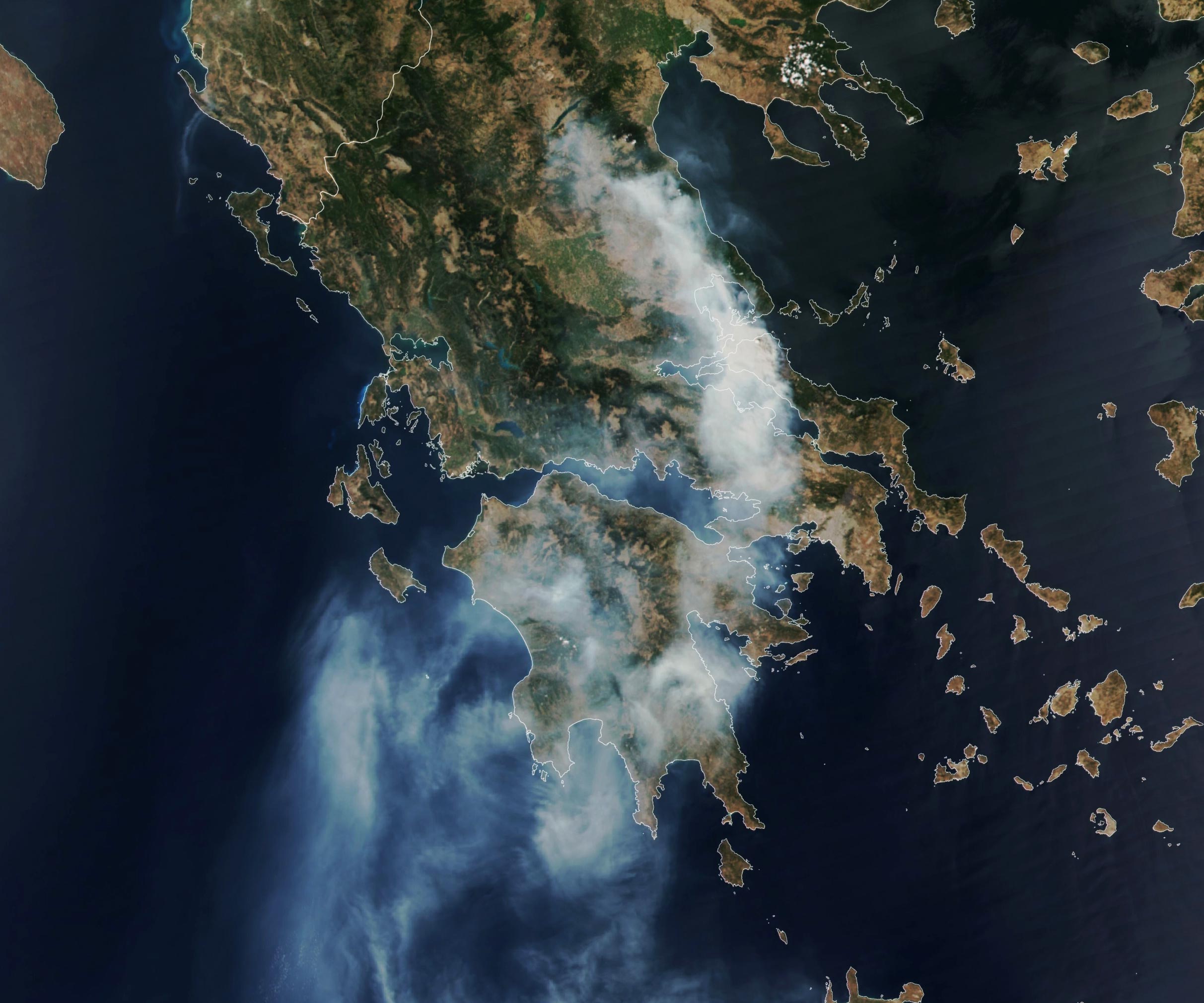
    Greece Fire August 2021 Annotated
    August 8, 2021

    Some of the worst fires in the country have burned on Evia, the second largest island in Greece and a major hub for tourism. Much of the island has been in a state of high fire alert for a week. The Associated Press reported that an estimated 50,000 hectares (123,000 acres) have burned on Evia, as well as hundreds of homes.

    Significant fires also broke out near Athens, Olympia, and Arcadia, and 63 organized evacuations have been reported across Greece in the past nine days. Firefighters and equipment have been sent from at least 15 countries to help Greek authorities.

    As of August 11, EFFIS reported that more than 338,000 hectares (1,300 square miles) have already burned across Europe in 2021, more than the 2008-2020 average for an entire year (295,000). More than 109,000 hectares have burned so far in Italy, 2.5 times the annual average. Large fires have also been burning in Algeria and Turkey.

    The heatwaves and fires fit with patterns described in the latest assessment report from the Intergovernmental Panel on Climate Change (IPCC), to which NASA-funded scientists contribute. In its summary of climate conditions in Europe, the IPCC noted: “The frequency and intensity of hot extremes…have increased in recent decades and are projected to keep increasing regardless of the greenhouse gas emissions scenario. Despite strong internal variability, observed trends in European mean and extreme temperatures cannot be explained without accounting for anthropogenic factors.”

    NASA Earth Observatory image by Lauren Dauphin, using VIIRS data from NASA EOSDIS LANCE, GIBS/Worldview, and the Suomi National Polar-orbiting Partnership.

    Never miss a breakthrough: Join the SciTechDaily newsletter.
    Follow us on Google and Google News.

    Geography NASA NASA Earth Observatory Wildfires
    Share. Facebook Twitter Pinterest LinkedIn Email Reddit

    Related Articles

    Hundreds of Wildland Fires Darken Skies Over Alaska

    Massive New Mexico Wildfire Spawns 7.5 Mile Fire Cloud

    Alisal Fire Rages Near Santa Barbara – Strong Winds Fuel Fast-Moving Fire

    California’s Massive Dixie Fire Keeps Growing – Stunning Image Captured by Astronaut on Space Station

    A Summer of Fire-Breathing Smoke Storms: Extreme Heat, Intense Wildfires, and a “Monster pyroCb”

    Blazing Heat: Dangerous Wildfires Rage Across British Columbia

    Fires Rage in Arizona: Hot, Dry Weather Parched Vegetation and Turned the State Into a Tinderbox

    Satellite View: Fierce Fire Season Rages in Nepal

    NASA/NOAA Satellites Observe Surprisingly Rapid Increase in Scale and Intensity of Fires in Siberia

    Leave A Reply Cancel Reply

    • Facebook
    • Twitter
    • Pinterest
    • YouTube

    Don't Miss a Discovery

    Subscribe for the Latest in Science & Tech!

    Trending News

    Scientists Recreate a Nuclear Fireball and Uncover Fallout’s Hidden Chemistry

    These Tiny Gut Particles Could Be Accelerating Aging Throughout the Body

    Doctors Changed One Thing and Weight Gain Stopped

    Magnetic Fields May Solve a Longstanding Binary Star Mystery

    The Probiotic Breakthrough for Natural Anxiety Relief and Better Mental Health

    Animal vs. Plant Protein: Scientists Found a Surprising Nutritional Difference

    According to Scientists, This Simple Dietary Change Is Linked to Lower Depression Scores

    Researchers Discover a Hidden Vitamin D Problem That Persists Year-Round

    Follow SciTechDaily
    • Facebook
    • Twitter
    • YouTube
    • Pinterest
    • Newsletter
    • RSS
    SciTech News
    • Biology News
    • Chemistry News
    • Earth News
    • Health News
    • Physics News
    • Science News
    • Space News
    • Technology News
    Recent Posts
    • Scientists Reveal What Happened When 12 People Were Trapped Together in Antarctica for 10 Months
    • Buried for 1.7 Billion Years: These Ancient Fossils May Rewrite the Story of Complex Life
    • NASA Spots Giant Ocean Swell Signaling a Potential El Niño Comeback
    • The “Impossible” Earthquake Beneath Utah Was Real After All
    • Scientists Uncover Why Walking Gets Slower and More Exhausting As We Age
    Copyright © 1998 - 2026 SciTechDaily. All Rights Reserved.
    • Science News
    • About
    • Contact
    • Editorial Board
    • Privacy Policy
    • Terms of Use

    Type above and press Enter to search. Press Esc to cancel.