

New high-resolution maps of the mouse brain provide researchers with valuable insights into brain development and offer a powerful tool for studying neurodevelopmental disorders.
Researchers at Penn State College of Medicine, in collaboration with five other institutes, have developed a 3D atlas of developing mouse brains using advanced imaging and microscopy techniques. This innovative atlas offers a comprehensive, 360-degree view of the entire mammalian brain during embryonic and early postnatal stages. It serves as a valuable reference and anatomical framework, aiding researchers in studying brain development and neurodevelopmental disorders.
They recently published their work in Nature Communications.
“Maps are a fundamental infrastructure to build knowledge upon but we don’t have a high-resolution 3D atlas of the developing brain,” said Yongsoo Kim, associate professor of neural and behavioral sciences at Penn State College of Medicine and senior author on the paper. “We are generating high-resolution maps that we can use to understand how the brain grows under normal circumstances and what happens when a brain disorder emerges.”
The Importance of Brain Atlases
Geographical atlases are a collection of maps that provide a comprehensive view of the Earth’s geography including boundaries between regions and countries, features like mountains and rivers, and thoroughfares like roads and highways. Importantly, they provide a common understanding that allows users to pinpoint specific locations and understand the spatial relationship between regions.
Similarly, brain atlases are foundational for understanding the architecture of the brain. They help researchers visualize how the brain is organized spatially and understand brain structure, function, and how different regions and neurons are connected. Previously, scientists have been limited to 2D histology-based snapshots, which makes it challenging to interpret anatomical regions in three dimensions and any changes that may occur, Kim said.
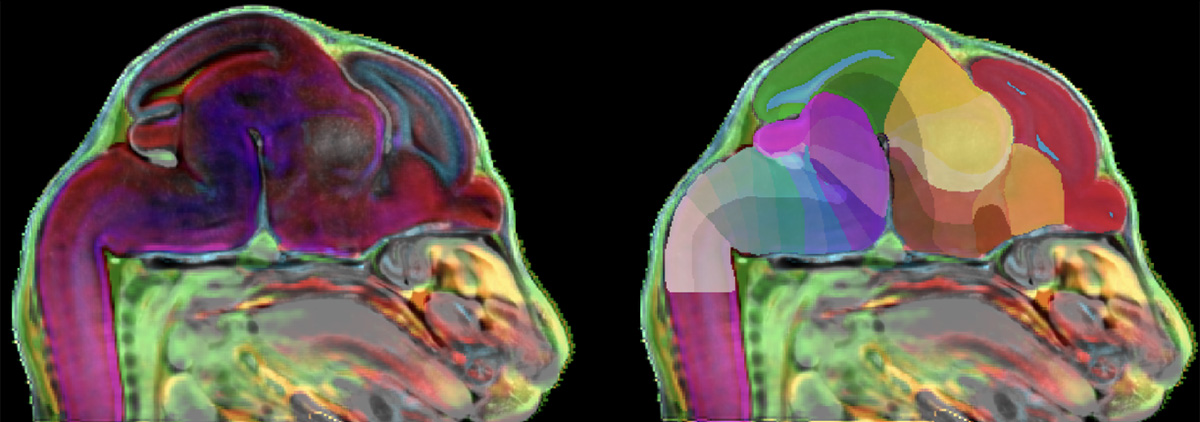
In recent years, there has been tremendous progress in whole brain imaging techniques that let researchers look at the whole brain at high resolution and produce large-scale 3D datasets. To analyze this data, Kim explained, scientists have developed 3D reference atlases of the adult mouse brain, which is a model for the mammalian brain. The atlases provide a universal anatomical framework that allows researchers to overlay diverse datasets and conduct comparative analyses. However, there’s no equivalent for the developing mouse brain, which undergoes rapid changes in shape and volume during the embryonic and post-natal stages.
“Without this 3D map of the developing brain, we cannot integrate data from emerging 3D studies into a standard spatial framework or analyze the data in a consistent manner,” Kim said. In other words, the lack of a 3D map hinders the advancement of neuroscience research.
The research team created a multimodal 3D common coordinate framework of the mouse brain across seven developmental timepoints — four points of time during the embryonic period and three periods during the immediate postnatal phase. Using MRI, they captured images of the brain’s overall form and structure. They then employed light sheet fluorescence microscopy, an imaging technique that enables visualization of the whole brain at a single-cell resolution. These high-resolution images were then matched to the shape of the MRI templates of the brain to create the 3D map. The team pooled samples from both male and female mice.
Creation of the 3D Brain Atlas
To demonstrate how the atlas can be used to analyze different datasets and track how individual cell types emerge in the developing brain, the team focused on GABAergic neurons, which are nerve cells that play a key communication role in the brain. This cell type has been implicated in schizophrenia, autism and other neurological disorders.
While scientists have studied GABAergic neurons in the outermost region of the brain called the cortex, not much is known about how these cells arise in the whole brain during development, according to the researchers. Understanding how these clusters of cells develop under normal conditions may be key to assessing what happens when something goes awry.
To facilitate collaboration and further advancement in neuroscience research, the team created an interactive web-based version that is publicly available and free. The aim is to significantly lower technical barriers for researchers around the world to access this resource.
“This provides a roadmap that can integrate a lot of different data — genomic, neuroimaging, microscopy, and more — into the same data infrastructure. It will drive the next evolution of brain research driven by machine learning and artificial intelligence,” Kim said.
Reference: “Developmental mouse brain common coordinate framework” by Fae N. Kronman, Josephine K. Liwang, Rebecca Betty, Daniel J. Vanselow, Yuan-Ting Wu, Nicholas J. Tustison, Ashwin Bhandiwad, Steffy B. Manjila, Jennifer A. Minteer, Donghui Shin, Choong Heon Lee, Rohan Patil, Jeffrey T. Duda, Jian Xue, Yingxi Lin, Keith C. Cheng, Luis Puelles, James C. Gee, Jiangyang Zhang, Lydia Ng and Yongsoo Kim, 21 October 2024, Nature Communications.
DOI: 10.1038/s41467-024-53254-w
Other Penn State College of Medicine authors on the paper include: Fae Kronman, joint degree student in the MD/PhD Medical Scientist Training Program; Josephine Liwang, doctoral student; Rebecca Betty, research technologist; Daniel Vanselow, research project manager; Steffy Manjila, postdoctoral scholar; Jennifer Minteer, research technologist; Donghui Shin, research technologist; Rohan Patil, student; and Keith Cheng, distinguished professor, department of pathology.
Nicholas Tustison at the University of Virginia School of Medicine; Ashwin Bhandiwad and Lydia Ng at the Allen Institute for Brain Science; Choong Heon Lee and Jiangyang Zhang at the NYU Grossman School of Medicine; Jeffrey Duda and James Gee at the University of Pennsylvania; Jian Xue and Yingxi Lin at the University of Texas Southwestern Medical Center; Luis Puelles at the Universidad de Murcia; and Yuan-Ting Wu, who was previously research scientist at Penn State and currently project scientist at Cedars-Sinai Medical Center, also contributed to the paper.
The National Institutes of Health’s grants RF1MH12460501 from the Brain Research through Advancing Innovative Neurotechnologies (BRAIN) Initiative, R01NS108407, R01MH116176 and R01EB031722 supported this work.
Never miss a breakthrough: Join the SciTechDaily newsletter.
Follow us on Google and Google News.