
Close Menu
    Facebook X (Twitter) Instagram
    SciTechDaily
    • Biology
    • Chemistry
    • Earth
    • Health
    • Physics
    • Science
    • Space
    • Technology
    Facebook X (Twitter) Pinterest YouTube RSS
    SciTechDaily
    Home»Biology»New Research Reveals That People With Anxiety Use a Less Suitable Section of Brain To Control Emotions
    Biology

    New Research Reveals That People With Anxiety Use a Less Suitable Section of Brain To Control Emotions

    By Radboud University NijmegenOctober 9, 2023No Comments3 Mins Read
    Facebook Twitter Pinterest Telegram LinkedIn WhatsApp Email Reddit
    Share
    Facebook Twitter LinkedIn Pinterest Telegram Email Reddit
    Glowing Brain Stimulation
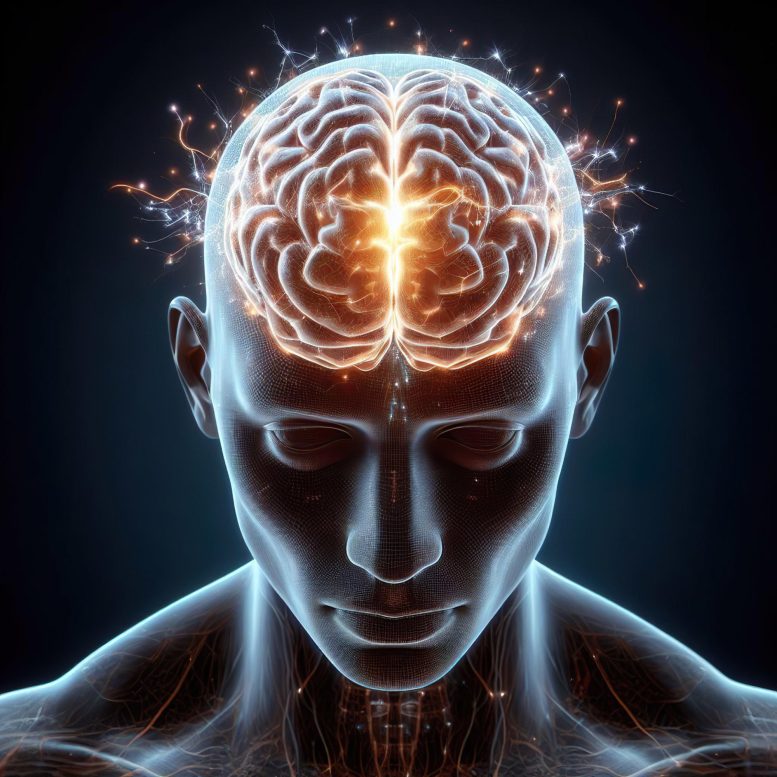
    Anxious individuals utilize a less suitable section of the forebrain when making decisions in socially challenging situations compared to non-anxious people, according to a recent study of brain scans. This difference in brain activity can lead anxious people to avoid social situations, hindering their ability to learn from such experiences.

    In socially challenging situations, individuals with anxiety tend to utilize a different part of the forebrain compared to those without anxiety.

    In socially challenging situations, individuals with anxiety tend to utilize a different region of the forebrain than those without anxiety. This can be seen in brain scans, as shown by the research of Bob Bramson and Sjoerd Meijer at the Donders Institute of Radboud University.

    For example, an anxious and a non-anxious person both run into someone whom they’ve been in love with for quite some time. Both of them find this tense and both would like to ask the person out on a date. But do you walk up to that person? Or do you pretend not to see them to avoid embarrassment?

    Whereas the non-anxious person can put aside this emotion and choose behavior that allows them to approach the potential lover, this is much more difficult for an anxious person. Bramson: “Anxious people use a less suitable section of the forebrain for this control. It’s more difficult for them to choose alternative behavior, so they avoid social situations more often.”

    Decisions like this demand a balancing act between a possible threat and a reward, a decision that non-anxious people make in the prefrontal cortex. Researchers at Radboud University have now shown that socially anxious people use a different section in the forebrain for decisions like this.

    Brain Scans

    Bramson and Meijer studied brain scans to see what happens in anxious and non-anxious people in a simulated social situation. “Our trial subjects were shown happy and angry faces and had to first move a joystick towards the happy face and away from the angry face. At a certain point they had to do the reverse: move towards an angry face and away from a happy face. This demands control over our automatic tendency to avoid negative situations.”

    Anxious people proved to perform just as well as non-anxious people in this simple task, but the scans showed that a completely different section of the brain was active. “In non-anxious people, we often see that, during emotional control, a signal is sent from the foremost section of the prefrontal cortex to the motor cortex, the section of the brain that directs your body to act. In anxious people, a less efficient section of that foremost section is used.” Other scans showed that the reason for this is probably because the ‘correct’ section becomes overstimulated in anxious people. “This could explain why anxious people find it difficult to choose alternative behavior and thus avoid social situations. The disadvantage of this is that they never learn that social situations aren’t as negative as they think.”

    Treating Anxiety

    For the first time, brain scans have now shown that the forebrain of anxious people works differently from that of non-anxious people with regard to control of emotional behavior. The researchers think that the results could be used to develop new treatments for people with anxiety.

    Reference: “Anxious individuals shift emotion control from lateral frontal pole to dorsolateral prefrontal cortex” by Bob Bramson, Sjoerd Meijer, Annelies van Nuland, Ivan Toni and Karin Roelofs, 12 August 2023, Nature Communications.
    DOI: 10.1038/s41467-023-40666-3

    Never miss a breakthrough: Join the SciTechDaily newsletter.
    Follow us on Google and Google News.

    Anxiety Disorders Brain Imaging Neuroscience Radboud University
    Share. Facebook Twitter Pinterest LinkedIn Email Reddit

    Related Articles

    Unmasking Addiction: Scientists Discover Common Brain Network Among People With Substance Use Disorder

    Scientists Uncover Brain Signals for Good Memory Performance

    Scientists Unveil Unprecedented “Live” View Into the Brain’s Complexity

    Scientists Discover That Adversities Can Permanently Change Our Brains

    The Brain’s “Chill Pill” – Gene That Suppresses Anxiety Discovered by Scientists

    Scientists Discover Previously Unknown Anatomical Structure in the Brain

    New Atlases Will Map All 180+ Billion Cells in the Human Brain

    Capturing the Intricacies of the Brain’s Activity at Unprecedented Resolution

    Researchers Use FDDNP–PET Scanning to Predict Cognitive Decline

    Leave A Reply Cancel Reply

    • Facebook
    • Twitter
    • Pinterest
    • YouTube

    Don't Miss a Discovery

    Subscribe for the Latest in Science & Tech!

    Trending News

    One of the Universe’s Largest Stars May Be Getting Ready To Explode

    Scientists Discover Enzyme That Could Supercharge Ozempic-Like Weight Loss Drugs

    Popular Sweetener Linked to DNA Damage – “It’s Something You Should Not Be Eating”

    Ancient “Rock” Microbes May Reveal How Complex Life Began

    Researchers Capture Quantum Interference in One of Nature’s Rarest Atoms

    “A Plague Is Upon Us”: The Mass Death That Changed an Ancient City Forever

    Scientists Discover Game-Changing New Way To Treat High Cholesterol

    This Small Change to Your Exercise Routine Could Be the Secret to Living Longer

    Follow SciTechDaily
    • Facebook
    • Twitter
    • YouTube
    • Pinterest
    • Newsletter
    • RSS
    SciTech News
    • Biology News
    • Chemistry News
    • Earth News
    • Health News
    • Physics News
    • Science News
    • Space News
    • Technology News
    Recent Posts
    • Scientists Prove There Are Just Six Degrees of Separation in a Social Network
    • Bee Bacteria Could Fix a Major Flaw in Plant-Based Milk
    • Scientists Discover a Surprising Way To Make Bread Healthier and More Nutritious
    • Natural Compounds Boost Bone Implant Success While Killing Bacteria and Cancer Cells
    • After 60 Years, Scientists Uncover Unexpected Brain Effects of Popular Diabetes Drug Metformin
    Copyright © 1998 - 2026 SciTechDaily. All Rights Reserved.
    • Science News
    • About
    • Contact
    • Editorial Board
    • Privacy Policy
    • Terms of Use

    Type above and press Enter to search. Press Esc to cancel.