
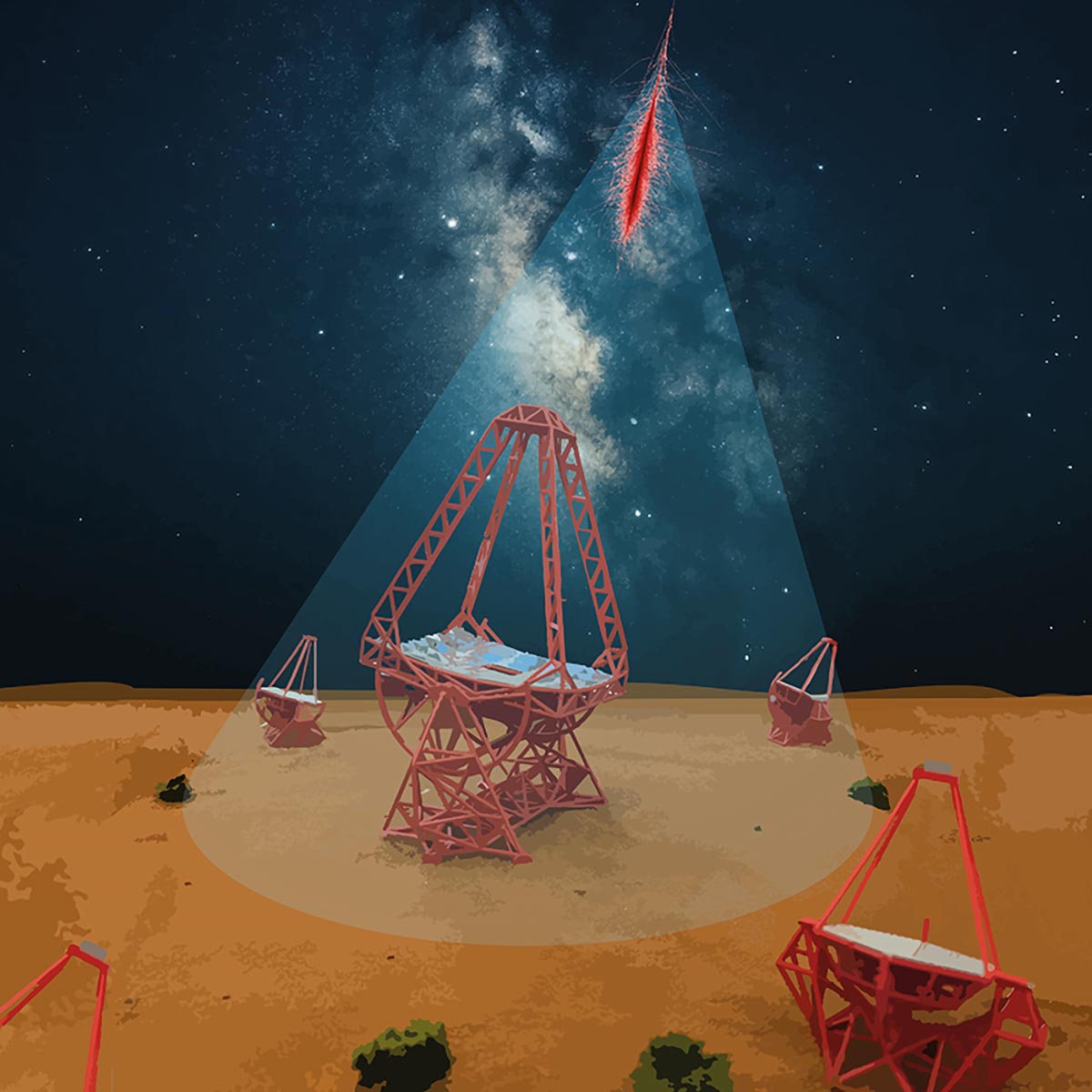
Researchers use the H.E.S.S. Observatory to overcome the challenge of detecting high-energy cosmic-ray electrons and positrons, revealing their likely origins close to our solar system through advanced data analysis techniques.
The Universe is filled with extreme environments, from the coldest regions to the most energetic sources imaginable. These conditions give rise to extraordinary objects like supernova remnants, pulsars, and active galactic nuclei, which emit charged particles and gamma rays with energies far exceeding those produced by the nuclear fusion processes in stars—by several orders of magnitude.
Challenges in Cosmic Ray Detection
Gamma rays detected on Earth provide valuable insights into their origins because they travel through space undisturbed. However, understanding charged particles, or cosmic rays, is far more challenging. These particles are constantly deflected by the magnetic fields that permeate the Universe, causing them to reach Earth isotropically—that is, from all directions. Along the way, they lose energy through interactions with light and magnetic fields. These energy losses are particularly significant for the most energetic electrons and positrons, known as cosmic-ray electrons (CRe), which carry energy exceeding one teraelectronvolt (TeV)—a staggering 1,000 billion times the energy of visible light.[1]
As a result, pinpointing the exact origin of these high-energy particles in space is impossible. Nevertheless, their detection on Earth confirms the presence of extremely powerful cosmic-ray accelerators in our galactic neighborhood.
Ground-Based Observations at H.E.S.S.
However, detecting electrons and positrons with energies of several teraelectronvolts is particularly challenging. Space-based instruments, with detection areas of around one square meter, are unable to capture sufficient numbers of such particles, which become increasingly rare the higher their energy. Ground-based instruments on the other hand, which indirectly detect the arrival of cosmic rays via the showers of particles they produce in the Earth’s atmosphere, are faced with the challenge of differentiating the showers triggered by cosmic-ray electrons (or positrons) from the much more frequent showers produced by the impact of the heavier cosmic-ray protons and nuclei.
The H.E.S.S. Observatory[2] located in Namibia uses five large telescopes to capture and record the faint Cherenkov radiation produced by the heavily charged particles and photons that enter the Earth’s atmosphere, producing a shower of particles in their wake. Although the Observatory’s main purpose is to detect and select gamma rays in order to investigate their sources, the data can also be used to search for cosmic-ray electrons.
Breakthroughs in Cosmic-Ray Research
In the most extensive analysis ever carried out, H.E.S.S. collaboration scientists have now obtained new information about the origin of these particles. The astrophysicists did this by combing through the huge data set collected over the course of a decade by the four 12-meter telescopes, applying new, more powerful selection algorithms capable of extracting the CRe from the background noise with unprecedented efficiency. This resulted in an unrivaled set of statistical data for the analysis of cosmic-ray electrons. More specifically, the H.E.S.S. researchers were able to obtain for the first time data about CRe in the highest energy ranges, all the way up to 40 TeV. This enabled them to identify a surprisingly sharp break in the energy distribution of the cosmic-ray electrons.
“This is an important result, as we can conclude that the measured CRe most likely originate from very few sources in the vicinity of our own solar system, up to a maximum of a few 1000 light years away, a very small distance compared to the size of our Galaxy,” explains Kathrin Egberts, from the University of Potsdam, one of the corresponding authors of the study.
“We were able to put severe constraints on the origin of these cosmic electrons with our detailed analysis for the first time,” adds Prof. Hofmann from the Max-Planck-Institut für Kernphysik, co-author of the study.
“The very low fluxes at larger TeV limit the possibilities of space-based missions to compete with this measurement. Thereby, our measurement does not only provide data in a crucial and previously unexplored energy range, impacting our understanding of the local neighborhood, but it is also likely to remain a benchmark for the coming years,” Mathieu de Naurois, CNRS Researcher from the Laboratoire Leprince-Ringuet, adds.
Notes
- 1 TeV = 1012 electronvolts.
- High-energy gamma rays can be observed from the ground only because of a very specific phenomenon. When a gamma ray enters the atmosphere it collides with its atoms and molecules, producing new particles that sweep towards the ground rather like an avalanche. The particles emit flashes lasting mere billionths of a second (Cherenkov radiation), which can be observed using large, specially equipped ground-based telescopes. The H.E.S.S. Observatory, located in the Khomas Highlands of Namibia at an altitude of 1835 m, officially began operation in 2002. It comprises an array of five telescopes. Four telescopes with mirrors 12 m in diameter are located at the corners of a square, with another 28 m telescope at the centre. This makes it possible to detect cosmic gamma rays ranging from a few tens of gigaelectronvolts (GeV, 109 electronvolts) to a few tens of teraelectronvolts (TeV, 1012 electronvolts). By comparison, photons of visible light have an energy of two to three electronvolts. H.E.S.S. is currently the only instrument observing the southern sky in high-energy gamma-ray light. It is also the largest and most sensitive telescope system of its kind.
Reference: “High-Statistics Measurement of the Cosmic-Ray Electron Spectrum with H.E.S.S.” 18 November 2024, Physical Review Letters.
Never miss a breakthrough: Join the SciTechDaily newsletter.
Follow us on Google and Google News.