
Despite new guidelines warning against daily aspirin use for healthy older adults, many Americans still believe it is beneficial. A survey found that 18% of those without a history of heart disease or stroke take aspirin regularly, even though the risks outweigh the benefits for most.
For years, doctors advised healthy older adults to take a low-dose aspirin daily to reduce the risk of heart attack. However, in March 2019, the American College of Cardiology and the American Heart Association (AHA) issued new guidelines, no longer recommending a daily aspirin for healthy adults over 70, as the risk of gastrointestinal bleeding outweighs the benefits.
Nearly five years later, many Americans still haven’t received the message.
A new health survey by the Annenberg Public Policy Center (APPC) at the University of Pennsylvania found that nearly half (48%) of U.S. adults incorrectly believe that, for most people, the benefits of taking a daily low-dose aspirin to prevent heart attack or stroke outweigh the risks.
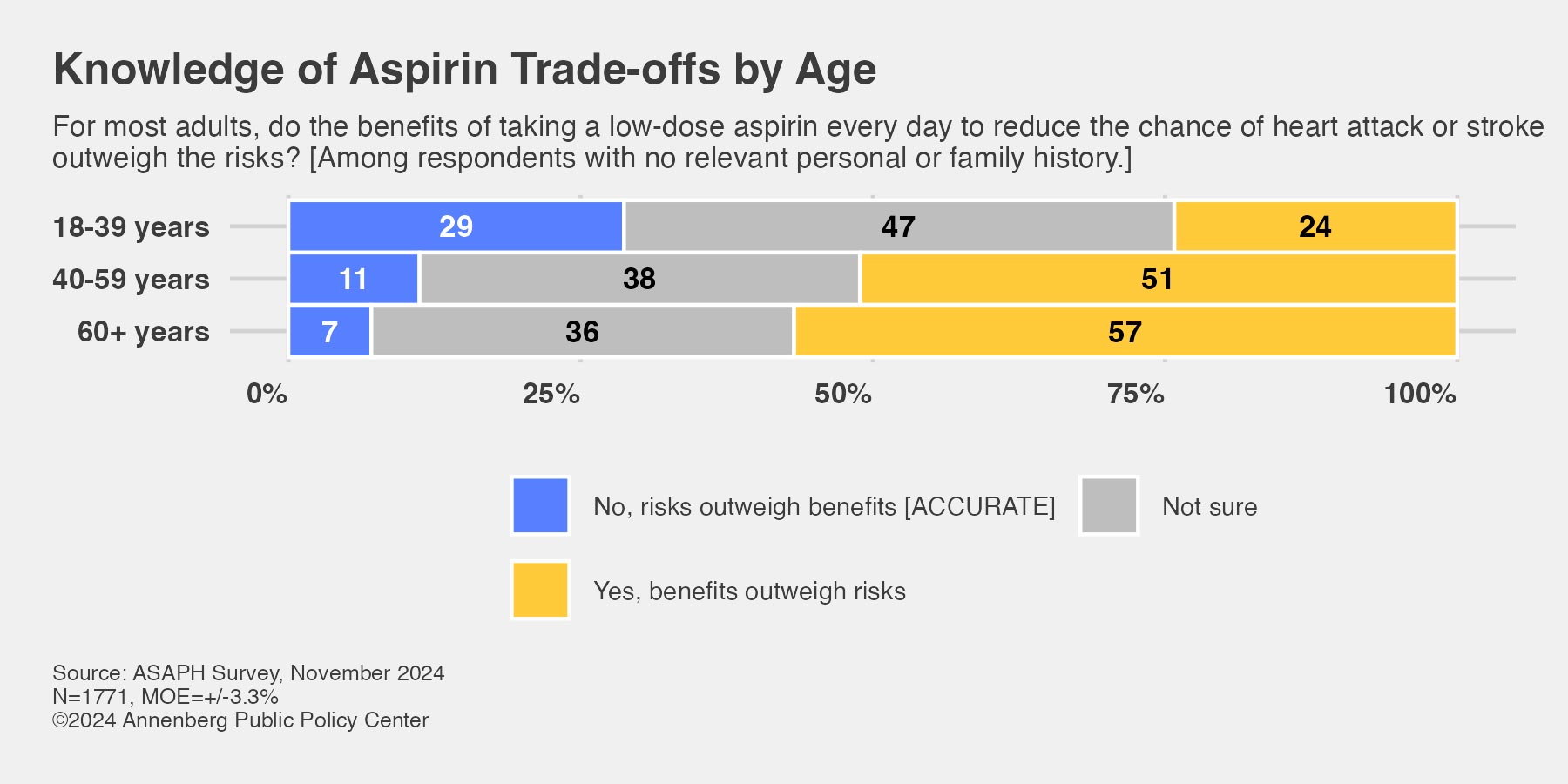
In all, nearly 1 in 5 U.S. adults who say they have no personal or family history of heart attack or stroke report routinely taking a low-dose aspirin, with 10% saying they take it “basically every day,” 2% “a few times a week,” and 6% “a few times a month.”
The past rationale for routine low-dose aspirin use was that aspirin acts as a blood thinner and reduces the clotting that can clog arteries and lead to heart attack or stroke. Low-dose aspirin is still considered an important strategy for preventing heart attack in people who have been diagnosed with cardiovascular disease and are not at risk of increased bleeding.
But doctors’ recommendations for healthy adults have shifted on the risks and benefits of taking a low-dose (typically 81 mg.) aspirin. In 2022, three years after the publication of the new AHA guidelines, the U.S. Preventative Services Task Force recommended against starting a new regimen of low-dose aspirin use for the primary prevention of cardiovascular disease for an even larger group of older adults – those 60 and older without a history of cardiovascular disease (including heart failure and stroke) or signs or symptoms of cardiovascular disease.
“Habits backed by conventional wisdom and the past advice of health care providers are hard to break,” noted Kathleen Hall Jamieson, director of the Annenberg Public Policy Center and director of the survey. “Knowing whether taking a low-dose aspirin daily is advisable or not for you is vital health information.”
Who takes a daily low-dose aspirin?
In the survey, 45% of respondents report that they or someone in their family has had a heart attack or stroke, while 49% do not have a family history of heart attack or stroke (6% are not sure). A 2024 AHA report estimates that 3.1% of Americans age 20 and older have had a heart attack and 3.3% have had a stroke, and over 48% of adults 20 and older have cardiovascular disease, including coronary heart disease, heart failure, stroke, or hypertension.
Those with a personal history of heart attack or stroke may be directed to take a low-dose daily aspirin by their doctors. Those 40- to 59-year-olds who have a 10% or greater 10-year cardiovascular risk also may be directed to take aspirin, in line with the recommendations. Still, the survey finds that 18% of those with no history of heart attack or stroke report regularly taking a daily low-dose aspirin and 43% of this no-history group say that for most adults, the benefits of doing so outweigh the risks.
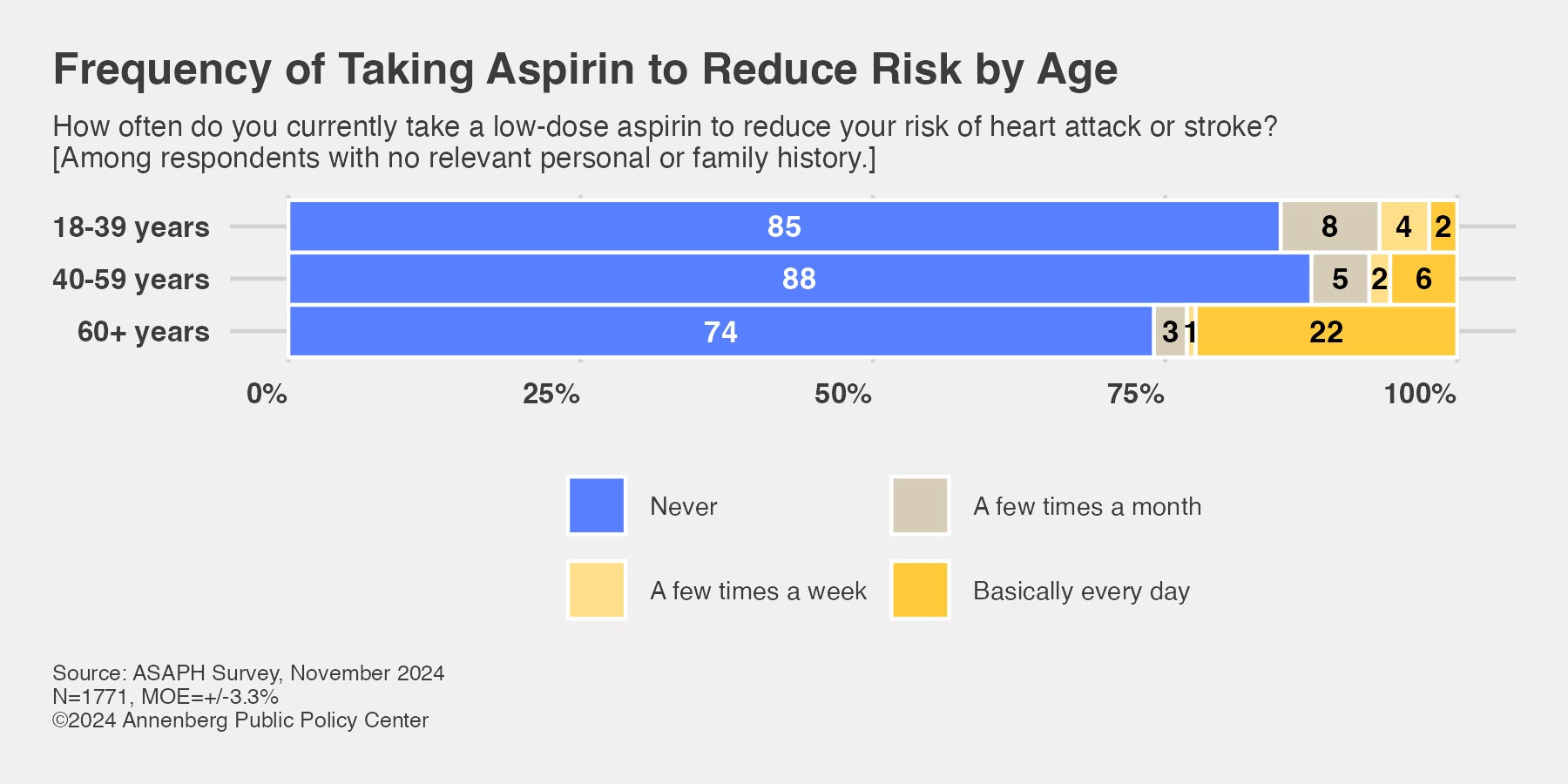
Among the group with no history, younger survey respondents are more likely to correctly report that the risks outweigh the benefits – possibly because older respondents are more familiar with the earlier guidance. Twenty-nine percent of respondents with no relevant medical history who are 18 to 39 years old correctly say that the risks of a daily aspirin outweigh the benefits, compared with 11% of those 40 to 59 years old and 7% of those 60 and older.
APPC’s Annenberg Science and Public Health knowledge survey
The survey data come from the 22nd wave of a nationally representative panel of 1,771 U.S. adults conducted for the Annenberg Public Policy Center by SSRS, an independent market research company. Most have been empaneled since April 2021. To account for attrition, small replenishment samples have been added over time using a random probability sampling design. The most recent replenishment, in September 2024, added 360 respondents to the sample. This wave of the Annenberg Science and Public Health Knowledge (ASAPH) survey was fielded Nov. 14-24, 2024. The margin of sampling error (MOE) is ± 3.3 percentage points at the 95% confidence level. All figures are rounded to the nearest whole number and may not add to 100%. Combined subcategories may not add to totals in the topline and text due to rounding.
Download the topline and the methods report.
Never miss a breakthrough: Join the SciTechDaily newsletter.
Follow us on Google and Google News.
8 Comments
Well, maybe there shouldn’t have been ads about it on TV for years, then.
Medical research changes the best advice known at the time, but no-one is making any money out of not selling you something. The private health industry isn’t there for the good of your health. We need a non-profit government-regulated health care system that is there solely to screw us over.
*NOT there solely there to screw us over. lol.
What dave saud
Correction Said
Said
Corection Said
It’s not a duplicate it’s a Correction Said