
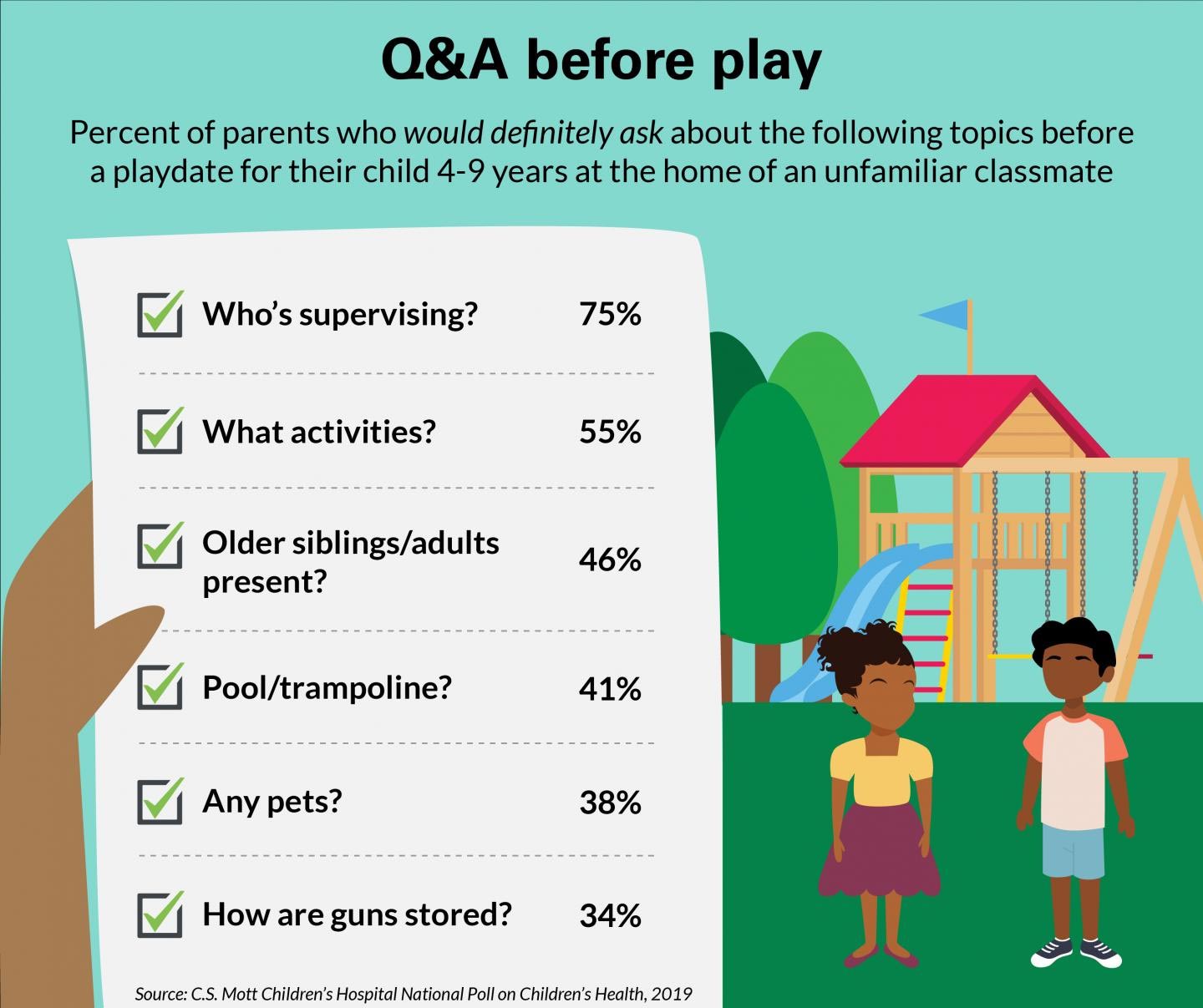
Many parents aren’t comfortable with their child playing at another family’s home — but only 1 in 4 have been asked about safety issues by another parent pre-playdate.
The new school year often leads to playdate invitations, sometimes between families who don’t know each other.
But parents don’t always agree to such invites, with nearly half in a new national poll saying they have declined a playdate because they didn’t feel comfortable leaving their child in the other parent’s care.
Parents’ top concerns about playdates include children being unsupervised, hearing inappropriate language, getting into medications and harmful substances, and getting injured, according to the C.S. Mott Children’s Hospital National Poll on Children’s Health at the University of Michigan.
Despite such concerns, just 1 in 4 parents have been asked about safety issues by another parent before a playdate, the poll suggests.
“Playdates allow children to develop independence, gain experience interacting with other children in an unstructured setting, and have fun with a friend,” says Mott Poll co-director Sarah Clark. “Before parents send their child on a playdate, they need to feel confident that their child will be safe and appropriately supervised.”
“Making sure children will be safe and well supervised during a playdate often means asking the host parents about key safety issues. However, our poll suggests that many parents are not proactive when it comes to having these conversations.”
The report is based on responses from 881 parents who had at least one child ages 4-9. When invited to a playdate at the house of a family they don’t know well, 22% of parents would let their child go without them, while 43% would stay with their child. Another 22% would decline the offer to a playdate.
Influences on parent decisions about playdates include the child being shy around strangers (17%), being afraid of certain pets (11%), having a food allergy/special diet (8%), or having a health condition (6%).
The majority of parents say they would try to meet the other parents before the playdate. Some would also try to learn about the other parents by asking friends and neighbors, checking social media, going to the other family’s neighborhood, searching sex offender registry/criminal records, or asking a teacher or other school staff.
“Many parents seem to be cautious about sending their child on a playdate at a new friend’s home, especially if they aren’t familiar with the family hosting the playdate,” Clark says. “There are several steps they can take ahead of time, including meeting and talking to the family, that may help them decide how to respond to a playdate invitation.”
But there are other aspects that parents should consider about playdates, such as supervision, risks related to activities such as trampolines and pools, and whether the host family owns harmful medications or guns — and if so, whether they are locked and stored safely away from the children.
However, few parents seem to be asking these questions, Clark says, which may reflect their worry about the host family’s reaction. However, three-quarters of parents in this poll said they wouldn’t be offended if another parent asked about playdate safety.
Clark suggests parents have a plan for a pre-playdate conversation to go over concerns.
“It may be helpful to develop a checklist to guide the conversation,” Clark says. “This could include asking questions about supervision, weapon and medication storage, and the family’s rules about potentially hazardous activities like using a trampoline.
“Parents should also communicate in advance if their child is fearful of certain types of pets or has allergies. Together, parents sending their child on a playdate and the host family can determine strategies to help children feel safe and comfortable.”
Never miss a breakthrough: Join the SciTechDaily newsletter.
Follow us on Google and Google News.