
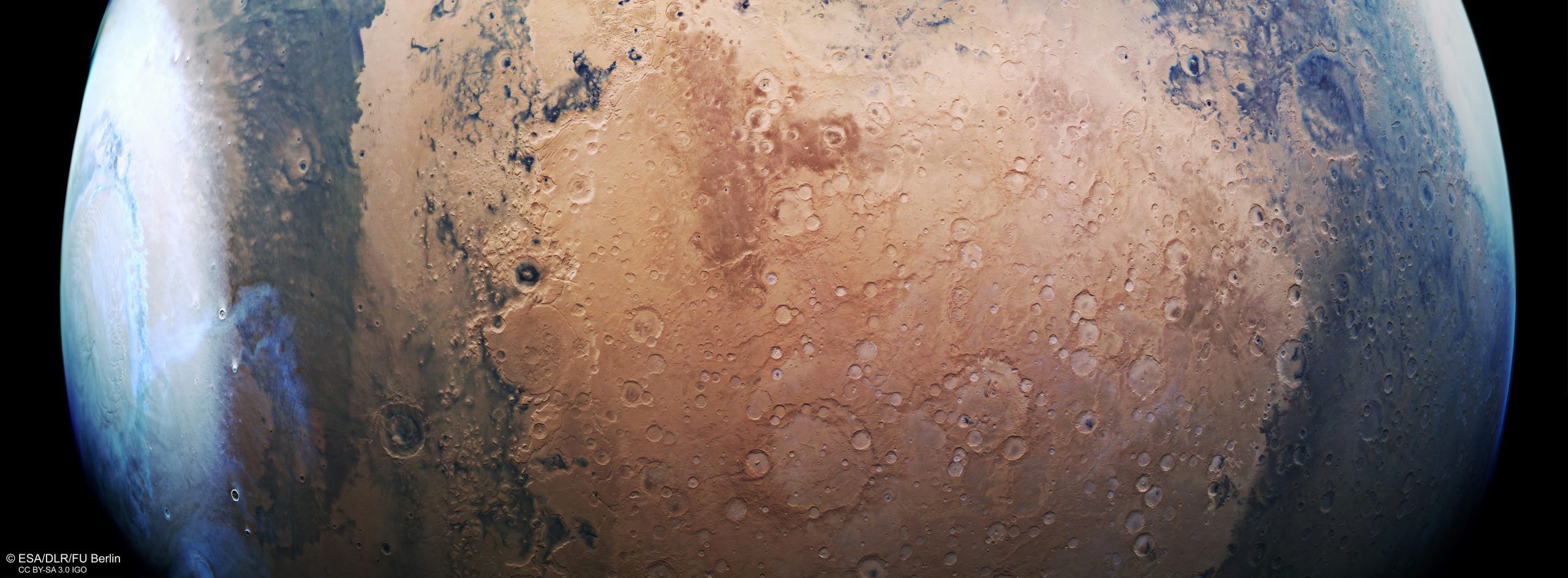
Mars celebrates a new year based on its orbit around the Sun, which takes 687 Earth days—nearly twice as long as Earth’s year.
Five, four, three, two, one…. FIREWORKS! The countdown to a new year is in many ways a defining moment for our lives on Earth. Our age, our seasons, filing our taxes… – all depend on the duration of Earth’s orbit around the Sun.
On Mars, there are no yearly tax returns, but as the planet also orbits around our Sun, time on Mars is similarly measured in years. However, there are some significant differences between a year on Mars and a year on Earth. As we approach New Year’s Eve on Mars, let’s look at some similarities and differences between a year on the two planets.

- One year on Mars equals 687 Earth days. It takes almost twice as long as our Earth to orbit the Sun. This means your age would be a lot less if you lived on Mars! If you would like to feel younger, just divide your current age by 1.88 and casually mention to your friends that that’s your real age … on Mars.
- A Martian day is defined, like on Earth, as the time it takes for the planet to make one revolution around its axis. This is called a sol. A sol is only slightly longer than an Earth day: 24 hours and 39 minutes.
- Mars has four seasons: winter, spring, summer, and autumn. They are defined by the planet’s position along its orbit around the Sun. The Martian New Year begins with the northward equinox (northern spring, southern autumn). As Mars travels through its yearly trajectory, the planet’s axial tilt causes the northern hemisphere to receive more sunlight during the northern summer, and the southern hemisphere to receive more sunlight in the northern winter – just like on Earth. Unlike Earth’s seasons, however, the seasons on Mars are not of equal lengths. This is because the orbit of Mars around the Sun is more elliptical than that of Earth. For example, the northern hemisphere spring (southern hemisphere autumn) lasts the longest, 194 sols, and the northern hemisphere autumn (southern hemisphere spring) is the shortest season at 142 sols.
- Mars’ elliptical orbit can have important consequences. During southern spring and summer, Mars swings by the sun closer and faster. The resulting increase in luminosity heats up the atmosphere, causing turbulence to lift up very fine particles from the Martian soil. For this reason, the second half of a Martian year is often marked by fierce dust storms that can sometimes become planet-wide.
- Like on Earth, winters are cold and summers are warm on Mars, but the planet’s overall temperature is a lot cooler, it has a yearly average temperature of minus 60 degrees Celsius (-76 degrees Fahrenheit). The planet experiences different weather phenomena throughout the seasons. A weather phenomenon that reappears every year around the southern spring and summer is the Arsia Mons Elongated Cloud, a cloud of ice crystals that can reach up to 1,800 kilometers (1,100 miles) in length. It repeats for at least 80 sols and then disappears again during the rest of the year.
- The Martian calendar began fairly recently compared to the one on Earth. The count started in Earth year 1955. This first Martian year coincided with a very large dust storm in its second half, aptly named ‘the great dust storm of 1956’.
February 7, 2021 marks the start of Year 36 on Mars. The dates of the next couple of New Years can be found in the table below.
If you’re looking for a reason to celebrate, here’s to a Happy New Mars Year!
| Mars year | Earth date |
| 36 | February 7, 2021 |
| 37 | December 26, 2022 |
| 38 | November 12, 2024 |
| 39 | September 30, 2026 |
| 40 | August 17, 2028 |
Never miss a breakthrough: Join the SciTechDaily newsletter.
Follow us on Google and Google News.
1 Comment
You defined the Martian day (sol) incorrectly. A day is not the time for one complete rotation about the axis. It is the time for one rotation relative to the Sun. The Earth, for example, rotates once every 23 hours, 56 minutes and 4 second.