

Close Menu
    Facebook X (Twitter) Instagram
    SciTechDaily
    • Biology
    • Chemistry
    • Earth
    • Health
    • Physics
    • Science
    • Space
    • Technology
    Facebook X (Twitter) Pinterest YouTube RSS
    SciTechDaily
    Home»Technology»Harnessing Blue Energy: The Sustainable Power Source of Tomorrow
    Technology

    Harnessing Blue Energy: The Sustainable Power Source of Tomorrow

    By Osaka UniversityAugust 15, 2024No Comments3 Mins Read
    Facebook Twitter Pinterest Telegram LinkedIn WhatsApp Email Reddit
    Share
    Facebook Twitter LinkedIn Pinterest Telegram Email Reddit
    Abstract Blue Energy Art Concept
    A study from Osaka University highlights advances in blue energy technology, demonstrating how voltage-controlled nanopore membranes can enhance the efficiency and scalability of this sustainable alternative to fossil fuels.

    Researchers at Osaka University have demonstrated how to control the flow of ions through a nanopore membrane by applying voltage to a gate electrode, potentially advancing the harvesting of sustainable blue energy.

    Blue energy offers a promising sustainable alternative to fossil fuels by harnessing the energy generated when ions in a salt solution move from areas of high concentration to low concentration. Researchers from Osaka University have explored how applying voltage affects ion movement through a nanopore membrane, achieving improved control over the process.

    In a study recently published in ACS Nano the researchers looked at tailoring the flow of ions through the array of nanopores that make up their membrane, and how this control could make applying the technology on a large scale a reality.
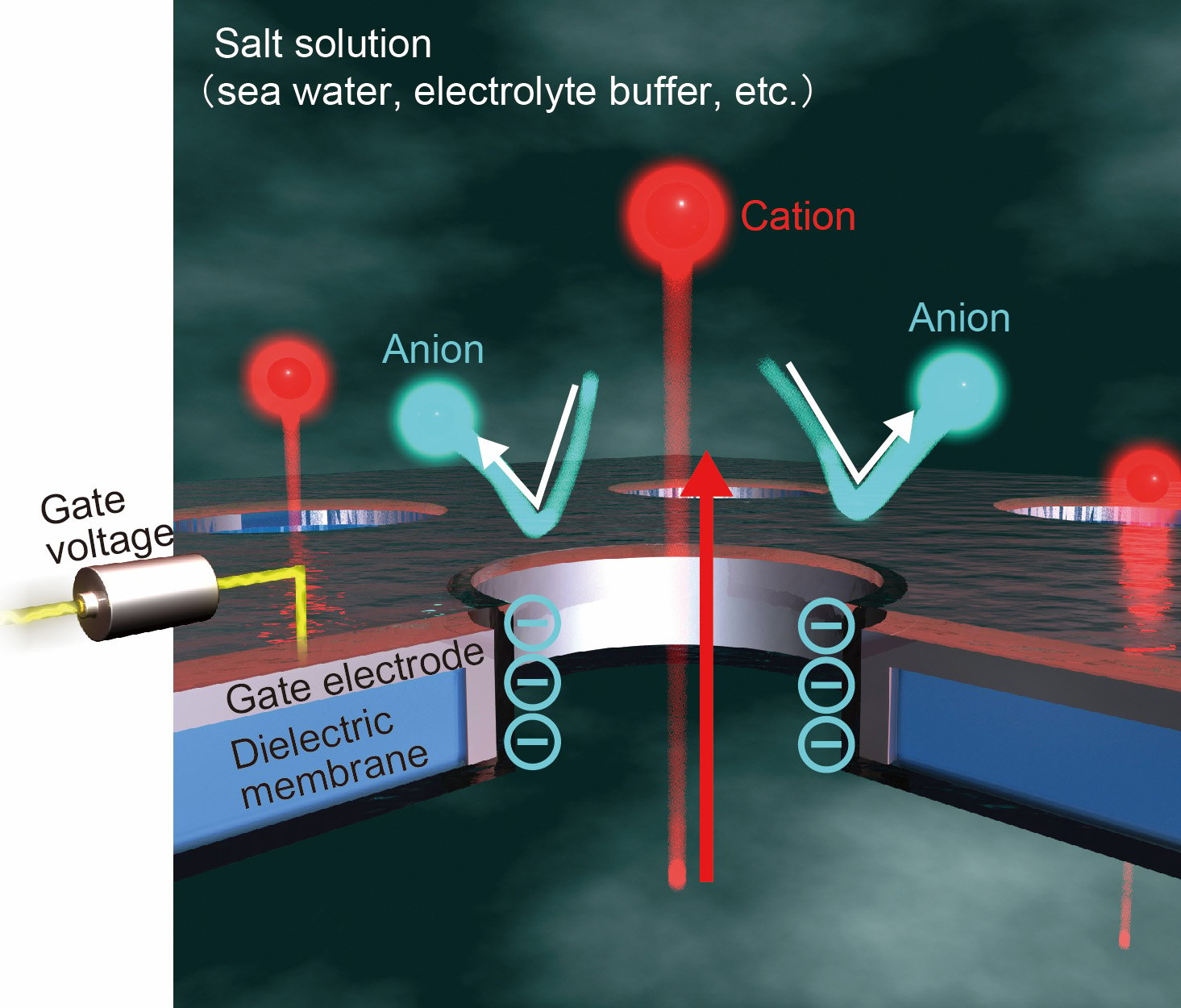
    Gate Voltage Control of Ion Selectivity in a Nanopore
    Schematic illustration depicting gate voltage control of ion selectivity in a nanopore. Credit: Makusu Tsutsui

    If the membranes are made from a charged material, nanopores can cause a current to flow through them by attracting solution ions with the opposite charge. The ions with the same charge can then move through the pore generating the current. This means that the pore material is very important and choosing it has been the means of controlling the flow and current to date.

    However, producing the exact same pore structures in a range of different materials to understand their comparative performances is challenging. The researchers therefore decided to investigate another way of tailoring the flow of ions across nanopore membranes.

    Voltage Application and Its Effects

    “Instead of simply using the basic surface charge of our membrane to dictate the flow, we looked at what happens when voltages are applied,” explains study lead author Makusu Tsutsui. “We used a gate electrode embedded across the membrane to control the field through voltage in a similar way to how semiconductor transistors work in conventional circuits.”

    The researchers found that with no voltage applied there was no charge generated by the flow of cations—positively charged ions—because they were attracted to the negatively charged membrane surface.

    However, if different voltages were applied, this performance could be tuned to allow cations to flow, even providing complete selectivity for cations. This led to a six-fold increase in the osmotic energy efficiency.

    “By enhancing the charge density at the surface of the nanopores that make up the membrane, we achieved a power density of 15 W/m2,” says senior author Tomoji Kawai. “This is very encouraging in terms of progressing the technology.”

    The study findings reveal the potential for scaling nanopore membranes for everyday application. It is hoped that nanopore osmotic power generators will provide a means of bringing blue energy to the mainstream for a more sustainable energy future.

    Reference: “Gate-All-Around Nanopore Osmotic Power Generators” by Makusu Tsutsui, Wei-Lun Hsu, Denis Garoli, Iat Wai Leong, Kazumichi Yokota, Hirofumi Daiguji and Tomoji Kawai, 28 May 2024, ACS Nano.
    DOI: 10.1021/acsnano.4c01989

    The study was funded by the Japan Society for the Promotion of Science.

    Never miss a breakthrough: Join the SciTechDaily newsletter.
    Follow us on Google and Google News.

    Energy Nanotechnology Renewable Energy University of Osaka
    Share. Facebook Twitter Pinterest LinkedIn Email Reddit

    Related Articles

    Researchers Develop First Fully Integrated Nanosystem for Artificial Photosynthesis

    Black Titanium Dioxide Nanoparticles Could Play Key Role in Clean Energy Photocatalysis

    Boron Nitride Nanotubes Channel Osmotic Power

    New Carbon Films Pave the Way for the Next Generation of Solar Cells

    First All Carbon Solar Cell Made From Nanotubes and Buckyballs

    Nanosheet-Flower Structure Boosts Energy Storage

    Highly Transparent Polymer Solar Cell Produces Energy by Absorbing Near-Infrared Light

    Textured Surface Maintains Efficiency and Reduces Thickness of Silicon Solar Cells

    Researchers Study the Use of Photosystem-I as Photovoltaic Panels

    Leave A Reply Cancel Reply

    • Facebook
    • Twitter
    • Pinterest
    • YouTube

    Don't Miss a Discovery

    Subscribe for the Latest in Science & Tech!

    Trending News

    Breakthrough Bowel Cancer Trial Leaves Patients Cancer-Free for Nearly 3 Years

    Natural Compound Shows Powerful Potential Against Rheumatoid Arthritis

    100,000-Year-Old Neanderthal Fossils in Poland Reveal Unexpected Genetic Connections

    Simple “Gut Reset” May Prevent Weight Gain After Ozempic or Wegovy

    2.8 Days to Disaster: Scientists Warn Low Earth Orbit Could Suddenly Collapse

    Common Food Compound Shows Surprising Power Against Superbugs

    5 Simple Ways To Remember More and Forget Less

    The Atomic Gap That Could Cost the Semiconductor Industry Billions

    Follow SciTechDaily
    • Facebook
    • Twitter
    • YouTube
    • Pinterest
    • Newsletter
    • RSS
    SciTech News
    • Biology News
    • Chemistry News
    • Earth News
    • Health News
    • Physics News
    • Science News
    • Space News
    • Technology News
    Recent Posts
    • After 37 Years, the World’s Longest-Running Soil Warming Experiment Uncovers a Startling Climate Secret
    • NASA Satellite Captures First-Ever High-Res View of Massive Pacific Tsunami
    • ADHD Isn’t Just a Deficit: Study Reveals Powerful Hidden Strengths
    • Scientists Uncover “Astonishing” Hidden Property of Light
    • Scientists Discover Stem Cells That Could Regrow Teeth and Bone
    Copyright © 1998 - 2026 SciTechDaily. All Rights Reserved.
    • Science News
    • About
    • Contact
    • Editorial Board
    • Privacy Policy
    • Terms of Use

    Type above and press Enter to search. Press Esc to cancel.