
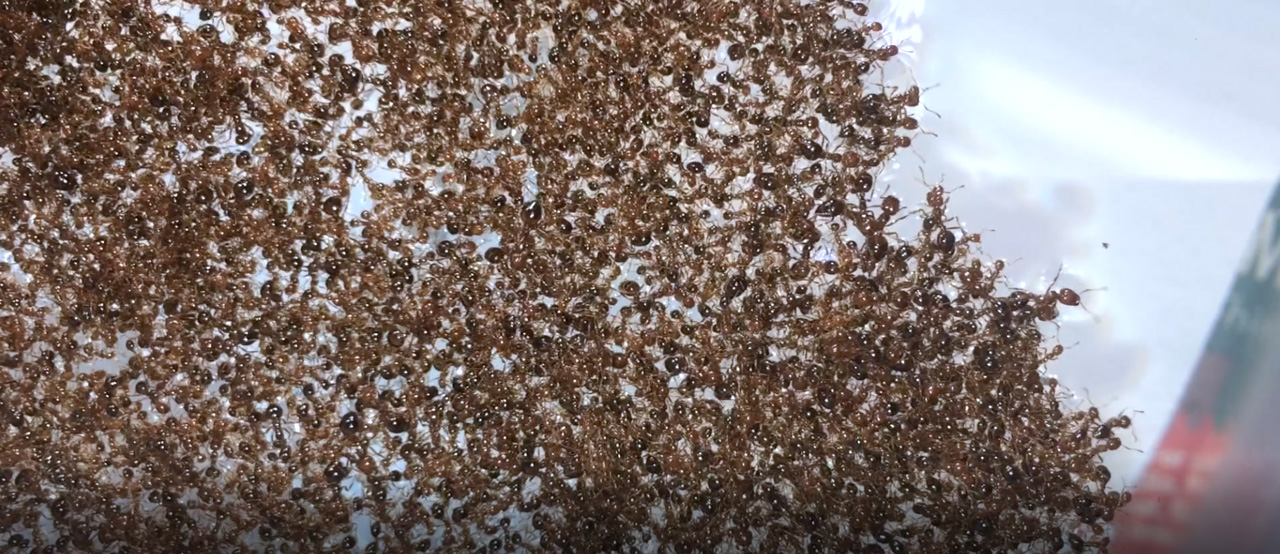
A new study examines the way ant ‘rafts’ come together to ensure survival during floods.
Fire ants form rafts to survive flooding, but how do those bonds work? And what can we learn from them? A Binghamton University, State University of New York professor is researching those questions to expand our knowledge of materials science.
When flooding hits a region where fire ants live, their survival response is to latch together to form a buoyant “raft” that floats and keeps the colony united. Think of it like a condensed, adaptive material where the building blocks — individual ants — are actually alive.
Binghamton University Assistant Professor Rob Wagner led the research as part of the Vernerey Soft Matter Mechanics Lab at the University of Colorado Boulder in which they investigated the adaptive response of these living rafts. The goals are to understand how they autonomously morph and change their mechanical properties, and then incorporate the simplest and most useful discoveries into artificial materials.
“Living systems have always fascinated me, because they achieve things that our current engineered materials cannot — not even close,” he said. “We manufacture bulk polymeric systems, metals, and ceramics, but they’re passive. The constituents don’t store energy and then convert it to mechanical work the way every single living system does.”
Wagner sees this storage and conversion of energy as essential to mimicking the smart and adaptive behaviors of living systems.
Comparing Ant Rafts to Polymers
In their most recent publication in the Proceedings of the National Academy of Sciences, Wagner and his co-authors at the University of Colorado investigated how fire ant rafts responded to mechanical load when stretched, and they compared the response of these rafts to dynamic, self-healing polymers.
“Many polymers are held together by dynamic bonds that break, but can reform,” Wagner said. “When pulled slowly enough, these bonds have time to restructure the material so that — instead of fracturing — it flows like the slime our kids play with, or soft-serve ice cream. When pulled very fast, though, it breaks more like chalk. Since the rafts are held together by ants clinging onto one another, their bonds can break and reform. So, my colleagues and I thought they’d do the same thing.”
But Wagner and his collaborators discovered that no matter what speed they pulled the ant rafts, their mechanical response was nearly the same, and they never flowed. Wagner speculates that the ants reflexively tighten and prolong their holds when they feel force because they want to stay together. They either turn down or turn off their dynamic behavior.
Experiement to test how fire ant rafts responded to mechanical load when stretched. Credit: Robert Wagner
This phenomenon of bonds that grow stronger when force is applied to them is called catch bond behavior, and it likely enhances cohesion for the colony, which makes sense for survival.
“As you pull on typical bonds with some amount of force, they’re going to let go sooner, and their lifetime goes down — you’re weakening the bond by pulling on it. That is what you see in almost any passive system,” Wagner said. “But in living systems, because of their complexity, you can sometimes have catch bonds that hold on for longer durations under some range of applied force. Some proteins do this mechanistically and automatically, but it’s not like the proteins are making a decision. They’re just arranged in such a way that when a force is applied, it reveals these binding sites that latch or ‘catch’.”
Wagner believes that mimicking these catch bonds in engineered systems could lead to artificial materials that exhibit autonomous, localized self-strengthening in regions of higher mechanical stress. This could enhance the lifetimes of biomedical implants, adhesives, fiber composites, soft robotics components, and many other systems.
Collective insect aggregations like fire ant rafts already are inspiring researchers to develop materials with stimuli-responsive mechanical properties and behaviors. A paper in Nature Materials earlier this year — led by the Ware Responsive Biomaterials Lab at Texas A&M and including contributions from Wagner and his former thesis advisor, Professor Franck J. Vernerey — demonstrates how ribbons made of special gels or materials called liquid crystal elastomers can coil due to heating, and then entangle with each other to form condensed, solid-like structures that were inspired by these ants
“A natural progression of this work is to answer how we can get the interactions between these ribbons or other soft building blocks to ‘catch’ under load like the fire ants and some biomolecular interactions do,” Wagner said.
Reference: “Catch bond kinetics are instrumental to cohesion of fire ant rafts under load” by Robert J. Wagner, Samuel C. Lamont, Zachary T. White and Franck J. Vernerey, 15 April 2024, Proceedings of the National Academy of Sciences.
DOI: 10.1073/pnas.2314772121
Never miss a breakthrough: Join the SciTechDaily newsletter.
Follow us on Google and Google News.