
Close Menu
    Facebook X (Twitter) Instagram
    SciTechDaily
    • Biology
    • Chemistry
    • Earth
    • Health
    • Physics
    • Science
    • Space
    • Technology
    Facebook X (Twitter) Pinterest YouTube RSS
    SciTechDaily
    Home»Space»Harvard Astronomers Find Evidence of Shocked Gas in Galaxy Collisions
    Space

    Harvard Astronomers Find Evidence of Shocked Gas in Galaxy Collisions

    By Harvard-Smithsonian Center for AstrophysicsApril 28, 2017No Comments3 Mins Read
    Facebook Twitter Pinterest Telegram LinkedIn WhatsApp Email Reddit
    Share
    Facebook Twitter LinkedIn Pinterest Telegram Email Reddit
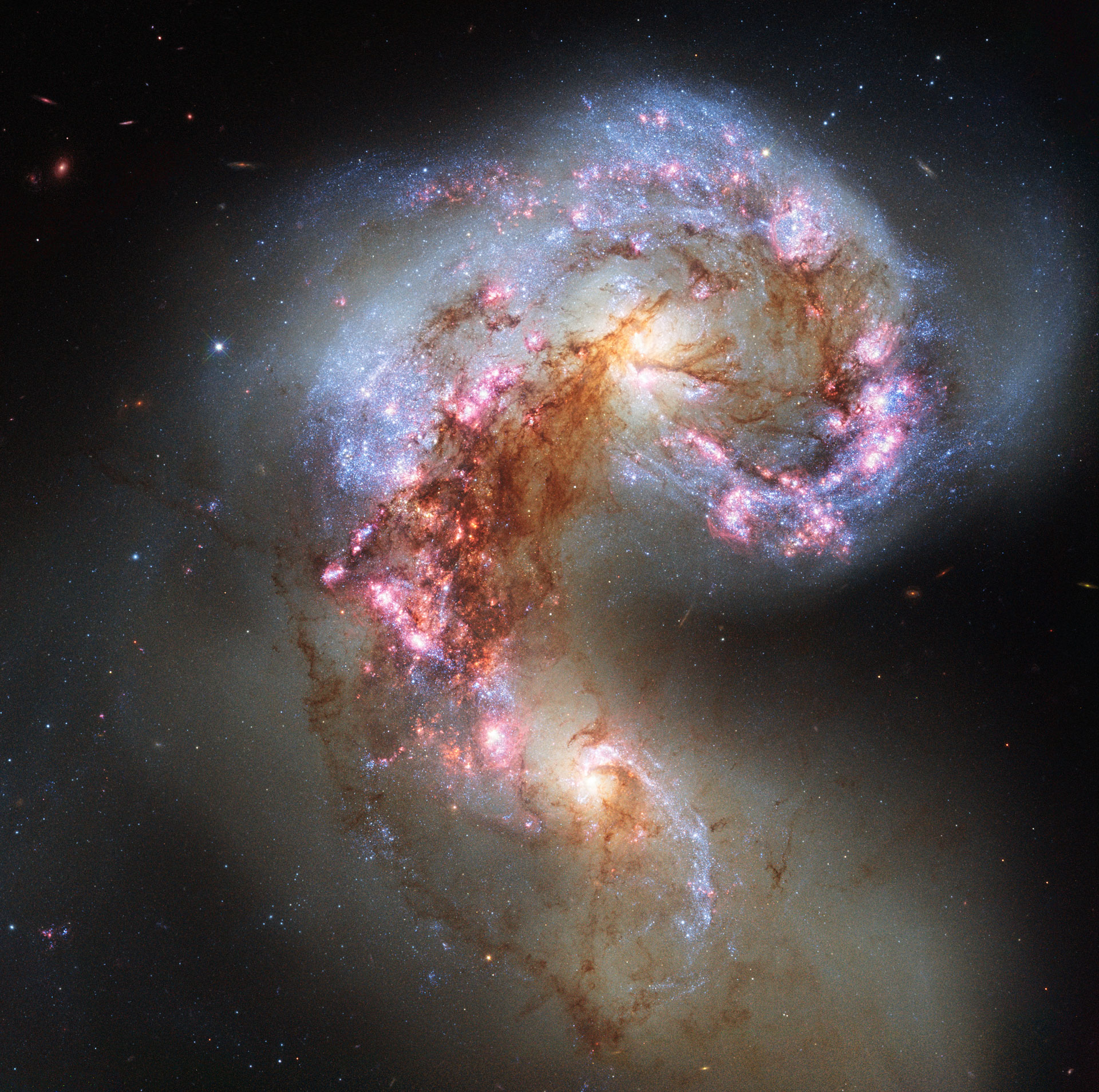
    ALMA Views Shocked Gas in the Nuclear Region of Antennae Galaxies
    An image of the colliding galaxies known as The Antennae, taken in the optical and near-infrared.

    Using the ALMA submillimeter array, a team of astronomers form the Harvard-Smithsonian Center for Astrophysics have found evidence for shocked gas near the nucleus of the northern NGC 4038 galaxy, and argue that it is due to material infalling onto the nuclear region.

    Collisions between galaxies, especially ones rich in molecular gas, can trigger bursts of star formation that heat the dust and result in their shining brightly in the infrared. Astronomers think that there is also significant gas inflowing to the central regions of galaxies that can stimulate starburst activity. Inflowing gas, as it collides with the gas in the inner regions, should produce powerful shocks that should make the gas itself glow. Some evidence for gas inflows on galactic scales has been discovered, but there have been few observational confirmations of the effects of the inflowing material in the inner region of the galactic nucleus.

    Harvard astronomers Junko Ueda, David Wilner, and Giovanni Fazio used the ALMA submillimeter array to study the gas in the central regions of the Antennae galaxies, the nearest mid-stage merging system (about seventy-two million light-years away). The star formation rate of the system is estimated to be about ten solar-masses per year, much of it in the off-nuclear region (the so-called “overlap region”) of the two galaxies; the two nuclear regions themselves appear to have lower star formation rates.

    The team examined the star formation in one of the two nuclear regions, whose gas abundance is as much as one hundred times more than in the Milky Way’s center. They measured the emission from five organic molecules, CN, HCN, HCO+, CH3OH (methanol), and HNCO (isocyanic acid), looking for evidence of shock activity. And they found it. The methanol and isocyanic acid in particular were detected, for the first time in this object, and show clear evidence ion their intensities, ratios, and velocities for being excited by shocks. The evidence from the geometry of the emission suggests that the shocks are produced by infall, rather than from the collision. However, there is also the possibility that the induced burst of star formation produced local shocks that contributed to the shock activity. Although further work is needed, the results so far indicate that infalling material is likely responsible.

    Reference: “ALMA Observations of the Dense and Shocked Gas in the Nuclear Region of NGC 4038 (Antennae Galaxies)” by Junko Ueda, Yoshimasa Watanabe, Daisuke Iono, David J. Wilner, Giovanni G. Fazio, Satoshi Ohashi, Ryohei Kawabe, Toshiki Saito and Shinya Komugi, 10 December 2016, Publications of the Astronomical Society of Japan.
    DOI: 10.1093/pasj/psw110
    arXiv

    Never miss a breakthrough: Join the SciTechDaily newsletter.
    Follow us on Google and Google News.

    ALMA Astronomy Astrophysics Cosmology Harvard-Smithsonian Center for Astrophysics
    Share. Facebook Twitter Pinterest LinkedIn Email Reddit

    Related Articles

    ALMA Views the Dust Disk Around Young Protostar HH-212

    ALMA Images the Planetesimal Belt around HR8799

    Astronomers Reveal a Planet Forming in an Earth-Like Orbit Around Young Star TW Hydrae

    ALMA Telescope Reveals Planetary Influences on Young Stellar Disks

    Herschel Observations Help Identify the Physical Processes Underway in Cold, Dense Clouds

    CfA Scientists Measure the Rate of Expansion of the Universe

    ALMA Reveals First Ever Snow Line Seen Around a Distant Star

    New Study Challenges Planck Results

    Calculations Show the Ideal Time to Study the Cosmos

    Leave A Reply Cancel Reply

    • Facebook
    • Twitter
    • Pinterest
    • YouTube

    Don't Miss a Discovery

    Subscribe for the Latest in Science & Tech!

    Trending News

    Scientists Warn That This Common Pet Fish Can Wreck Entire Ecosystems

    Scientists Make Breakthrough in Turning Plastic Trash Into Clean Fuel Using Sunlight

    This Popular Supplement May Interfere With Cancer Treatment, Scientists Warn

    Scientists Finally Solved One of Water’s Biggest Mysteries

    Could This New Weight-Loss Pill Disrupt the Entire Market? Here’s What You Should Know About Orforglipron

    Earth’s Crust Is Tearing Open in Africa, and It Could Form a New Ocean

    Breakthrough Bowel Cancer Trial Leaves Patients Cancer-Free for Nearly 3 Years

    Natural Compound Shows Powerful Potential Against Rheumatoid Arthritis

    Follow SciTechDaily
    • Facebook
    • Twitter
    • YouTube
    • Pinterest
    • Newsletter
    • RSS
    SciTech News
    • Biology News
    • Chemistry News
    • Earth News
    • Health News
    • Physics News
    • Science News
    • Space News
    • Technology News
    Recent Posts
    • Ancient Roman Ship Coating Reveals Secrets Hidden for 2,200 Years
    • Enormous Prehistoric Insects Puzzle Scientists
    • College Student Identifies Bizarre New Carnivorous Dinosaur Three Times Older Than T. rex
    • The Most Effective Knee Arthritis Treatments Aren’t What You Expect
    • Scientists Develop Bioengineered Chewing Gum That Could Help Fight Oral Cancer
    Copyright © 1998 - 2026 SciTechDaily. All Rights Reserved.
    • Science News
    • About
    • Contact
    • Editorial Board
    • Privacy Policy
    • Terms of Use

    Type above and press Enter to search. Press Esc to cancel.