
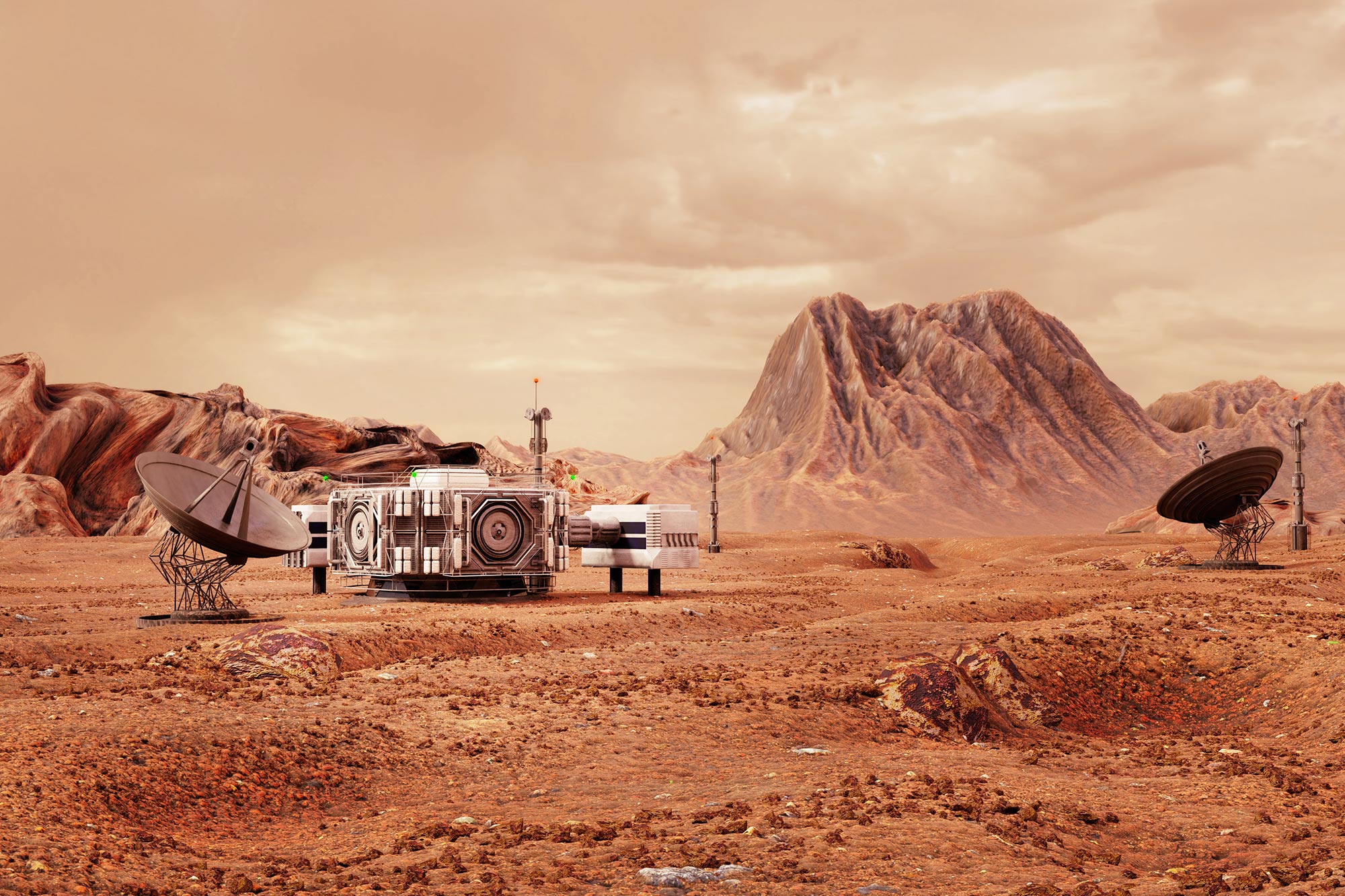
Researchers show algae can grow in Mars-like atmospheric pressure conditions.
If humans are ever to establish permanent settlements beyond Earth, they will need to build habitable structures. However, transporting large quantities of industrial materials for construction poses major logistical and financial challenges. Scientists at the Harvard John A. Paulson School of Engineering and Applied Sciences (SEAS) are exploring a biological alternative.
Led by Robin Wordsworth, Gordon McKay Professor of Environmental Science and Engineering and Professor of Earth and Planetary Sciences, an international team has successfully grown green algae inside shelters constructed from bioplastics under Mars-like conditions. These experiments represent an initial step toward developing self-sustaining space habitats that do not rely on materials transported from Earth.
“If you have a habitat that is composed of bioplastic, and it grows algae within it, that algae could produce more bioplastic,” explained Wordsworth. “So you start to have a closed-loop system that can sustain itself and even grow through time.”
The research is published in Science Advances.

Growing algae in Mars-like conditions
In laboratory tests simulating Mars’ low-pressure environment, the research team led by Wordsworth successfully cultivated a common green algae species known as Dunaliella tertiolecta. The algae grew inside a 3D-printed chamber made from polylactic acid, a type of bioplastic that blocks harmful UV radiation while still allowing enough light through for photosynthesis.
The algae was maintained in conditions with an atmospheric pressure of 600 Pascals—more than 100 times lower than Earth’s—and a carbon dioxide-rich atmosphere, rather than Earth’s nitrogen and oxygen mix. Although liquid water typically cannot exist at such low pressure, the chamber created a pressure gradient that kept water stable inside. These findings suggest that bioplastics could play a vital role in building life-support systems in uninhabitable environments.

The researchers’ method mimics the natural way organisms grow on Earth, offering an alternative to traditional industrial approaches that rely on expensive and difficult-to-recycle materials.
Humans living in space
Wordsworth’s team previously demonstrated a type of local Martian terraforming using sheets of silica aerogels that mimic the Earth’s greenhouse warming effect to allow for biological growth. A combination of the algae experiments with the aerogels would solve both temperature and pressure issues for supporting plant and algae growth, Wordsworth said, and could open a clearer path toward extraterrestrial existence.
Next, Wordsworth said the researchers want to demonstrate that their habitats also work in vacuum conditions, which would be relevant for lunar or deep-space applications. His team also has plans to design a working closed-loop system for habitat production.
“The concept of biomaterial habitats is fundamentally interesting and can support humans living in space,” Wordsworth said. “As this type of technology develops, it’s going to have spinoff benefits for sustainability technology here on Earth as well.”
Reference: “Biomaterials for organically generated habitats beyond Earth” by Robin Wordsworth, Rafid Quayum, Elida Kocharian, Ann Pearson, Xavier Portillo, Madeleine Yang, Charles S. Cockell, Shannon Nangle and George Church, 2 July 2025, Science Advances.
DOI: 10.1126/sciadv.adp4985
The research was supported by the Leverhulme Center for Life in the University grant, the Harvard Origins of Life Grant, and the National Science Foundation (NSF-2100509). Co-authors were Rafid Quayum, Elida Kocharian, Ann Pearson, Xavier Portillo, Madeleine Yang, Charles S. Cockell, Shannon Nangle, and George Church.
Never miss a breakthrough: Join the SciTechDaily newsletter.
Follow us on Google and Google News.
2 Comments
Defense teu Tobias porque e brasilian Carla boca suica Defense bunda e Catarina
You better grow any combination of life in a Mars-simulated environment BEFORE you go inoculate life into the Martian Permafrost, if you value your reputations, all future science investment and the derision of the immediately ensuing generation. No unplanned ‘Green-Muck Planet’ for which headlines shall ring.