
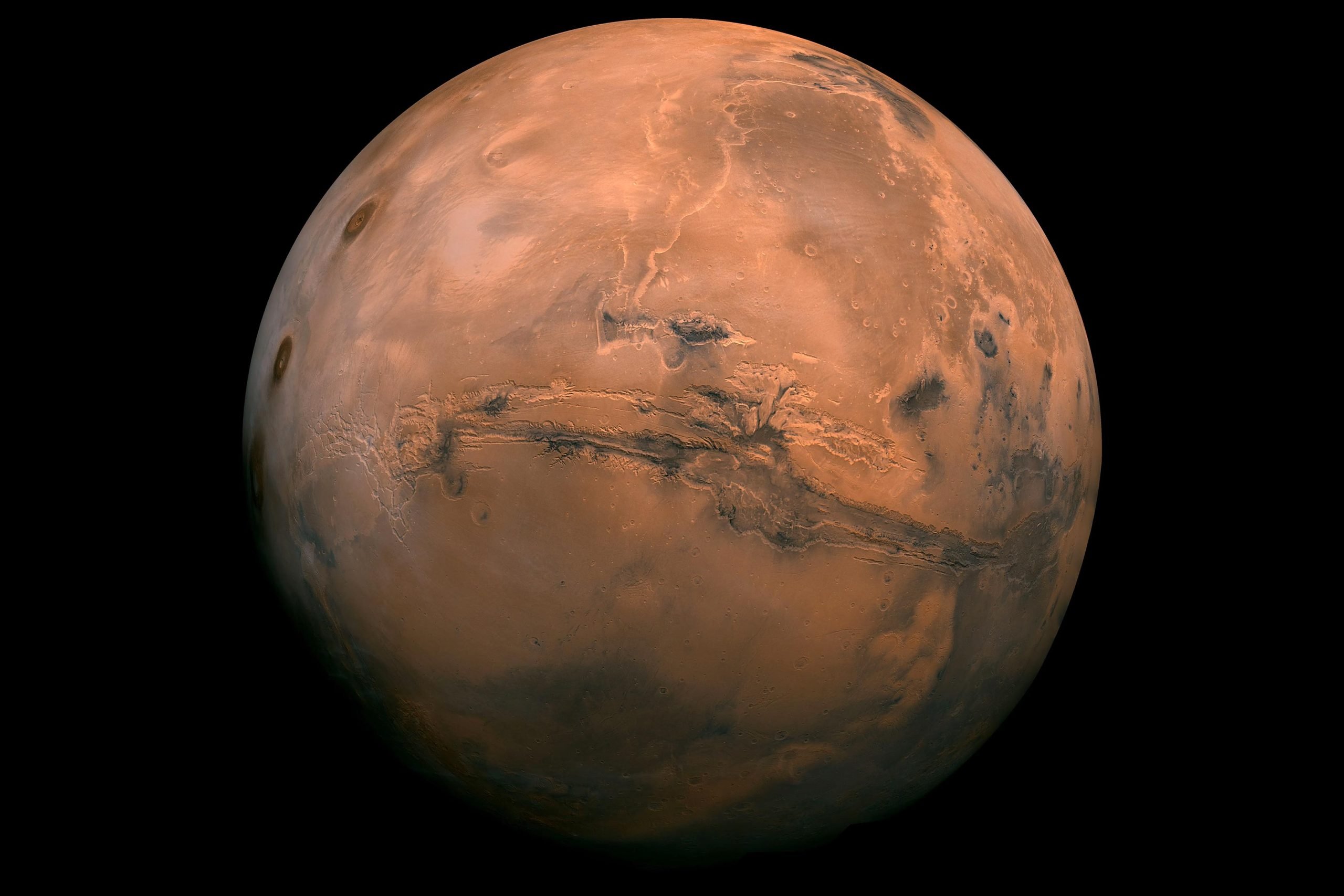
Researchers at Harvard’s Paleomagnetics Lab have made a compelling case that Mars’ magnetic field, which could have supported life, lasted until 3.9 billion years ago—much later than previously thought.
Evidence suggests that billions of years ago, Mars may have been a thriving environment for life. Today, however, the planet is cold, dry, and stripped of the magnetic field that might once have protected it. This transformation has turned Mars into a kind of forensic scene, where scientists piece together clues to determine if—and when—the Red Planet could have supported life.
Rethinking the Martian Magnetic Timeline
The question of “when” has particularly intrigued researchers at Harvard’s Paleomagnetics Lab in the Department of Earth and Planetary Sciences. In a new paper published in Nature Communications, they present their strongest evidence yet that Mars’ magnetic field—an essential shield for life—may have lasted until as recently as 3.9 billion years ago. This extends previous estimates of 4.1 billion years, pushing the possibility of habitability hundreds of millions of years closer to our time.
Enhanced Methods Reveal New Insights
The study, led by Sarah Steele, a student at Harvard’s Griffin Graduate School of Arts and Sciences, used advanced simulations and computer modeling to estimate the age of the Martian “dynamo,” or global magnetic field. Like Earth’s, Mars’ dynamo was generated by convection in its iron core. Alongside senior author Roger Fu, the John L. Loeb Associate Professor of Natural Sciences, Steele and her team build on their previous theory that the Martian dynamo, which shielded the planet from cosmic rays, persisted longer than previously believed.
Their thinking evolved from experiments simulating cooling and magnetization cycles of huge craters on the Red Planet’s surface. Known to be only weakly magnetic, these well-studied impact basins have led researchers to assume they formed after the dynamo shut down.
The researchers simulated the cooling and magnetization of large impact basins on Mars to defend a later dynamo shutdown. Credit: Sarah Steele
Challenging Established Theories
This timeline was hypothesized using basic principles of paleomagnetics, or the study of a planet’s prehistoric magnetic field. Scientists know ferromagnetic minerals in rock align themselves with surrounding magnetic fields when the rock is hot, but these small fields become “locked in” once the rock has cooled. This effectively turns the minerals into fossilized magnetic fields, which can be studied billions of years later.
Looking at basins on Mars with weak magnetic fields, scientists surmised they initially formed amid hot rock during a period in which there were no other strong magnetic fields present — in other words, after the planet’s dynamo had gone away.
The Dynamo’s Persistence and Impact
But the Harvard team says this early shutdown isn’t necessary to explain those largely de-magnetized craters, according to Steele. Rather, they argue that the craters were formed while the dynamo of Mars was experiencing a polarity reversal — north and south poles switching places — which, through computer simulation, can explain why these large impact basins only have weak magnetic signals today. Magnetic pole flips also happen on Earth every few hundred thousand years.
“We are basically showing that there may not have ever been a good reason to assume Mars’ dynamo shut down early,” Steele said.
Unveiling Martian Mysteries Through Modern Science
Their results build on previous work that first upended existing Martian habitability timelines. They used a famed Martian meteorite, Allan Hills 84001, and a powerful quantum diamond microscope in Fu’s lab, to infer a longer-persisting magnetic field until 3.9 billion years ago by studying different magnetic populations in thin slices of the rock.
Steele says poking holes in a long-held theory is a little nerve-wracking, but that they’ve been “spoiled rotten” by a community of planetary researchers who are open to new interpretations and possibilities.
“We are trying to answer primary, important questions about how everything got to be like it is, even why the entire solar system is the way that it is,” Steele said. “Planetary magnetic fields are our best probe to answer a lot of those questions, and one of the only ways we have to learn about the deep interiors and early histories of planets.”
Reference: “Weak magnetism of Martian impact basins may reflect cooling in a reversing dynamo” by S. C. Steele, R. R. Fu, A. Mittelholz, A. I. Ermakov, R. I. Citron and R. J. Lillis, 9 August 2024, Nature Communications.
DOI: 10.1038/s41467-024-51092-4
Never miss a breakthrough: Join the SciTechDaily newsletter.
Follow us on Google and Google News.
8 Comments
Mars lost its strong gravitational field as a result of a warming episide caused by the great collision that started life on earth. Proto Earth and Mars were once much closer to each other than they now are. Lots of ice was thrown out from Earth when the collision occurred and a large amounts landed on Mars and reacted with the hydrogen sulphide present, evaporating it off. Since Mars no longer had liquid hydrogen sulphide on it’s surface, it no longer had a strong conductive force driving it’s core spin, hence its techtonic action failed and it became the planet it now is.
Earth gained life from that collision happening 3.9 billion years ago but Mars did not lose life because life is created when a new iron nucleus is injected into a cell and that’s exactly what happened to proto Earth, with its old core being displaced at that point to form our Moon.
Sarah.. Much of what you wrote doesn’t make sense with respect to the fossil record on Earth going back to the early Archean.
It does for some. However, Creation Science debunks your Uniformitarian theory, and your ancient age of the geological column which though describing layers, denies the gigantic layers of sedimentary rock, uniform over all the known continents, being rapidly laid down, then folded tectonically..young earth more like.
Mars? Big waste of time and money.
I assume you are unaware that your theory is just a bunch of unscientific whargarbl.
There is large difference between “habitability” that could have supported life and life itself. So far, no credible evidence for life on Mars has turned up. The fossil record is empty of direct evidence.
I always imagined they was planet movers and that Earth was part of the transition of life. Maybe a tad to much sci-fi growing up 😆
If you’ve not found any signs of life on Mars by now you never will
There is the outside possibility of ancient primitive life.