
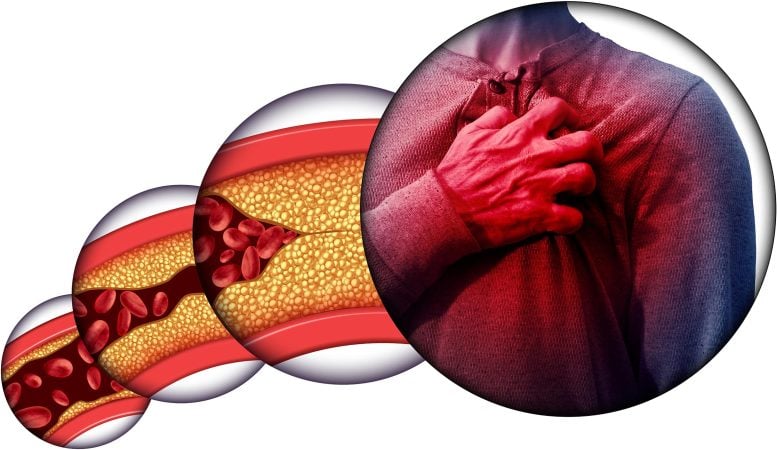
Study challenges “good” cholesterol’s role in universally predicting heart disease risk.
Lower levels of HDL cholesterol were associated with increased risks for heart attacks in white but not black adults, and higher levels were not protective for either group.
A study found that high-density lipoprotein (HDL) cholesterol, often called the “good cholesterol,” may not be as effective as scientists once believed in uniformly predicting cardiovascular disease risk among adults of different racial and ethnic backgrounds. The study was supported by the National Institutes of Health (NIH).
Racial Disparities in Cardiovascular Risk Prediction
The research found that while low levels of HDL cholesterol predicted an increased risk of heart attacks or related deaths for white adults – a long-accepted association – the same was not true for black adults. Additionally, higher HDL cholesterol levels were not associated with reduced cardiovascular disease risk for either group. The study was published on November 21 in the Journal of the American College of Cardiology,
LDL (low-density lipoprotein) cholesterol, sometimes called “bad” cholesterol, makes up most of your body’s cholesterol. High levels of LDL cholesterol raise your risk for heart disease and stroke. HDL (high-density lipoprotein) cholesterol, sometimes called “good” cholesterol, absorbs cholesterol in the blood and carries it back to the liver.
“The goal was to understand this long-established link that labels HDL as the beneficial cholesterol, and if that’s true for all ethnicities,” said Nathalie Pamir, Ph.D., a senior author of the study and an associate professor of medicine within the Knight Cardiovascular Institute at Oregon Health & Science University, Portland. “It’s been well accepted that low HDL cholesterol levels are detrimental, regardless of race. Our research tested those assumptions.”
To do that, Pamir and her colleagues reviewed data from 23,901 United States adults who participated in the Reasons for Geographic and Racial Differences in Stroke Study (REGARDS). Previous studies that shaped perceptions about “good” cholesterol levels and heart health were conducted in the 1970s through research with a majority of white adult study participants. For the current study, researchers were able to look at how cholesterol levels from black and white middle-aged adults without heart disease who lived throughout the country overlapped with future cardiovascular events.
Study participants enrolled in REGARDS between 2003-2007 and researchers analyzed information collected throughout a 10- to 11-year period. Black and white study participants shared similar characteristics, such as age, cholesterol levels, and underlying risk factors for heart disease, including having diabetes, high blood pressure, or smoking. During this time, 664 black adults and 951 white adults experienced a heart attack or heart attack-related death. Adults with increased levels of low-density lipoprotein (LDL) cholesterol and triglycerides had modestly increased risks for cardiovascular disease, which aligned with findings from previous research.
New Insights into HDL Cholesterol
However, the study was the first to find that lower HDL cholesterol levels only predicted increased cardiovascular disease risk for white adults. It also expands on findings from other studies showing that high HDL cholesterol levels are not always associated with reduced cardiovascular events. The REGARDS analysis was the largest U.S. study to show that this was true for both black and white adults, suggesting that higher than optimal amounts of “good” cholesterol may not provide cardiovascular benefits for either group.
“What I hope this type of research establishes is the need to revisit the risk-predicting algorithm for cardiovascular disease,” Pamir said. “It could mean that in the future we don’t get a pat on the back by our doctors for having higher HDL cholesterol levels.”
Quality Over Quantity
Pamir explained that as researchers study HDL cholesterol’s role in supporting heart health, they are exploring different theories. One is quality over quantity. That is, instead of having more HDL, the quality of HDL’s function – in picking up and transporting excess cholesterol from the body – may be more important for supporting cardiovascular health.
They are also taking a microscopic look at properties of HDL cholesterol, including analyzing hundreds of proteins associated with transporting cholesterol and how varying associations, based on one protein or groups of proteins, may improve cardiovascular health predictions.
“HDL cholesterol has long been an enigmatic risk factor for cardiovascular disease,” explained Sean Coady, a deputy branch chief of epidemiology within the National Heart, Lung, and Blood Institute (NHLBI)’s Division of Cardiovascular Sciences. “The findings suggest that a deeper dive into the epidemiology of lipid metabolism is warranted, especially in terms of how race may modify or mediate these relationships.”
The authors conclude that in addition to supporting ongoing and future research with diverse populations to explore these connections, the results suggest that cardiovascular disease risk calculators using HDL cholesterol could lead to inaccurate predictions for black adults.
“When it comes to risk factors for heart disease, they cannot be limited to one race or ethnicity,” said Pamir. “They need to apply to everyone.”
Reference: “Race-Dependent Association of High-Density Lipoprotein Cholesterol Levels With Incident Coronary Artery Disease” by Neil A. Zakai MD, Jessica Minnier PhD, Monika M. Safford MD, Insu Koh PhD, Marguerite R. Irvin PhD, Sergio Fazio MD, PhD, Mary Cushman MD, Virginia J. Howard PhD and Nathalie Pamir PhD, 21 November 2022, Journal of the American College of Cardiology.
DOI: 10.1016/j.jacc.2022.09.027
The REGARDS study is co-funded by the National Institute of Neurological Disorders and Stroke and the National Institute of Aging and received additional support from NHLBI.
Never miss a breakthrough: Join the SciTechDaily newsletter.
Follow us on Google and Google News.
5 Comments
Why on earth would anybody believe any of your studies? You’re all paid off by the pharmaceutical companies! every other commercial on TV is for yet another drug with massive side effects as are all your anti-cholesterol medications.
Precisely!
“The REGARDS study is co-funded by the National Institute of Neurological Disorders and Stroke and the National Institute of Aging and received additional support from NHLBI.”
Learn to read, fktard.
There’s no such thing as “bad cholesterol”, stop using this idiotic outdated language please. Cholesterol is cholesterol and it’s all GOOD, no matter which lipoproteins carry it in the bloodstream. Cholesterol is an essential component of cell membranes and without it you could not possibly function. Blaming LDL cholesterol for atherosclerosis is like blaming for arson firemen who show up to put out a fire, completely outdated and faulty reasoning.
Relax. No one is “blaming” your precious lipoproteins. In medicine, we use them as markers of high risk. Correlation does not imply causation, but correlation improves prediction. So, in people with high LDL we prescribe statins to bring down the overall cholesterol levels.
Cholesterol, in normal levels, is required for the body to function. In high serum concentrations, it causes problems – just like glucose, or potassium, or even water. It’s not that hard to understand, is it?