
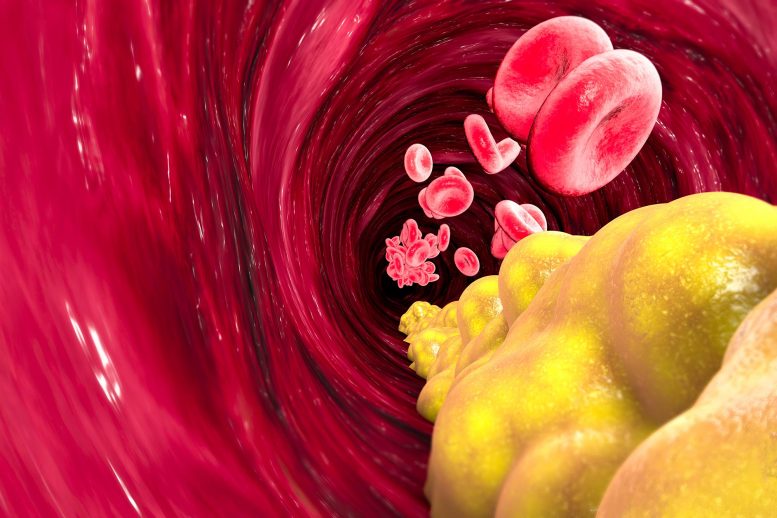
The work shows that people with large HDL particles have an increased risk of myocardial infarction, while only small HDL particles are actually associated with decreased risk.
HDL cholesterol (high-density lipoprotein cholesterol) or good cholesterol is associated with a decreased risk of cardiovascular disease as it transports cholesterol deposited in the arteries to the liver to be eliminated. This contrasts with the so-called bad cholesterol, LDL (low-density lipoprotein cholesterol), which causes cholesterol to accumulate in the arteries and increases cardiovascular risk.
The Good Cholesterol Paradox
Although drugs that lower bad cholesterol reduce cardiovascular risk, those that raise good cholesterol have not proven effective in reducing the risk of heart disease. This paradox has called into question the relationship between good cholesterol and cardiovascular risk, and researchers are now studying the characteristics of these HDL or good cholesterol particles.
A study led by the Hospital del Mar Medical Research Institute (IMIM), published in the journal Metabolism, Clinical and Experimental, has now demonstrated that not all good cholesterol is healthy. Researchers from the CIBER on Cardiovascular Diseases (CIBERCV), the CIBER on Obesity and Nutrition (CIBEROBN), and the CIBER on Epidemiology and Public Health (CIBERESP), as well as others from Hospital Clínic-IDIBAPS, IDIBELL, the Hospital de la Santa Creu i Sant Pau Research Institute, and the Hospital Clínico Universitario in Zaragoza also took part in this study.
Large HDL Particles Linked to Higher Risk
In the work, the researchers analyzed genetic characteristics that determine the size of good cholesterol particles, and then studied their relationship with the risk of myocardial infarction. The conclusion is that genetic characteristics linked to the generation of large good cholesterol particles are directly associated with a higher risk of heart attack, while features linked to small good cholesterol particles are related to a lower risk of heart attack. “There is a positive causal relationship between the size of HDL cholesterol particles and the risk of heart attack, so although we have to increase the levels of good cholesterol in the blood, they must always be small particles,” explains the study’s principal investigator, Dr. Robert Elosua, a researcher at the Hospital del Mar-IMIM, CIBERCV, and the University of Vic-Central University of Catalonia (UVic-UCC).
The good cholesterol particles are more effective in transferring cholesterol to the liver so that it can be eliminated. “If we need to do something in relation to HDL, it is to increase the number of small particles, which are those that adequately perform the function of eliminating cholesterol, those that really move it to the liver for removal, and do not allow it to accumulate in the arteries and cause cardiovascular disease,” says Dr. Álvaro Hernáez, a IDIBAPS and CIBEROBN researcher.
Currently, there are no drugs that increase good cholesterol levels and reduce the risk of cardiovascular disease. “This study highlights new and potential therapeutic targets in the field of cardiovascular diseases, including several genes related to the qualitative aspects of HDL particles, which may contribute to cardiovascular prevention,” concludes Dr. Albert Prats, a researcher in the Epidemiology and Cardiovascular Genetics Research Group at the Hospital del Mar-IMIM and first author of the study.
Reference: “High-density lipoprotein characteristics and coronary artery disease: a Mendelian randomization study” by Albert Prats-Uribe, Sergi Sayols-Baixeras, Alba Fernández-Sanlés, Isaac Subirana, Robert Carreras-Torres, Gemma Vilahur, Fernando Civeira, Jaume Marrugat, Montserrat Fitó, Álvaro Hernáez and Roberto Elosua, 3 September 2020, Metabolism, Clinical and Experimental.
DOI: 10.1016/j.metabol.2020.154351
Never miss a breakthrough: Join the SciTechDaily newsletter.
Follow us on Google and Google News.