
Your brain may build memory not by adding connections, but by cutting them away.
The hippocampus is one of the brain’s most important regions for memory and navigation. It helps convert short-term experiences into lasting memories, allowing people to learn from and build on past events. Researchers led by Magdalena Walz, Professor for Life Sciences, and Peter Jonas at the Institute of Science and Technology Austria (ISTA) study this area in detail. Their latest work, published in Nature Communications, investigates how a major neural network in the hippocampus changes after birth.
Blank Slate vs. Full Slate
Imagine writing on a completely empty sheet of paper. Every new piece of information is added to a blank surface. This idea is known as tabula rasa, or the “blank slate.”
Now imagine trying to write on a page that already contains markings. New information must either fit around existing material or replace it. This concept is called tabula plena, or the “full slate.”
The debate behind these ideas centers on a major question about development: Are we largely shaped from birth, or do experiences define who we become over time?
Biology reflects the same discussion through the interaction between genetics, which provide the initial framework, and environmental influences, which shape the final outcome.
Researchers in the Jonas group at ISTA applied this question to the hippocampus, the brain region responsible for memory formation and spatial orientation. They wanted to know how the hippocampal network develops after birth and whether it behaves more like a blank slate or a full slate.
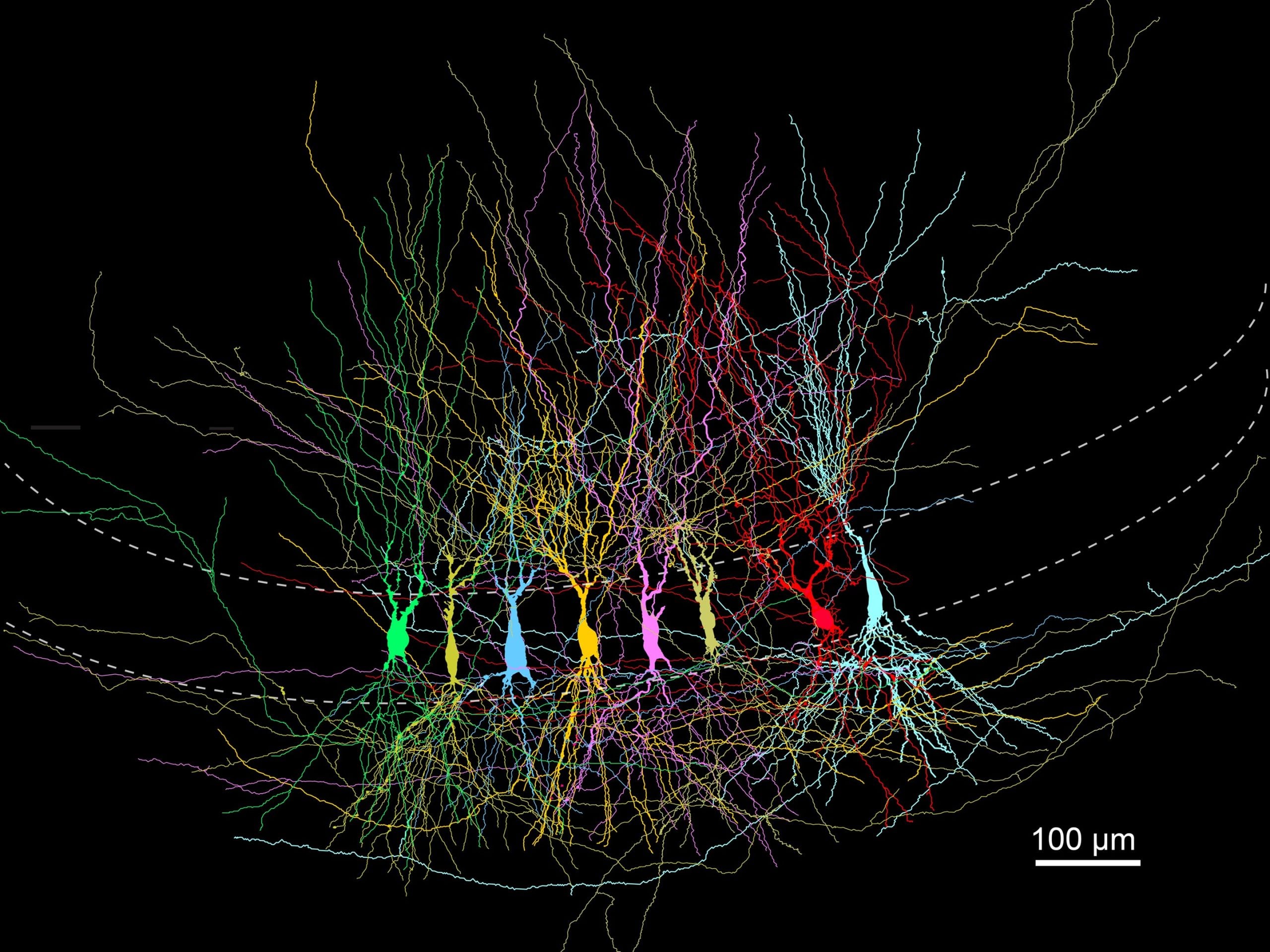
Network of interconnected CA3 pyramidal neurons in the mouse hippocampus. As the animals mature, the configuration shifts—the network becomes sparser but more structured and refined (blue). Credit: © Jake Watson / ISTA
Dense Neural Networks in the Young Brain
The study focused on a core hippocampal circuit made up of interconnected CA3 pyramidal neurons. These neurons are heavily involved in storing and retrieving memories through plasticity, the brain’s ability to adapt by changing the strength and structure of neural connections.
ISTA alum Victor Vargas-Barroso examined mouse brains during three stages of development: shortly after birth (day 7-8), adolescence (day 18-25), and adulthood (day 45-50).
To study these networks, he used the patch clamp technique, which measures tiny electrical signals in different parts of neurons, including presynaptic terminals and dendrites. The team also used advanced microscopy and laser-based tools to observe activity inside cells and activate individual neural connections with high precision.
Network of interconnected CA3 pyramidal neurons in the mouse hippocampus: In young mice, the CA3 network is very dense, and the connections appear random (yellow). Credit: © Jake Watson / ISTA
Brain Connections Become More Refined Over Time
The researchers discovered that the CA3 network starts out extremely dense, with connections appearing widespread and somewhat random. As the animals matured, however, the network became less crowded and more organized.
“This discovery was quite surprising,” says Jonas. “Intuitively, one might expect that a network grows and becomes denser over time. Here, we see the opposite. It follows what we call a pruning model: it starts out full, and then it becomes streamlined and optimized.”
Instead of continually adding connections, the brain appears to begin with an overabundance of links and then remove many of them as development progresses.

Why Starting “Full” May Help Memory Formation
Researchers are still investigating why this process occurs. Jonas believes that an initially broad network may help neurons communicate rapidly and efficiently during early development, a feature that is especially important in the hippocampus.
This region does more than store separate pieces of sensory information, such as sights, sounds, or smells. It combines them into integrated memories and experiences.
“That’s a complex task for neurons,” Jonas explains. “An initially exuberant connectivity, followed by selective pruning, might be exactly what enables this integration.”
If the hippocampal network began as a true tabula rasa with no existing connections, neurons would first need to locate and connect with one another. According to the researchers, that would make efficient communication far more difficult.
The findings suggest that the brain may not begin as an empty system waiting to be filled. Instead, it may start with a rich network of connections that gradually becomes more efficient through selective pruning.
Reference: “Developmental emergence of sparse and structured synaptic connectivity in the hippocampal CA3 memory circuit” by Victor Vargas-Barroso, Jake F. Watson, Andrea Navas-Olive, Alois Schlögl and Peter Jonas, 21 April 2026, Nature Communications.
DOI: 10.1038/s41467-026-71914-x
Never miss a breakthrough: Join the SciTechDaily newsletter.
Follow us on Google and Google News.