
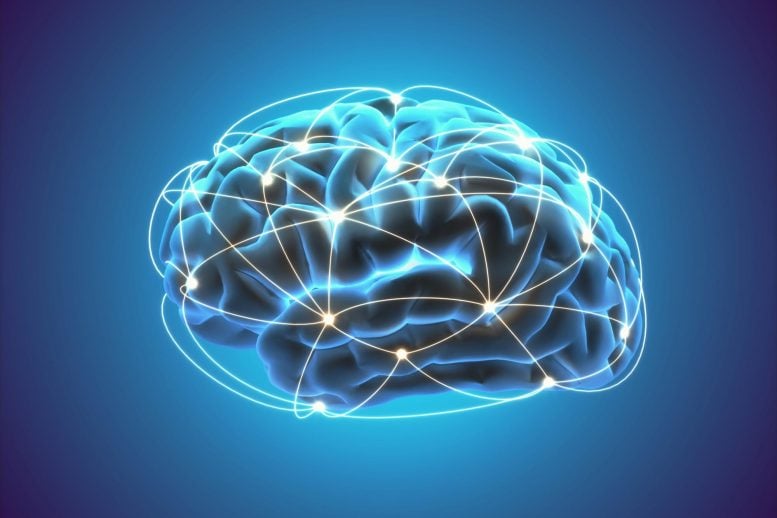
Researchers from the Human Brain Project used a multi-scale approach, combining various imaging methods to understand the human brain’s connectome, or the interconnected structure, from the molecular to the macro level. They used 3D Polarized Light Imaging to visualize nerve fibers and placed their findings within the Julich Brain Atlas to spatially reference the data, revealing new insights about the brain’s organization and functioning.
To understand how our brain works, there is no getting around investigating how different brain regions are connected with each other by nerve fibers. In the journal Science, researchers of the Human Brain Project (HBP) review the current state of the field, provide insights on how the brain’s connectome is structured on different spatial scales – from the molecular and cellular to the macro level – and evaluate existing methods and future requirements for understanding the connectome’s complex organization.
“It is not enough to study brain connectivity with one single method, or even two,” says author and HBP Scientific Director Katrin Amunts, who leads the Institute of Neuroscience and Medicine (INM-1) at Forschungszentrum Jülich and the C. & O. Vogt Institute of Brain Research at the University Hospital Düsseldorf. “The connectome is nested at multiple levels. To understand its structure, we need to look at several spatial scales at once by combining different experimental methods in a multi-scale approach and by integrating the obtained data into multilevel atlases such as the Julich Brain Atlas that we have developed.”
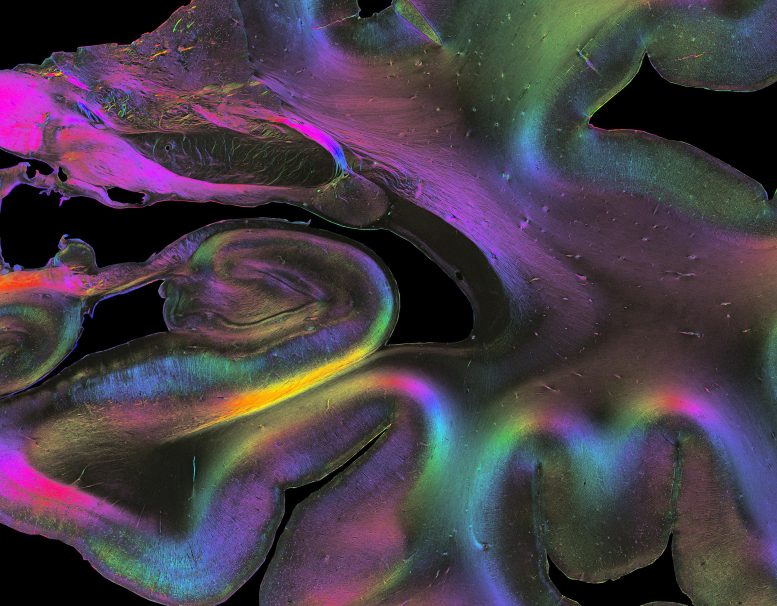
Markus Axer from Forschungszentrum Jülich and the Physics Department of the University of Wuppertal, who is the first author of the Science article, has with his team at INM-1 developed a unique method called 3D Polarized Light Imaging (3D-PLI) to visualize nerve fibers at microscopic resolution. The researchers trace the three-dimensional courses of fibers across serial brain sections with the aim of developing a 3D fiber atlas of the entire human brain.
Combining Advanced Imaging Modalities
Together with other HBP researchers from Neurospin in France and the University of Florence in Italy, Axer and his team have recently imaged the same tissue block from a human hippocampus using several different methods: anatomical and diffusion magnetic resonance imaging (aMRI and dMRI), two-photon fluorescence microscopy (TPFM) and 3D-PLI, respectively.
Microscopy methods like TPFM provide sub-micrometer resolution images of small brain volumes revealing microstructures of the brain’s cerebral cortex, but they have their limitations in disentangling fibers connecting distant brain regions, which build the deep white matter structures. This is even more true for electron microscopic measurements, which enable nanometre-resolved insights into a cubic millimeter of brain tissue. In contrast, dMRI can be used for tractography at the whole-brain level – visualizing white matter connections – but cannot resolve individual fibers or small tracts.
“3D-PLI serves as a bridge between micro and macro methods,” says Amunts. “This is because 3D-PLI resolves the fiber architecture at high resolution and, at the same time, allows imaging of whole-brain sections that we can then reconstruct in 3D to trace fiber connections.”
Combining dMRI, TPFM, and 3D-PLI enabled the researchers to superimpose the three modalities within the same reference space. “This integration of data was only made possible by imaging one and the same tissue sample,” explains Axer. The human hippocampus block traveled from Germany to France, back to Germany, and finally to Italy, being processed and imaged in different laboratories benefiting from the local, highly specialized equipment.
The researchers then used the Julich Brain Atlas to spatially anchor their data in an anatomical reference space. The three-dimensional atlas contains more than 250 cytoarchitectonic maps of brain areas and forms the centerpiece of the HBP’s Multilevel Human Brain Atlas. “Our brain atlas enables us to pinpoint exactly where in the brain we find these microstructures,” explains Amunts. The dataset is openly accessible via the HBP’s EBRAINS infrastructure and can be browsed in an interactive atlas viewer.
Mapping the Connectome at Multiple Levels
The researchers multi-scale approach combining multiple modalities at different spatial scales to unravel the human connectome is unique and provides exciting new insights into how the human brain works.
Even though the hippocampus reconstruction is a lighthouse project, there are several international efforts ongoing (or about to start) that need to be orchestrated at an open atlas level to enable the integration of multi-scale data. Amunts and Axer emphasize that this is a prerequisite for revealing the principles of connectivity within the experimentally accessible range of scales – from axons to pathways. In other words, an integrated multi-scale approach that combines micro and macro methods is necessary to describe and understand the nested organization of the human brain. This requires critical reassessment of current methodology, including tractography, the authors say.
Reference: “Scale matters: The nested human connectome” by Markus Axer and Katrin Amunts, 3 November 2022, Science.
DOI: 10.1126/science.abq2599
Never miss a breakthrough: Join the SciTechDaily newsletter.
Follow us on Google and Google News.
1 Comment
The link to the universal mysteries.