
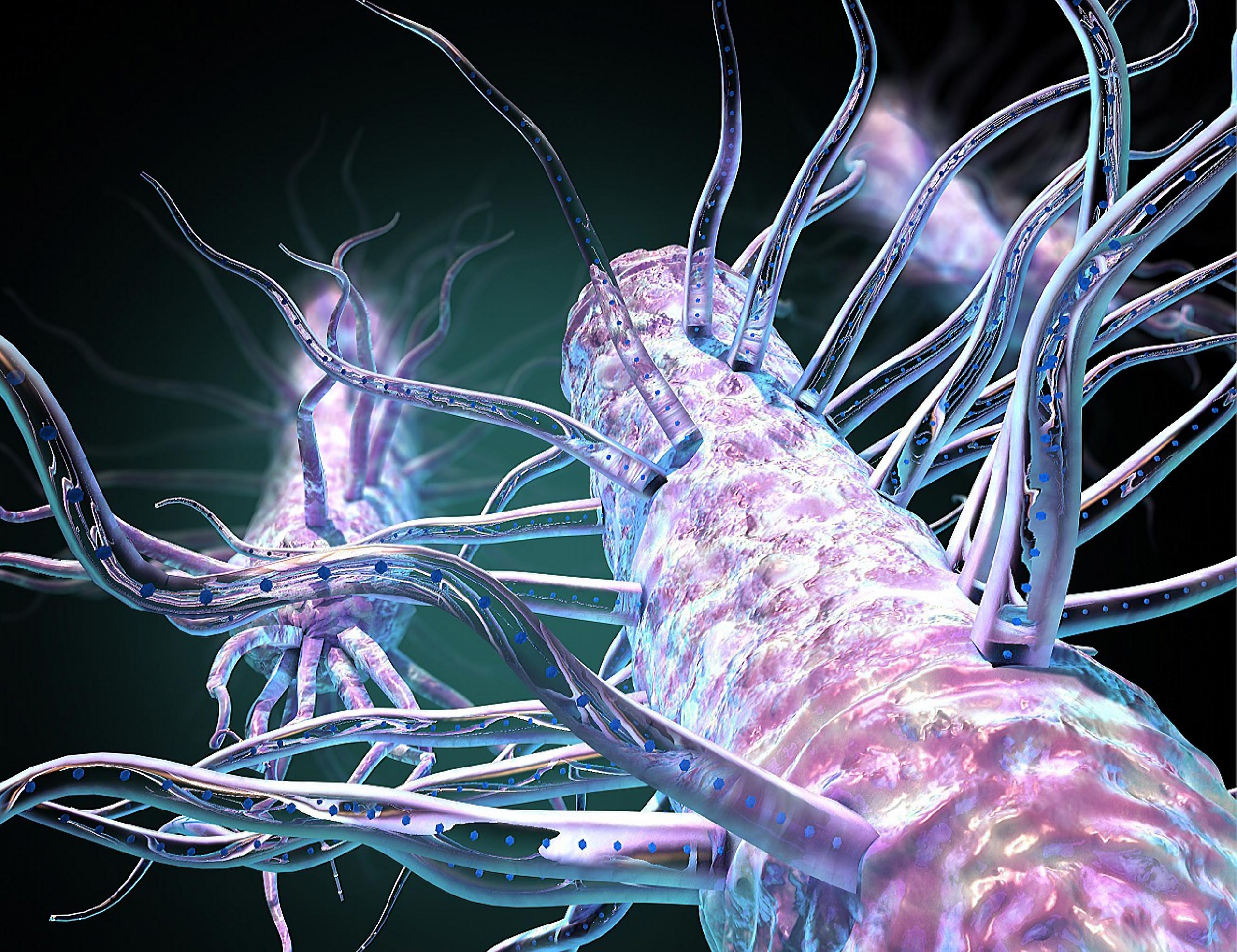
Yale researchers discovered that soil bacteria use internal pili structures to push out nanowires, forming a global bioelectric network.
A hair-like protein hidden inside bacteria serves as a sort of on-off switch for nature’s “electric grid,” a global web of bacteria-generated nanowires that permeates all oxygen-less soil and deep ocean beds, Yale researchers report in the journal Nature. “The ground beneath our feet, the entire globe, is electrically wired,” said Nikhil Malvankar, assistant professor of molecular biophysics and biochemistry at the Microbial Sciences Institute at Yale’s West Campus and senior author of the paper. “These previously hidden bacterial hairs are the molecular switch controlling the release of nanowires that make up nature’s electrical grid.”
Almost all living things breathe oxygen to get rid of excess electrons when converting nutrients into energy. Without access to oxygen, however, soil bacteria living deep under oceans or buried underground over billions of years have developed a way to respire by “breathing minerals,” like snorkeling, through tiny protein filaments called nanowires.
Nanowires: Nature’s Underground Electrical Exhalation
Two proteins within buried bacteria, lacking oxygen, pump out nanowires, which essentially “exhale” electrons. Scientists are seeking to use this natural electrical grid to generate electricity, new biofuels and even self-healing electronic components.
Two proteins within buried bacteria, lacking oxygen, pump out nanowires, which essentially “exhale” electrons. Scientists are seeking to use this natural electrical grid to generate electricity, new biofuels and even self-healing electronic components.
Just how these soil bacteria use nanowires to exhale electricity, however, has remained a mystery. Since 2005, scientists had thought that the nanowires are made up of a protein called “pili” (“hair” in Latin) that many bacteria show on their surface. However, in research published 2019 and 2020, a team led by Malvankar showed that nanowires are made of entirely different proteins. “This was a surprise to everyone in the field, calling into question thousands of publications about pili,” Malvankar said.
Hidden Pili Function as Nanowire Pistons
For the new study, graduate students Yangqi Gu and Vishok Srikanth used cryo-electron microscopy to reveal that this pili structure is made up of two proteins. And instead of serving as nanowires themselves, pili remain hidden inside the bacteria and act like pistons, thrusting the nanowires into the environment. Previously nobody had suspected such a structure.
Understanding how bacteria create nanowires will allow scientists to tailor bacteria to perform a host of functions — from combatting pathogenic infections or biohazard waste to creating living electrical circuits, the authors say. It will also assist scientists seeking to use bacteria to generate electricity, create biofuels, and even develop self-repairing electronics.
Reference: “Structure of Geobacter pili reveals secretory rather than nanowire behaviour” by Yangqi Gu, Vishok Srikanth, Aldo I. Salazar-Morales, Ruchi Jain, J. Patrick O’Brien, Sophia M. Yi, Rajesh Kumar Soni, Fadel A. Samatey, Sibel Ebru Yalcin and Nikhil S. Malvankar, 1 September 2021, Nature.
DOI: 10.1038/s41586-021-03857-w
Other authors are Aldo Salazar-Morales, Ruchi Jain, Patrick O’Brien, Sophia Yi, Fadel A. Samatey, and Sibel Ebru Yalcin, all from Yale, as well as Rajesh Soni from Columbia University.
Never miss a breakthrough: Join the SciTechDaily newsletter.
Follow us on Google and Google News.
3 Comments
Thank you for this scientific fact.
My question is how to diminish the nanowires.
Thank you so much.
I have them in my lips
Not so long ago I cut my hair short enough and I wanted to make micro braids, because I think they really suit me. I asked a friend where I could find examples of such a hairstyle and he advised me this site https://lovehairstyles.com/micro-braids/, thanks to which I was able to choose the perfect hairstyle for myself, which will soon be done to me in the salon! It’s so cool!