
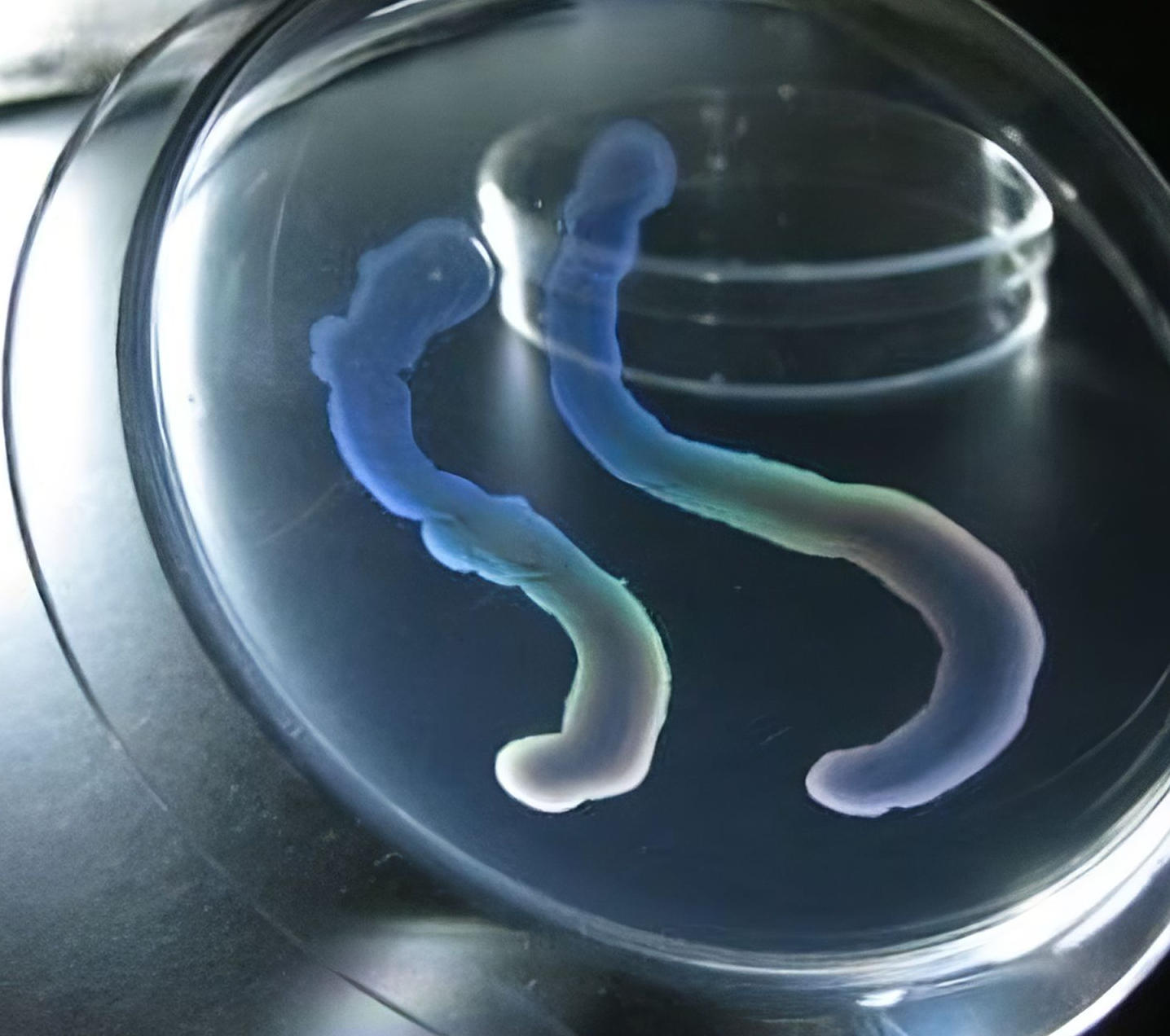
Scientists in Japan have found a type of bacteria in a cave that exhibits multicellular behavior and a unique, two-phase life cycle.
The bacterium, HS-3, was isolated from a limestone cave wall that is periodically submerged by an underground river. HS-3 has two different life phases; on a solid surface, it self-organizes into a layer-structured colony with liquid crystal-like qualities. The HS-3 colony matures into a semi-closed sphere that contains clusters of “daughter” coccobacillus cells, or short rod-shaped cells, which are released when in contact with water.
“The emergence of multicellularity is one of the greatest mysteries of life on Earth,” states corresponding author Kouhei Mizuno, a professor at the National Institute of Technology (KOSEN), Tokyo, Japan. “The point is that we already know the superior function and adaptability of multicellularity, but we know almost nothing about its origins. Established function and adaptability are not necessarily their own formative driving force. A curiosity of multicellularity is the conflict between the ‘benefits of individuals’ versus the ‘benefit of the group’ that must have existed in the early stage of the evolutionary transition. We don’t have a good existing model to study multicellularity except for theoretical models.”
One such model, called “ecological scaffolding,” contends that the environment exerts selection pressure on a population that is developing, arguing that Darwinian natural selection is still applicable to unicellular organisms.
Mizuno and his lab student Ohta identified HS-3 from dripping water on a limestone cave wall on Japan’s northern Kyushu Island in 2008. They were initially looking for lipid-accumulating bacteria, but Ohta discovered a little colony with extraordinarily beautiful color and texture when inspecting old agar plates for bacteria before disposal. Due to their disorganized structure, most bacteria on agar have an opaque texture, however, this colony was transparent and had an iridescent hue. Phenotypic comparisons with closely related species verified this colony as a new species, HS-3, which the scientists named Jeongeupia sacculi (meaning “cradle”).
Unique Colony Structure and Liquid Crystal Properties
The team used microscopies to analyze the colony growth. The cells started to reproduce simply as coccobacilli, but the occurrence of cell elongation caused the colony to form a single-layered structure, orientated like a liquid crystal. Bulges form particularly at the colony edge, relieving internal pressure and granting HS-3 the unique ability to maintain this two-dimensional liquid arrangement for a prolonged period, which may be a prerequisite for HS-3 to establish multicellular behavior.
Then, the colony then expanded to form additional layers. The internal filamentous cells buckled, generating vortex-structured domains. These domains and the liquid crystal-like arrangement explain the transparency observed in HS-3 colonies on agar. After two days, rapid cell reproduction occurred internally and the colony began to swell three-dimensionally, forming a semi-closed sphere housing the coccobacillus cells. After the fifth day, the internal cells were crowded-out of the colony, triggering a chain reaction of this event in adjacent colonies and thereby indicating some multicellular control.
As the cave wall sampling site of HS-3 was regularly subject to flowing water in the cave, the team submerged the mature semi-sphere colonies in water. The internal coccobacilli were released into the water, leaving behind the filamentous cell architecture. By plating these daughter cells on fresh agar, they discovered that the cells were able to reproduce the original filamentous structure, showing that the two distinct phases of HS-3’s life cycle are reversible, and may have arisen due to the changing conditions inside the cave.
Evidence Supporting Multicellularity and Ecological Scaffolding
“We needed 10 years to be sure that this was not a contamination of two different species and that it was not just a mutation,” says Mizuno. “First, we used a series of microscopic observations to film the entire process from a single cell to a colony, for which we developed our own methods. Then, we found that the morphological changes in cells and colonies were both controlled and reversible. Those data led us to believe that it is a ‘multicellularity’ of HS-3.”
“The first stage of HS-3’s life cycle suggests that the liquid crystal-like organization is involved in the emergence of multicellularity, which has not been reported before. The existence of the second life stage implicates the involvement of dynamic water environment in the emergence of HS-3’s multicellularity” says co-corresponding author Kazuya Morikawa, a professor in the Division of Biomedical Science, University of Tsukuba, Japan.
“We have been surprised by the various curious properties that HS-3 encompasses, one of which is that the multicellular behavior of this new species fits well with the recently proposed ‘ecological scaffolding’ hypothesis. We now think that the leap towards multicellularity would be a more elaborate and beautiful process than the one we have imagined so far.” commented Mizuno and Morikawa.
Reference: “Novel multicellular prokaryote discovered next to an underground stream” by Kouhei Mizuno, Mais Maree, Toshihiko Nagamura, Akihiro Koga, Satoru Hirayama, Soichi Furukawa, Kenji Tanaka and Kazuya Morikawa, 11 October 2022, eLife.
DOI: 10.7554/eLife.71920
Never miss a breakthrough: Join the SciTechDaily newsletter.
Follow us on Google and Google News.
3 Comments
Can’t wait for them to weaponize it,and blame an animal.
If stupidity could be weaponized, you’d be at the center of military advancement right now.
Reminds me of that movie “Evolution” next we will see dinosaurs make a come back…a new kind of alien life form will be implanted into all humans & take over😁