
Microbes unable to break down carbohydrates belong to a newly identified family of marine bacteria.
A German-American research team, led by Professor Iliana Baums of the Helmholtz Institute for Functional Marine Biodiversity at the University of Oldenburg (HIFMB) and Dr. Samuel Vohsen from Lehigh University in the United States, has identified two highly unusual bacterial species within the tissue of two deep-sea coral species from the Gulf of Mexico.
These previously unknown coral symbionts have an extremely reduced genome and lack the ability to obtain energy from carbohydrates, the team reports in an article published in the scientific journal Nature Communications. “These species are impressive examples of how few genes are needed for a functional organism,” says Baums, who co-authored the paper.
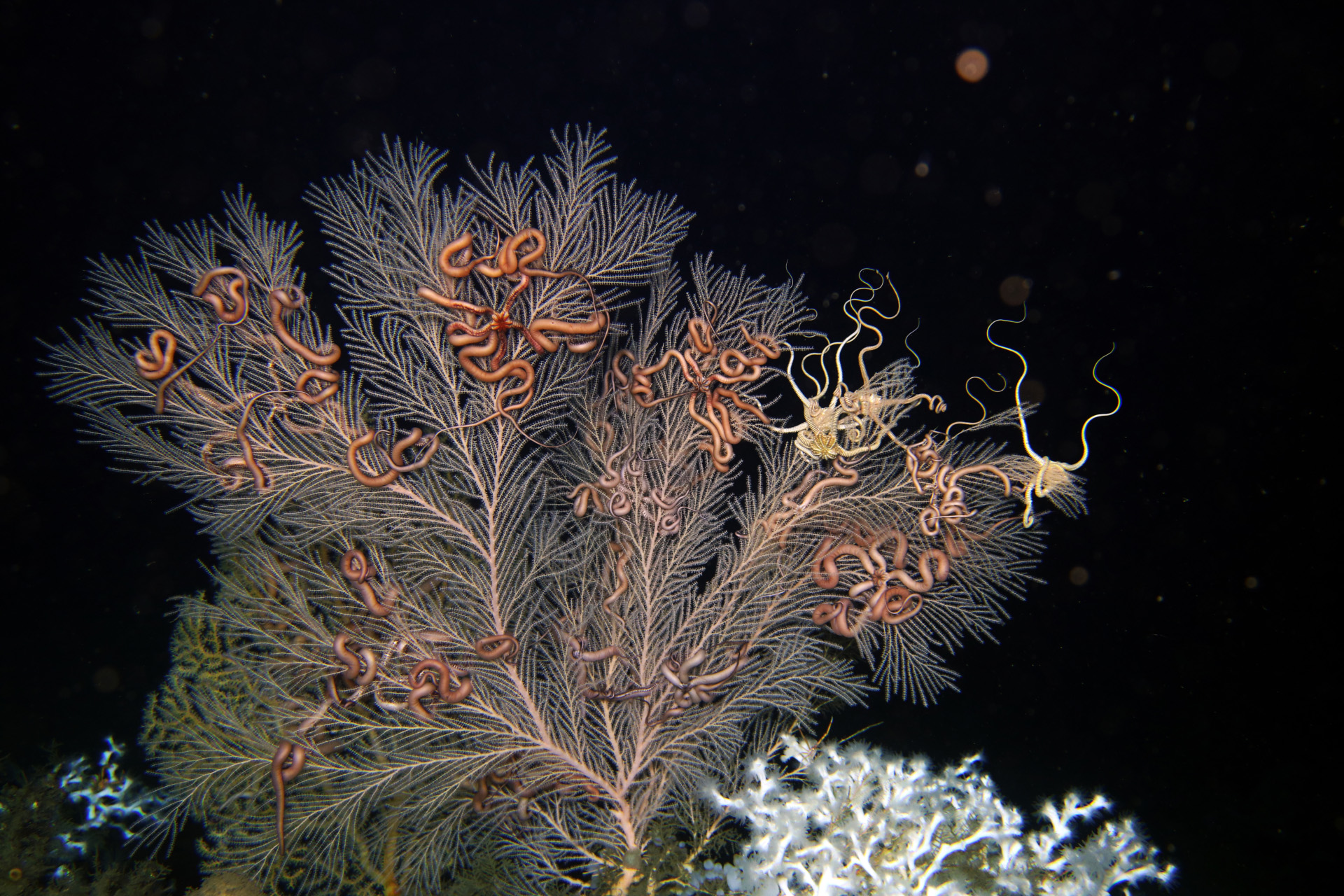
The research team studied several colonies of two soft coral species, Callogorgia delta and Callogorgia Americana, which are found in the Gulf of Mexico at depths ranging from 300 to 900 meters, where it is completely dark. The researchers discovered two previously unknown, closely related species from the mollicutes class of bacteria. Mollicutes often live as parasites either on or in the cells of plants, animals, and humans, and in some cases cause diseases. On the basis of their genetic analyses, the researchers propose a new family called Oceanoplasmataceae, to which the two bacteria are to be assigned.

Further investigations revealed that the bacteria are the dominant symbionts of these corals and live in a gelatinous layer of tissue that forms part of their immune defense system and transports nutrients. One of the species (Oceanoplasma callogorgiae) contains only 359 genes which encode proteins for various metabolic functions. The other (Thalassoplasma callogorgiae) has 385 protein-coding genes. By comparison, the intestinal bacterium Escherichia coli contains more than 4,000 such genes, while humans have around 21,000 of them.
Amino acid is their only source of energy
The question of how the metabolism of the two newly discovered microbes can function with such a reduced genome remains a mystery to the researchers: “These bacteria don’t even carry genes for normal carbohydrate metabolism, in other words, for obtaining energy from carbohydrates – something that basically every living organism has,” Baums explains.
According to the research to date, their only source of energy is the amino acid arginine, which is provided by the host coral. “But the breakdown of this amino acid provides only tiny amounts of energy. It is astonishing that the bacteria can survive on so little,” says Vohsen. The bacteria also obtain other essential nutrients from their host.
It remains unclear whether the microbes are purely parasites, or whether the corals benefit in some way from their symbionts. According to the scientists’ genetic analysis, the two bacterial species use various defense mechanisms called CRISPR/Cas systems to remove foreign DNA. These systems are also used in biotechnology to edit genes. The researchers hypothesize that these mechanisms may also be useful to the host corals, helping them to fend off pathogens. Another possibility is that the bacteria provide nitrogen to their host when they break down arginine.
For Baums, whose research focuses on both the ecology and evolution of corals, the symbionts offer an opportunity to gain further insights into the history of this diverse group of animals. “I always find it amazing that corals can colonize so many different habitats despite being very simple animals in terms of their genetic blueprint,” says the researcher.
Symbionts are crucial for the ability of corals to adapt to different environmental conditions, she explains: “They provide metabolic functions that the corals themselves lack.” For example, tropical corals, which live in shallow, light-flooded waters, rely on photosynthetic algae to provide them with food and energy. Cold-water corals, many of which live in the dark and nutrient-poor deep sea, are thought to rely on bacteria to convert nutrients or obtain energy from chemical compounds.
Reference: “Discovery of deep-sea coral symbionts from a novel clade of marine bacteria with severely reduced genomes” by Samuel A. Vohsen, Harald R. Gruber-Vodicka, Santiago Herrera, Nicole Dubilier, Charles R. Fisher and Iliana B. Baums, 4 November 2024, Nature Communications.
DOI: 10.1038/s41467-024-53855-5
Baums, an evolutionary ecologist and coral expert, conducts research at the Helmholtz Institute for Functional Marine Biodiversity at the University of Oldenburg (HIFMB) and holds a joint professorship at the University of Oldenburg and the Alfred Wegener Institute, Helmholtz Centre for Polar and Marine Research in Bremerhaven. In addition to Professor Baums and Dr Vohsen, scientists from the Max Planck Institute for Marine Microbiology in Bremen, Kiel University and Pennsylvania State University in the US were also involved in the current study.
Never miss a breakthrough: Join the SciTechDaily newsletter.
Follow us on Google and Google News.