
Close Menu
    Facebook X (Twitter) Instagram
    SciTechDaily
    • Biology
    • Chemistry
    • Earth
    • Health
    • Physics
    • Science
    • Space
    • Technology
    Facebook X (Twitter) Pinterest YouTube RSS
    SciTechDaily
    Home»Space»HiRISE Images Reveal the Fading Scars of Mars Rover Landing
    Space

    HiRISE Images Reveal the Fading Scars of Mars Rover Landing

    By Guy Webster, Jet Propulsion LaboratoryMarch 30, 20151 Comment3 Mins Read
    Facebook Twitter Pinterest Telegram LinkedIn WhatsApp Email Reddit
    Share
    Facebook Twitter LinkedIn Pinterest Telegram Email Reddit
    Scars on Mars from 2012 Rover Landing Fade
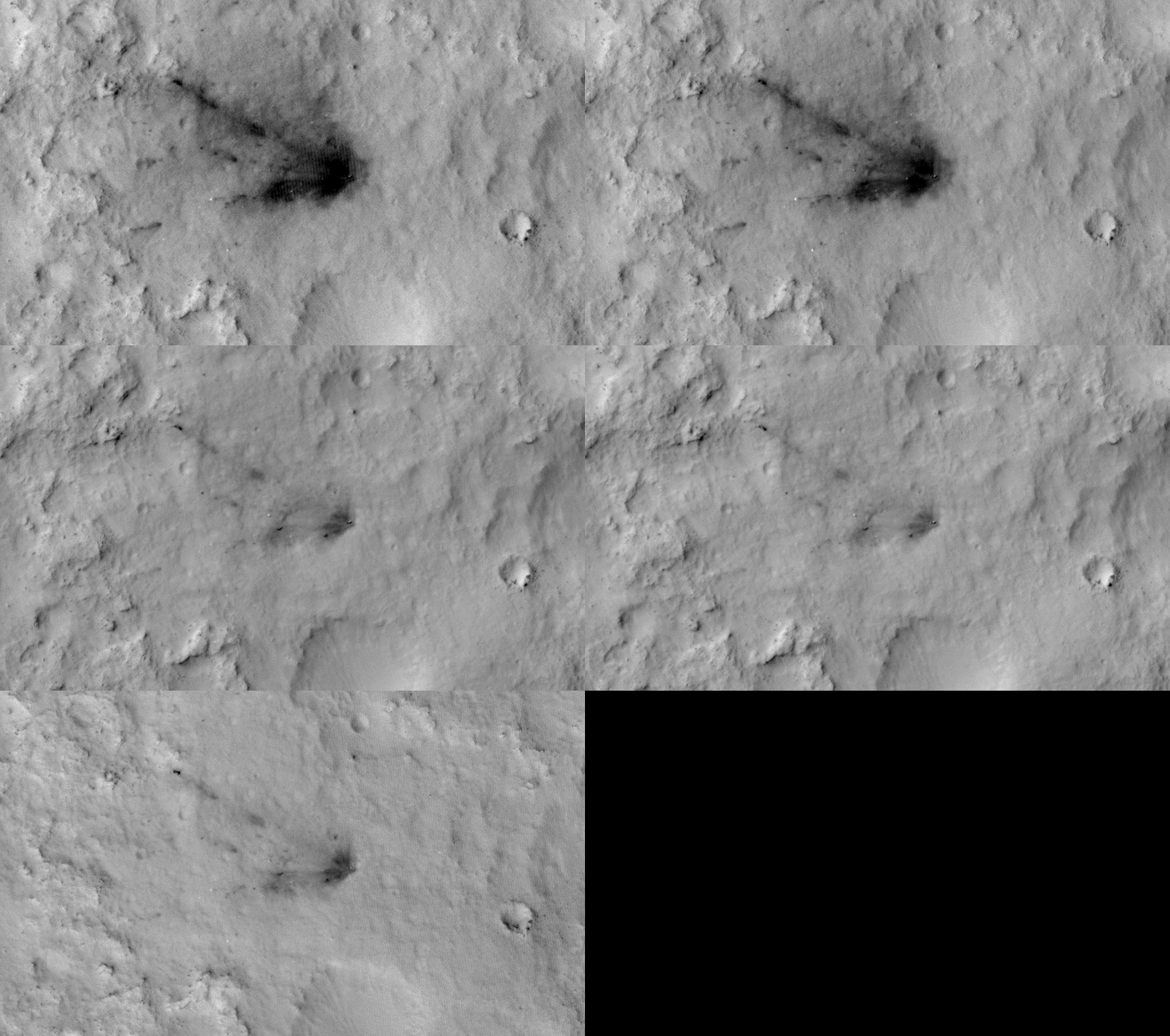
    This sequence of images shows a blast zone where the sky crane from NASA’s Curiosity rover mission hit the ground after setting the rover down in August 2012, and how that dark scar’s appearance changed over the subsequent 30 months. The images are from HiRISE on NASA’s Mars Reconnaissance Orbiter. Credit: NASA/JPL-Caltech/University of Arizona

    A series of observations from NASA’s Mars Reconnaissance Orbiter show how dark blast zones from the Curiosity rover have faded inconsistently.

    The High Resolution Imaging Science Experiment (HiRISE) camera on NASA’s Mars Reconnaissance Orbiter made the observations on multiple dates from landing to last month. After fading for about two years, the pace of change slowed and some of the scars may have even darkened again.

    The images track changes in blast zones at four locations caused by different pieces of Curiosity hardware, such as the heat shield and the descent stage. The four series, each with images from five to seven different dates since landing, are available online at:

    http://www.jpl.nasa.gov/spaceimages/details.php?id=PIA19159

    “Spacecraft like Curiosity creates these dark blast zone patterns where bright dust is blown away by the landing,” said Ingrid Daubar, a HiRISE team scientist at NASA’s Jet Propulsion Laboratory, Pasadena, California, who has used similar blast zones to find fresh meteor impact sites on Mars. “We expected to see them fade as the wind moved the dust around during the months and years after landing, but we’ve been surprised to see that the rate of change doesn’t appear to be consistent.”

    One purpose for repeated follow-up imaging of Curiosity’s landing area has been to check whether scientists could model the fading and predict how long it would take for the scars to disappear. Daubar’s work on this aids preparations for NASA’s next Mars lander, InSight, on track for launch in March 2016. The InSight mission will deploy a heat probe that will hammer itself a few yards, or meters, deep into the ground to monitor heat coming from the interior of the planet. The brightness of the ground affects the temperature below ground, because a dark surface warms in sunshine more than a bright one does.

    HiRISE is one of six instruments with which NASA’s Mars Reconnaissance Orbiter has been studying Mars since 2006.

    NASA’s Mars Science Laboratory Project has been using the Curiosity rover to examine ancient Martian environments favorable for microbial life.

    With three active NASA Mars orbiters and two Mars rovers, NASA seeks to characterize and understand Mars as a dynamic system, including its present and past environment, climate cycles, geology, and biological potential. In parallel on its journey to Mars, NASA is developing the capabilities needed for human missions there.

    The University of Arizona, Tucson, operates HiRISE, which was built by Ball Aerospace & Technologies Corp. of Boulder, Colorado. JPL, a division of the California Institute of Technology, Pasadena, manages the Mars Reconnaissance Orbiter Project, the Mars Science Laboratory Project and the InSight Project for NASA’s Science Mission Directorate, Washington. Lockheed Martin Space Systems, Denver, built the orbiter and collaborates with JPL to operate it.

    Never miss a breakthrough: Join the SciTechDaily newsletter.
    Follow us on Google and Google News.

    Astronomy Curiosity Rover HiRISE Mars
    Share. Facebook Twitter Pinterest LinkedIn Email Reddit

    Related Articles

    Curiosity’s ChemCam Laser Yields Good Results

    NASA’s Curiosity Readies for First Drive on Mars

    Curiosity’s ChemCam Laser Analyzes Its First Martian Rock

    Color HiRISE Image of Curiosity Rover on Mars

    First 360-Degree Color Panorama From NASA’s Curiosity Mars Rover

    Curiosity’s First Color Image of Mars

    Image of NASA’s Curiosity and its Parachute Heading Towards the Surface of Mars

    A Connection Between Volatiles in the Subsurface of Mars and the Impact Process

    Mission Engineers Prepare for Curiosity’s Landing on Mars

    1 Comment

    1. Madanagopal.V.C. on April 5, 2015 8:08 am

      Fading scars of Mars are indicative of cometary dust falling on the planet and also due to astroidal dusts. This is true even in our case of Earth since the canopy of dust is an ever increasing job. Thank You.

      Reply
    Leave A Reply Cancel Reply

    • Facebook
    • Twitter
    • Pinterest
    • YouTube

    Don't Miss a Discovery

    Subscribe for the Latest in Science & Tech!

    Trending News

    Goodbye Plastic? Scientists Create New Supermaterial That Could Transform Modern Manufacturing

    Beyond Pain Relief: Scientists Discover a Protein That Could Stop Osteoarthritis in Its Tracks

    Scientists Discover Why Alcohol Prevents the Liver From Healing, Even After You Quit

    Scientists Stunned As Volcano Removes Methane From the Air

    Scientists Discover Signs Africa May Be Splitting Apart Beneath Zambia

    Common Blood Pressure Drug Supercharges Cancer Treatment in Surprising New Study

    540-Million-Year-Old Fossils Reveal a Huge Surprise About Early Life on Earth

    Scientists Reverse Stroke Damage Using Stem Cells in Breakthrough Study

    Follow SciTechDaily
    • Facebook
    • Twitter
    • YouTube
    • Pinterest
    • Newsletter
    • RSS
    SciTech News
    • Biology News
    • Chemistry News
    • Earth News
    • Health News
    • Physics News
    • Science News
    • Space News
    • Technology News
    Recent Posts
    • Goodbye Plastic? Scientists Create New Supermaterial That Could Transform Modern Manufacturing
    • Scientists Uncover Hidden Biological Differences Between Men and Women’s Immune Systems
    • Scientists Challenge a Long-Held Belief About Why Human Childbirth Is So Difficult
    • Too Much Sleep May Age Your Body Faster, New Study Warns
    • Scientists Uncover Promising New Strategy To Stop Parkinson’s in Its Tracks
    Copyright © 1998 - 2026 SciTechDaily. All Rights Reserved.
    • Science News
    • About
    • Contact
    • Editorial Board
    • Privacy Policy
    • Terms of Use

    Type above and press Enter to search. Press Esc to cancel.